
We may earn a commission if you buy through links on this page. It never changes a score or a ranking. How we make money
The bottom line
A capable JavaScript app platform with a worthwhile free tier and a clear paid-plan jump.
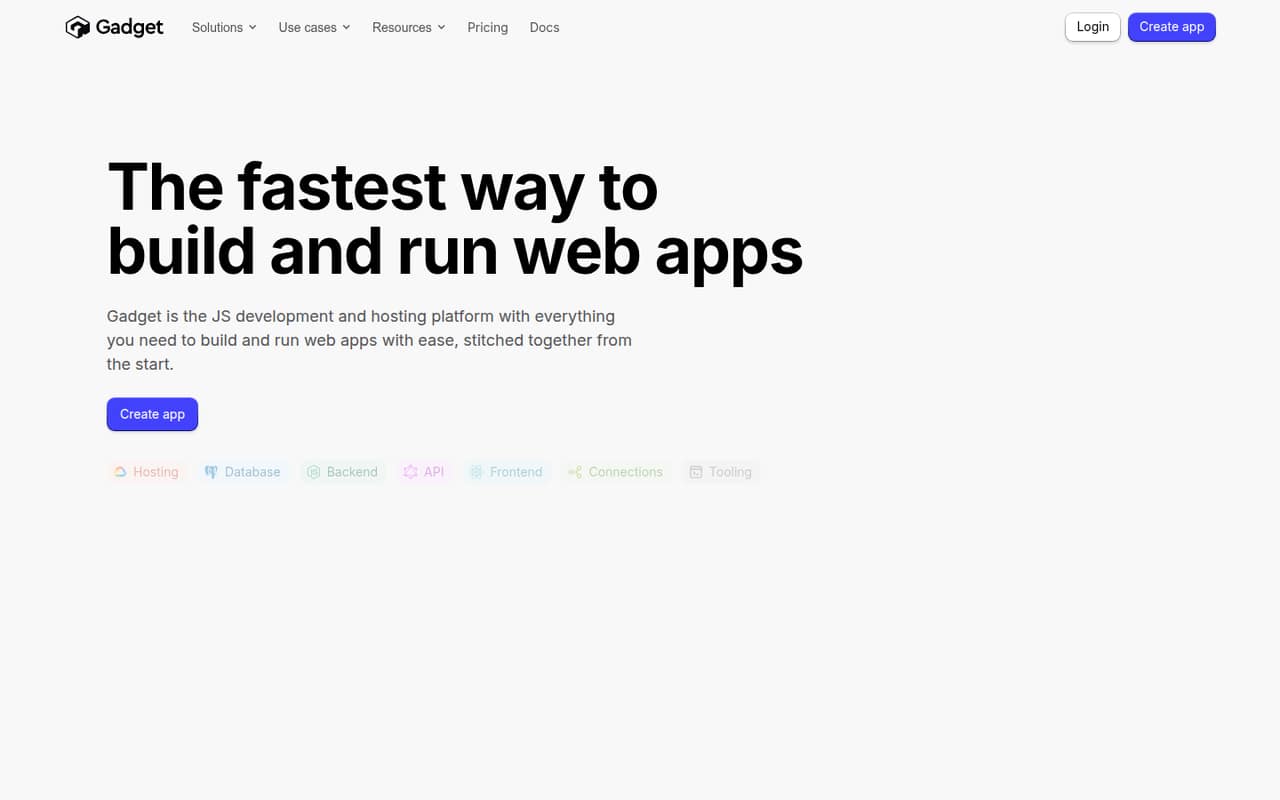
Gadget brings a hosted backend, frontend, database, APIs and development tools together for building web apps with JavaScript. Its Hobby plan is free for up to two seats, with 10 CPU hours and 0.5 GB of data storage.
For a team of three or five, Pro is the entry point at $35 per month. That buys room for up to 10 seats, 30 CPU hours and 3 GB of data storage, but extra production environments and usage-based add-ons can raise the bill.
Good fit if
- JavaScript app builders
- Solo developers testing an idea
- Small teams wanting hosted infrastructure
Skip it if
- Teams needing more than 10 Pro seats
- Nontechnical teams avoiding code
- Apps needing custom infrastructure on a budget
ScoresHow it rates
What works
- Free Hobby plan allows up to two seats
- Backend, frontend and database in one platform
- Includes API actions, scheduled tasks and background jobs
- Pro supports up to 10 seats
- Custom domains are free
What doesn't
- Hobby includes only 10 CPU hours
- Hobby storage is limited to 0.5 GB
- Three or more seats require the $35 Pro plan
- Extra production environments cost $10 each monthly
- Annual prices and discounts are not listed
01Who Gadget is for
Gadget is aimed at developers building and operating web apps with JavaScript. It combines a hosted backend, frontend, database, custom API and development tools, so a small team can build an app without assembling those pieces across separate services. The platform includes Node.js backend actions, scheduled tasks and background jobs, plus a React frontend.
For a solo developer or a two-person team, the free Hobby plan is a sensible place to start if its limits cover the project. A team of three to five needs to budget for Pro at $35 per month. That plan allows up to 10 seats, which makes it a practical fit for a small app team that wants one platform for its stack. Gadget is less suitable if the team wants to avoid JavaScript development or needs more capacity than the listed plan allowances.
02Gadget free plan and trial
Gadget’s free Hobby plan allows up to two seats, unlimited development environments and one production environment. It includes 10 CPU hours and 0.5 GB of data storage. The pricing page lists no free trial period; Hobby is the free way to try the platform.
The limits matter if you plan to run a live app. Hobby includes just one production environment, and the listed CPU and storage allowances are modest. A team with three or more people cannot use Hobby because of its two-seat maximum. Pro is the first plan for that team size, at $35 per month, with up to 10 seats, 30 CPU hours and 3 GB of data storage. The vendor does not list annual billing or annual discounts.
03What a small team pays for Gadget
For one person, Hobby costs $0 per month if its two-seat cap, 10 CPU hours and 0.5 GB of storage are enough. Pro costs $35 monthly and allows up to 10 seats. Averaged across the plan’s maximum seats, that is $3.50 per seat per month; for a three-person team, the same flat fee averages about $11.67 per person, and for five people it averages $7. Gadget does not list per-seat billing, so these are just comparisons, not separate seat prices.
There is no annual price or discount listed. Pro includes one production environment; each additional one is $10 per month. Other possible extras include AI assistant credits at $25 per 100 credits, additional data storage at $1.50 per GB monthly, and execution capacity at $25. Custom domains are free. Check the listed CPU, storage and production needs before budgeting, since add-ons can change the total.
04Getting started with Gadget
Gadget brings several app-building pieces together: a database with spreadsheet-style record management and rich field types, Node.js API actions, scheduled tasks, background jobs and a React frontend with generated components and live previews. Its AI assistant has app context and can help with development tasks. That makes it a broad toolkit, not a no-code shortcut; a team should be comfortable working with JavaScript and React to make use of the custom app-building features.
For day-one connections, Gadget supports third-party API connections, webhooks and dataset syncing. The product details do not specify a setup-time estimate or name particular integrations, so teams should confirm whether their required services are supported and how they connect before committing. The platform does not publish a setup-effort measure. A small team can begin on Hobby, but should account for the time needed to build and configure its app rather than assuming the hosted stack removes that work.
05When small teams outgrow Gadget
The first clear upgrade trigger is team size: Hobby stops at two seats, so a third teammate means moving to Pro at $35 per month. Pro allows up to 10 seats, 30 CPU hours and 3 GB of data storage. If the team needs more capacity or a second production environment, budget for the listed add-ons; extra production environments cost $10 each monthly, and additional data storage costs $1.50 per GB per month.
A team can move to Premium for $350 per month, which allows up to 25 seats and lists 150 CPU hours and 15 GB of data storage. That is a substantial jump from Pro, so it is worth checking whether the additional capacity is actually needed. Enterprise offers custom pricing, bring-your-own-cloud options for GCP or AWS, unlimited projects and hosting, cost-plus hosting pricing, and performance and support SLAs. Teams needing those infrastructure or SLA terms should ask the vendor for a quote.
Questions people ask
Is Gadget free?
Yes. The Hobby plan costs $0 per month and allows up to two seats, unlimited development environments and one production environment. It includes 10 CPU hours and 0.5 GB of data storage.
How much does Gadget cost for a small team?
Hobby is free for up to two seats. A team of three to 10 needs Pro, listed at $35 per month. The plan price is monthly, and the pricing page does not list annual billing or discounts.
What does Gadget include?
Gadget combines a hosted backend, frontend, database, custom API and development tools. It also lists Node.js backend actions, scheduled tasks, background jobs, third-party API connections and a React frontend.
Does Gadget support React and APIs?
Yes. Gadget lists a React frontend with generated components and live previews, plus custom API tools and third-party API connections. It also supports webhooks and dataset syncing.
When should a team upgrade from Hobby?
A third seat requires Pro, since Hobby is capped at two. A team may also need to upgrade or buy add-ons if it needs more than Hobby’s 10 CPU hours, 0.5 GB of data storage or one production environment.