
We may earn a commission if you buy through links on this page. It never changes a score or a ranking. How we make money
The bottom line
Genmo is a budget-friendly way to try AI video, especially for storyboards and concept clips.
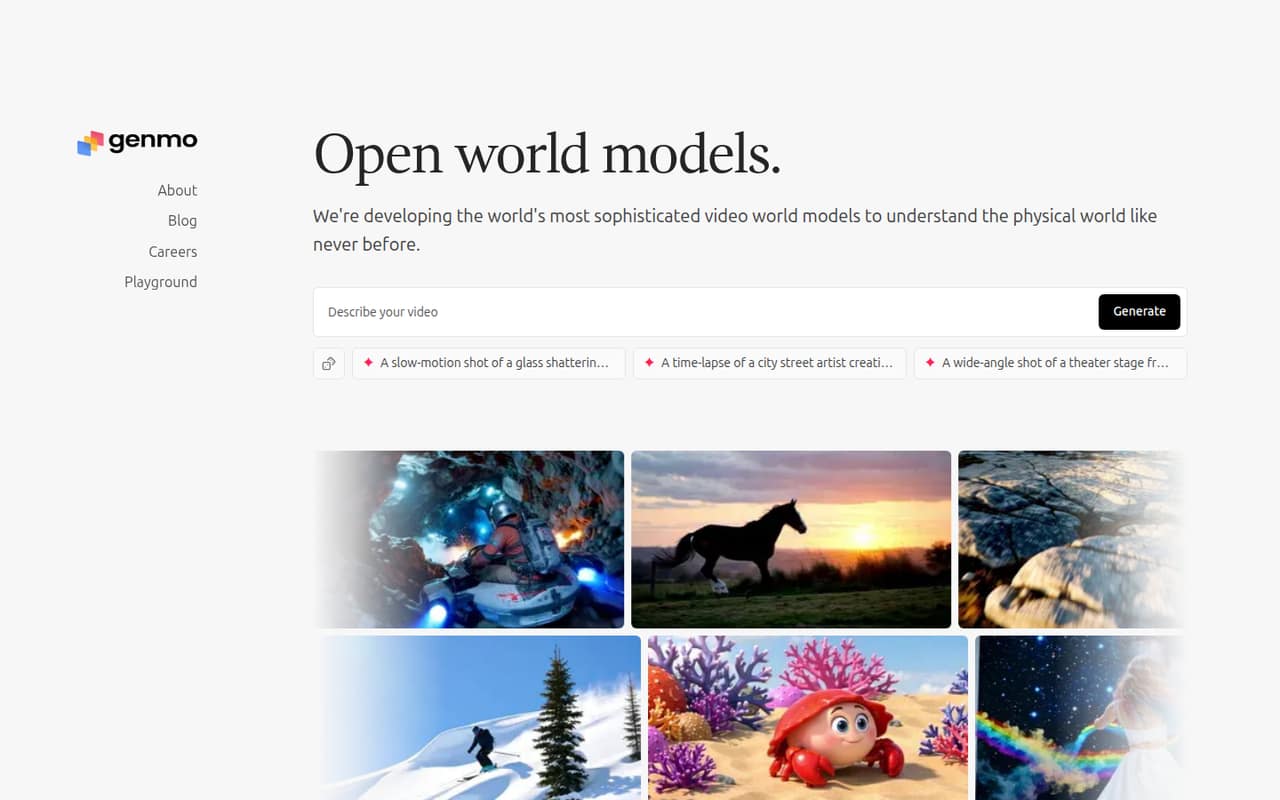
Genmo pairs an interactive playground with Mochi 1, an open-source text-to-video model that the homepage says can run locally and be customized. The free plan is useful for a small first look, but its credits are lifetime-only and creations have a watermark.
Lite starts at $10 per month, or $8 per month with annual billing. That is a reasonable entry price for an individual creator, but team seat rules and integrations aren’t published, so confirm how a shared workflow would work before buying for several people.
Good fit if
- Solo creators testing AI video
- Small teams making concept clips
- Developers exploring open models
Skip it if
- Teams needing polished emotional acting
- Groups requiring published seat pricing
- Workflows dependent on listed integrations
ScoresHow it rates
What works
- Free plan includes 250 lifetime credits
- Mochi 1 is open source
- Homepage says Mochi can run locally
- Lite includes commercial usage rights
- Interactive playground offers a starting point
What doesn't
- Free creations include a Genmo watermark
- Free credits do not renew monthly
- Mochi videos cost 100 credits each
- Vendor doesn’t publish seat rules
- Integrations aren’t listed on the homepage
01Who Genmo is for
Genmo makes most sense for a solo creator or a small team of up to 10 people that needs quick visual ideas, not a full production pipeline. In plain terms, you write a concept and Mochi 1 turns it into a video. The homepage also presents an interactive playground, and says the open-source model can be run locally and customized.
That mix makes Genmo worth considering for storyboard drafts, sci-fi or fantasy previews, and teams curious about video world-model research. One Reddit thread praises it for storyboards and concept videos, while noting that subtle emotion is a weak spot. The free plan lets a budget-conscious team explore before paying. For commercial use, the pricing page lists rights on Lite and Standard, not Free. If several teammates need access, ask Genmo how accounts and seats work: the vendor doesn’t publish seat rules in the listed pricing.
02Genmo free plan and trial
The pricing page lists a Free plan at $0 with 250 lifetime credits. Mochi videos cost 100 credits each, so that covers two Mochi videos with 50 credits left. Replay videos cost 50 credits, so the same balance could cover five Replay videos if spent on those instead. The credits are lifetime credits, not a monthly allowance.
Free creations include a Genmo watermark. The vendor doesn’t list commercial usage rights for Free, so ask before using free outputs in paid work. Genmo offers a free plan; a separate time-limited trial isn’t listed. It’s enough for a small first look, but the credit pool runs out quickly if several people want to experiment.
03What a small team pays for Genmo
The pricing page lists Lite at $10 per month, or $8 per month with annual billing. If each teammate needs a separate Lite subscription, three people cost $30 monthly or $24 per month on annual billing ($288 for the year). Five cost $50 monthly or $40 per month on annual billing ($480 for the year). The vendor doesn’t publish seat rules, so confirm whether that per-person assumption matches your setup.
Standard is $30 monthly or $24 per month with annual billing. On the same per-person assumption, three people would cost $90 monthly or $72 per month billed annually ($864 for the year); five would cost $150 monthly or $120 per month billed annually ($1,440 for the year). Standard lists 5,000 monthly credits, versus 1,200 on Lite, plus highest queue priority and early model access. No add-ons are listed. Free is the cheapest way in, but its 250 lifetime credits and watermark make it a test option, not an ongoing team budget.
04Getting started with Genmo
For a first look, the interactive playground is the clearest route described on Genmo’s homepage. The basic task is easy to grasp: write a concept for text-to-video generation. A Reddit user describes building short story scenes with text prompts, which gives small teams a practical starting point for trying story or concept ideas.
There are two other routes to consider: the homepage says Mochi 1 can run locally and be customized, and the model is open source. Those options may suit a team with technical capacity, but the vendor doesn’t publish setup requirements in the material available to buyers. The homepage also doesn’t list integrations or a day-one connection checklist. If you need the playground to fit into an existing content workflow, ask Genmo what it supports before committing. Ease of setup is likely to depend on whether you stick with the playground or pursue local use and customization.
05When small teams outgrow Genmo
The first pressure point is output volume. Free includes 250 lifetime credits, and the pricing page lists 100 credits per Mochi video. Lite raises that to 1,200 credits per month; Standard lists 5,000. A team making videos regularly may need a paid plan, and costs rise with each separate subscription if every person needs an account. Genmo doesn’t publish seat rules, so confirm the actual team price before budgeting.
The second pressure point is the kind of work you need. A Reddit thread says Genmo is good for sci-fi or fantasy previews but not great for subtle emotion yet. If that matters to your output, try the free plan before upgrading. Teams that need documented integrations or shared-team features should ask the vendor directly; the homepage and pricing details don’t list them. Standard may suit higher-volume creators, but it doesn’t resolve whether Genmo fits a team workflow.
From the threadsWhat users say
One Reddit thread is positive about Genmo for storyboards and concept videos, while flagging limits with subtle emotion. That is encouraging for early-stage visual ideas, but a narrow basis for judging wider user sentiment.
great for storyboards and concept videos
not great for subtle emotion yet
good for sci-fi or fantasy previews
build short story scenes with text prompts
Questions people ask
Can I use Genmo for free?
Yes. The pricing page lists a Free plan with 250 lifetime credits. Mochi videos cost 100 credits each, and Replay videos cost 50. Free creations include a Genmo watermark. The vendor doesn’t list commercial usage rights for Free, so ask before using those creations in paid work.
Can Mochi 1 run locally?
Genmo’s homepage says Mochi 1 can be run locally and customized, and describes it as an open-source model. The vendor doesn’t publish setup requirements in the material available to buyers. Check Genmo’s open-source repository and ask about requirements that matter to your hardware or workflow.
Does Genmo include commercial usage rights?
The pricing page lists commercial usage rights on both Lite and Standard. It doesn’t list those rights for Free. If you plan to use generated videos in client or commercial work, check the terms with Genmo before relying on a free creation.
How much does Genmo Lite cost?
The pricing page lists Lite at $10 per month, or $8 per month with annual billing. It includes 1,200 credits per month, watermark-free generation, commercial usage rights, and high queue priority. The vendor doesn’t publish whether one subscription covers multiple teammates, so confirm seat rules.
What kind of videos is Genmo good for?
Genmo’s Mochi 1 turns written concepts into video. One Reddit thread describes short story scenes and praises Genmo for storyboards and concept videos, including sci-fi or fantasy previews. The same thread says subtle emotion is a weak spot, so try the free plan if that matters to your work.