
We may earn a commission if you buy through links on this page. It never changes a score or a ranking. How we make money
The bottom line
A flexible, free-to-start scheduler for teams willing to own more of their infrastructure.
Small teams running several kinds of workloads may find Nomad a simpler starting point than a more feature-heavy orchestrator. It handles containers and other applications, with a Community edition listed for individuals and teams.
The catch is pricing clarity: the vendor doesn't publish Community limits or paid plan prices. Reddit users praise its approachable setup, but some report production bugs and a smaller community than Kubernetes.
Good fit if
- Teams scheduling mixed workloads
- Budget-conscious infrastructure teams
- Teams already using HashiCorp tools
Skip it if
- Teams needing published plan limits
- Teams seeking a large support community
- Teams wanting an all-in-one platform
ScoresHow it rates
What works
- Schedules containers and non-containerized applications
- Supports cloud and on-premises environments
- Runs batch jobs alongside other workloads
- Parameterized jobs and reusable templates
- Community edition is listed for teams
What doesn't
- Paid plan prices aren't published
- Community plan limits aren't published
- Some teams add Consul for service discovery
- Reddit users report production bugs and outages
- Reddit users describe a smaller community than Kubernetes
01Who HashiCorp Nomad is for
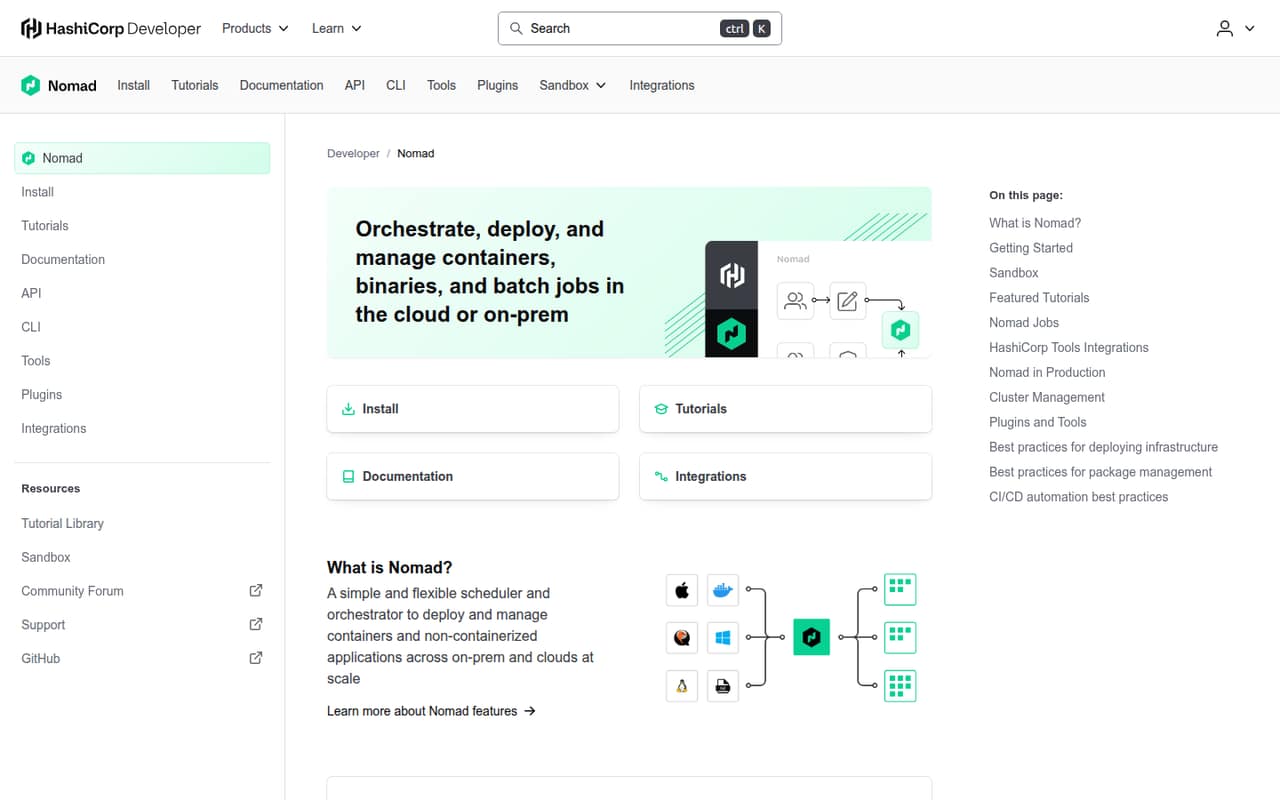
Nomad is worth considering if your small team needs to schedule more than containers. It manages containers, binaries, batch jobs, and other applications across cloud and on-premises environments. Parameterized jobs and reusable templates can help when you need to run workloads from repeatable specifications.
For a team of one to ten, the Community edition is the clearest budget-conscious starting point: it is listed for individuals and teams. But the vendor doesn't publish its limits, so confirm that it covers your intended use before building around it. Paid plan pricing is also unpublished, which makes it harder to forecast costs as you grow.
Reddit users often describe Nomad as approachable and simpler to get started with than Kubernetes. That simplicity may suit a small infrastructure team, but Nomad is still infrastructure software to operate. If you only need to launch a few containers on one machine, a simpler tool may be enough.
02HashiCorp Nomad free plan and trial
The Community plan is listed for individuals and teams, and the pricing information marks a free plan as available. That makes it the cheapest way to start evaluating Nomad. The vendor doesn't publish the Community plan's workload, cluster, or support limits, so ask which terms apply to your setup before relying on it in production.
The pricing page also lists a $500 credit to get started across the IBM HashiCorp Cloud Platform on its Pay-as-You-Go plan. That's platform credit, not a published Nomad-specific allowance. The page doesn't state how long the credit lasts or what Nomad usage it covers. Enterprise Self-Managed and Flex are also listed, but their prices and inclusions aren't published. Treat the credit as a way to explore the platform, not as a known estimate of your ongoing Nomad bill.
03What a small team pays for HashiCorp Nomad
The pricing page lists Community, Enterprise Self-Managed, Pay-as-You-Go, and Flex, but it doesn't publish monthly or annual prices. It also doesn't list per-seat billing. So we can't give a reliable one-person cost or calculate totals for three or five people; those figures are not published, not zero. The Community plan is listed for individuals and teams, but its limits and any conditions aren't stated.
Pay-as-You-Go includes a listed $500 credit to get started across the platform. Enterprise Self-Managed is for organizations needing self-managed Nomad, while Flex is described as a sales-led cloud plan. Prices and included features for both are not published. No add-ons are listed in the published pricing information.
For a team watching every subscription, start by confirming whether Community fits your workloads and what the paid plans would cost if you need more. Ask the vendor for a written estimate for your team size, deployment model, and expected usage; there is no published starting price to use for a budget.
04Getting started with HashiCorp Nomad
Nomad's core job is scheduling workloads: containers, non-containerized applications, and batch jobs. Its task drivers execute tasks and extend the kinds of workloads it can run. Parameterized jobs and Nomad Pack templates support reusable job definitions. Those building blocks give a small team room to start with one workload type and add others, though the setup still requires infrastructure and job specifications to manage.
Reddit users describe Nomad as approachable; one commenter said installation worked well, while reporting an issue with standalone mode that led them to use Consul with Nomad instead. Other users say they pair Nomad with Consul for service discovery and Vault for secrets. These are user reports, not requirements for every installation. Decide early whether your setup needs those integrations, and check the relevant vendor documentation before rollout. The available sources don't establish a typical setup time, so plan for evaluation rather than assuming a same-day deployment.
05When small teams outgrow HashiCorp Nomad
You may outgrow Nomad when your workloads need capabilities beyond scheduling, or when the team wants more of its supporting infrastructure in one ecosystem. A Reddit commenter notes that load balancing, shared storage, SSL certificates, and DNS can become additional needs; another says Nomad users may integrate Consul for service discovery. The sources don't define a specific scale or workload limit at which an upgrade is necessary.
Support and reliability are worth weighing as your environment becomes business-critical. Some Reddit users praise Nomad's simplicity, while others report bugs, outages related to shared storage, and difficulty getting help. One commenter describes the community as much smaller than Kubernetes'. Those are individual reports, not a guarantee of your experience, but they are a reason to test your own failure scenarios and support expectations.
Enterprise Self-Managed and Flex are listed options, but the vendor doesn't publish prices or plan details. Before you commit to growth on Nomad, ask what support and features those plans include and compare that cost with the alternatives your team is considering.
From the threadsWhat users say
Reddit sentiment is mixed but leans positive on Nomad's simplicity and approachability. Some users also describe reliability problems, hard-to-find help, and a smaller community than Kubernetes.
Nomad is to me, what Docker Swarm should have been, a simple orchestration solution
much easier to setup and manage than K8S
I had multiple outages caused by nomad + shared storage deadlocks
The community is relatively tiny compared to K8S
Questions people ask
What workloads can HashiCorp Nomad schedule?
Nomad schedules containers and non-containerized applications, including binaries and batch jobs. The published product description also lists parameterized jobs, reusable job templates through Nomad Pack, and task drivers that execute tasks and extend support for different workload types. Check the vendor's documentation for details on a particular workload or driver.
Is HashiCorp Nomad free?
A Community plan is listed for individuals and teams, and the pricing information marks a free plan as available. The vendor doesn't publish the Community plan's limits or conditions in the published pricing details. Confirm those terms with the vendor before assuming a workload or production setup is covered.
How much does HashiCorp Nomad cost for a small team?
The vendor doesn't publish monthly or annual prices for Nomad's listed plans, and the pricing information doesn't specify per-seat billing. That means we can't calculate a reliable price for one, three, or five people. Ask the vendor for a quote based on your deployment model and expected usage.
Does HashiCorp Nomad require Consul or Vault?
The available product description doesn't say that either tool is required. Reddit users report pairing Nomad with Consul for service discovery and Vault for secrets, while other commenters describe using Nomad on its own. Whether you need those integrations depends on your setup; verify requirements for your workloads in the vendor documentation.
When should a team consider moving away from HashiCorp Nomad?
Consider a change if your team needs capabilities that aren't covered by your Nomad setup, requires clearer support commitments, or finds the operational workload too demanding. Reddit users report both simpler operations and, in some cases, bugs and outages. The vendor doesn't publish a specific scale limit that signals when to move.