
We may earn a commission if you buy through links on this page. It never changes a score or a ranking. How we make money
The bottom line
Kick can simplify bookkeeping, but its free transaction cap and unpublished seat details need a close look.
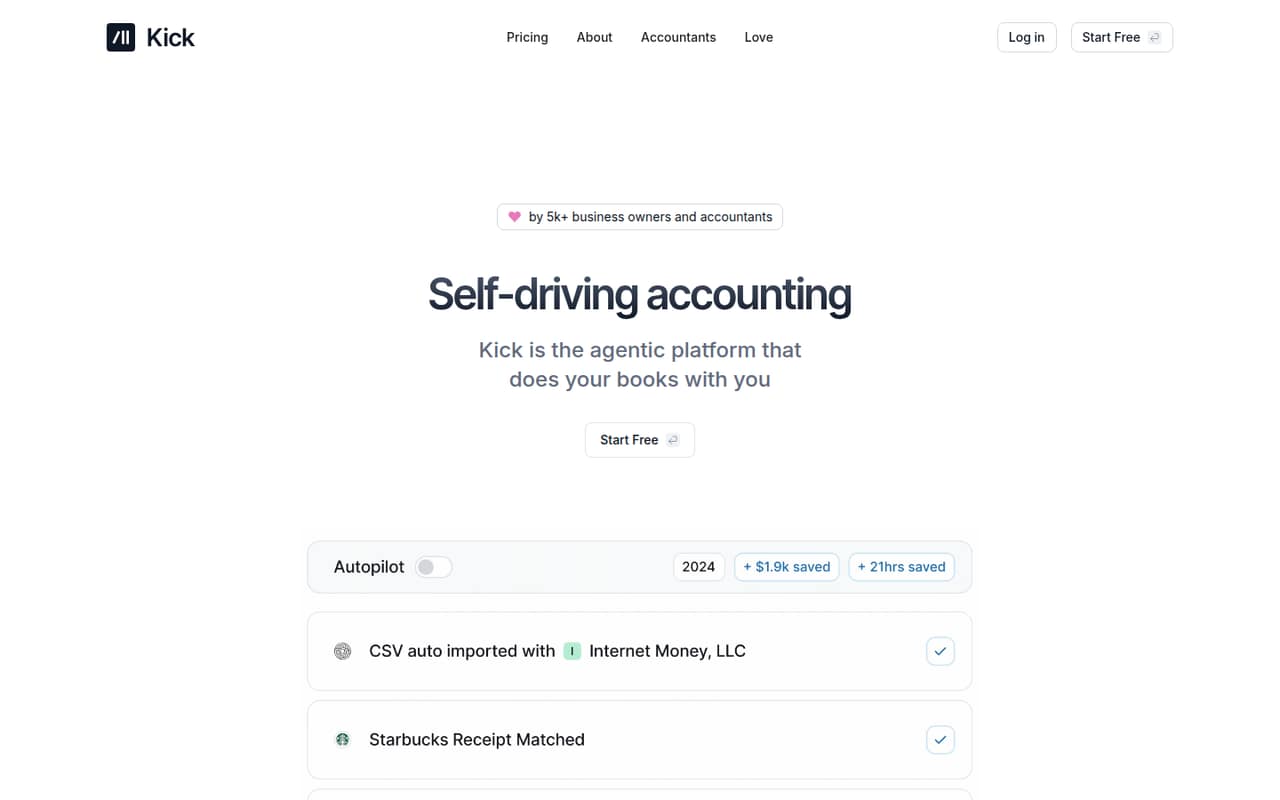
Kick is an accounting platform that helps categorize transactions, match receipts, and prepare financial reports. Its Free plan covers one entity and 250 transactions a year, which may be enough for a new business with modest activity.
For more automation, the pricing page lists Basic at $40 per month and Plus at $100 per month. Those are plan prices, not published per-seat rates; confirm user access and billing details with Kick before choosing a plan.
Good fit if
- New businesses with limited transactions
- Owners who want automated bookkeeping
- Businesses tracking multiple entities
Skip it if
- Teams that need published seat pricing
- Businesses with high transaction volume on Free
- Firms needing clear integration details upfront
ScoresHow it rates
What works
- Free plan includes one entity and 250 annual transactions
- Automates categorization and receipt matching
- Includes profit and loss and balance sheet reports
- Basic lists reconciliation and statement sync
- Plus includes multi-entity accounting and accrual features
What doesn't
- Free plan is limited to 250 transactions per year
- User or seat limits are not published
- Additional entities can add $50 per month
- Basic's annual billing is $480 upfront
- Supported integrations are not clearly listed
01Who Kick is for
Kick is aimed at businesses and accountants that want help keeping their books current. For a solo owner or a small team of one to five, it may suit a business that wants transaction categorization, receipt matching, and standard financial reports without handling every entry manually.
The Free plan is the budget-friendly starting point: it includes one entity and 250 transactions a year. That makes it a better fit for a new business with light activity than an established shop processing transactions every day. Basic is listed at $40 per month for businesses that need unlimited categorization and reconciliation features; Plus is $100 per month for multi-entity and accrual needs. Those are plan prices, not published prices per user. Kick does not publish seat limits in the pricing details, so a team should confirm how many people can access its account before comparing the cost with other bookkeeping tools.
02Kick free plan and trial
Kick's Free plan includes 250 transactions per year, one entity, automatic categorization, receipt matching, and profit and loss and balance sheet reports. It gives a new business a way to start organizing its books without a monthly plan fee.
The key limit is transaction volume. Once a business needs more than 250 transactions a year, Free may no longer cover its bookkeeping needs. The plan also covers only one entity, and the pricing page lists an additional-entity charge after the first 250 transactions per year. Kick does not list a free trial in its pricing details. The next business plan is Basic at $40 per month, with unlimited categorization, one entity, reconciliation, statement sync, MCP/CLI, and a universal importer.
03What a small team pays for Kick
Kick's published business prices are plan rates, not per-seat rates. For one business, the Free plan costs $0; Basic is listed at $40 per month, or $480 billed annually. The pricing page lists Plus at $100 per month, billed quarterly at $300, and Advanced at $300 per month. It does not publish how many user seats those business plans include.
That means a one-, three-, or five-person team should not multiply the Basic price by its headcount: the listed $40 is a plan price, and the pricing details do not establish a per-user charge. Before committing, ask Kick whether your team size changes the bill or access limits. For a small team, the likely paid starting point is Basic if Free's transaction cap is too low. Plus is for businesses that need unlimited entities, classes, AR/AP automation, or an accrual ledger. Additional entities can cost $50 per month after the first 250 transactions per year.
04Getting started with Kick
Kick describes itself as an accounting platform that works with businesses on their books, with transaction categorization, receipt matching, and financial reporting. The homepage says an expert reviews transaction categorization for accuracy. The pricing details list a universal importer on Basic, plus reconciliation and statement sync, but they do not spell out supported banks, accounting systems, or other integrations.
That leaves the setup effort hard to estimate from the published details. A small team should check what data Kick can import, what account connections it supports, and whether the expert review applies to its plan before moving financial records. Basic also lists MCP/CLI, which may matter to technical teams, but the pricing details do not describe setup steps or required technical skills. Ask Kick for a migration and onboarding walkthrough if you have multiple entities or a complex bookkeeping history; the published plan details do not specify setup time or support included with Basic.
05When small teams outgrow Kick
The first clear growing pain is Free's 250-transaction annual limit. A business that exceeds it will need to consider a paid plan, starting with Basic at $40 per month. Free also covers one entity; adding another can mean $50 per month once the stated transaction allowance is passed.
Basic still covers one entity, so businesses with multiple entities, classes, or accrual needs may need Plus at $100 per month, billed quarterly at $300. Advanced, listed at $300 per month, adds consolidation and revenue recognition. Teams should also check user access before expanding: Kick's pricing details do not publish seat limits or per-user charges. Accountants have separate per-client plans, but exact rates are not published. If your team needs a confirmed seat count, detailed integration list, or predictable multi-entity costs before signing, ask Kick for those details in writing.
Questions people ask
Is Kick free to use?
Yes. Kick lists a Free plan at $0 per month with one entity and 250 transactions per year. It also includes automatic categorization, receipt matching, and profit and loss and balance sheet reports.
Does Kick include profit and loss reports?
Yes. The Free plan includes profit and loss and balance sheet reports. Kick also lists financial reporting as part of its accounting platform.
How many entities does Kick Free include?
Kick Free includes one entity. The pricing page says additional entities have their first 250 transactions per year free, then cost $50 per month.
Does Kick offer a free trial?
Kick's pricing details list a Free plan but do not list a separate free trial. The Free plan includes one entity and 250 transactions per year.
What does Kick Basic include?
Basic is listed at $40 per month and includes unlimited categorization, one entity, MCP/CLI, a universal importer, reconciliation, and statement sync. The pricing page also lists annual billing at $480.