
We may earn a commission if you buy through links on this page. It never changes a score or a ranking. How we make money
The bottom line
Strong healthcare focus, but small teams face custom pricing and unanswered setup questions.
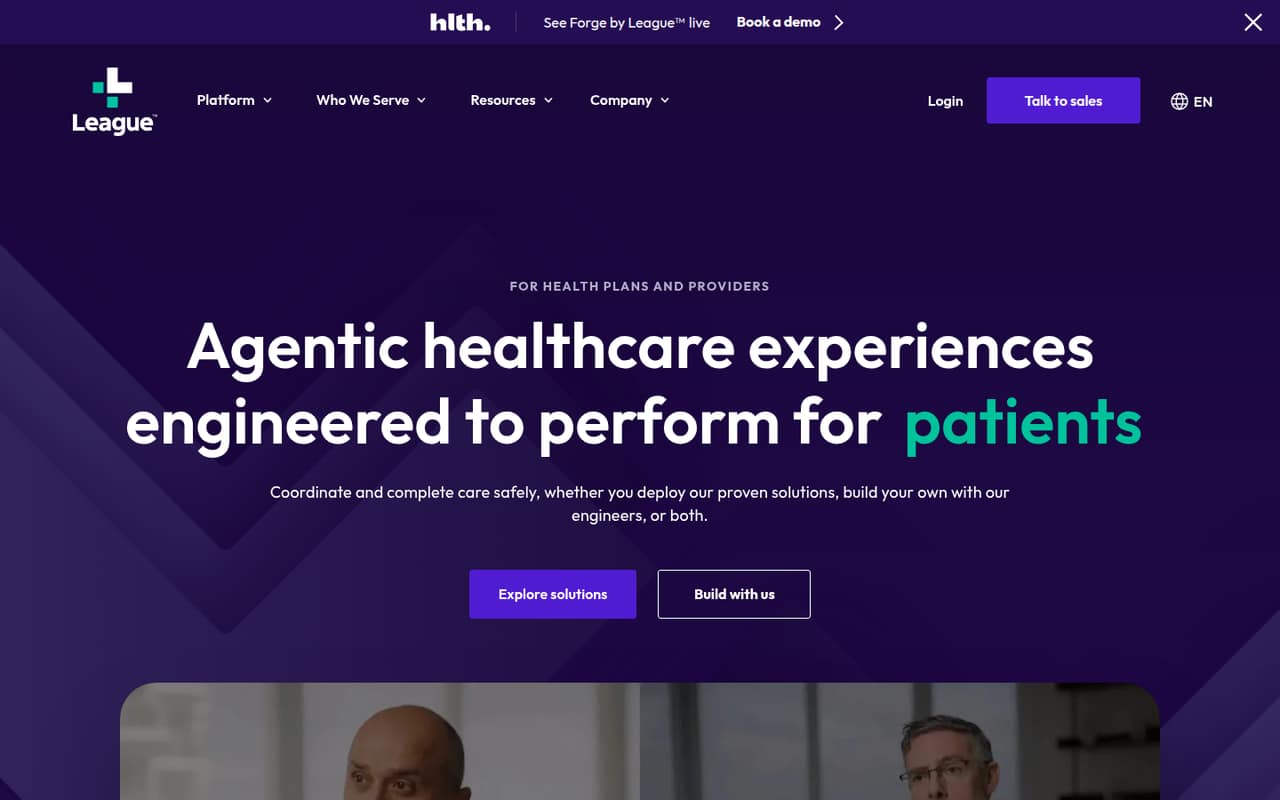
League provides a governed platform for deploying healthcare agents or building custom ones with its engineers. Its tools cover benefits navigation, finding care, care gap outreach and health coaching, with healthcare-specific guardrails and operational tools.
For a 1–10-person team watching costs, the main drawback is buying uncertainty: the pricing page lists no plans or starting price, and says prospective customers must request a custom quote. There is no published free plan.
Good fit if
- Health plans improving member engagement
- Providers coordinating care
- Teams needing healthcare-specific agents
Skip it if
- Teams needing a published starting price
- Buyers looking for a free plan
- General-purpose small businesses
ScoresHow it rates
What works
- Benefits navigation answers coverage questions
- Can help members find in-network care
- Includes care gap outreach tools
- Supports personalized health coaching
- Offers healthcare-specific guardrails and audit trails
What doesn't
- Starting price is not published
- No free plan is listed
- Trial details are not published
- Custom quote makes seat budgeting difficult
- Setup effort and integrations are not published
01Who League is for
League is aimed at health plans and providers that want to deploy healthcare agents for care coordination and member or patient engagement. It is not a general-purpose assistant for a small business team. The platform can support benefits questions, help members find in-network care, prompt care gap outreach, and offer health coaching.
For a 1–10-person team, the key question is whether you work in healthcare and have a specific member or patient service problem to solve. A small health-tech team could explore it, but the pricing page lists no public plans or starting price, so a tight budget is hard to assess before talking with League. The platform also offers custom agent building with League engineers, which may suit teams that need tailored healthcare workflows. We would ask for a quote tied to your users, use cases, and implementation needs before treating it as a practical small-team option.
02League free plan and trial
League has no free plan listed. The pricing information also does not publish free-trial terms, so buyers should ask the vendor whether a trial, demo environment, or limited pilot is available. Do not budget on the assumption that a team can test the platform at no cost.
The cheapest way in is to request a custom quote from League. The pricing page publishes no monthly or annual rates, paid plan names, or entry-level package. That means even a small team cannot compare a no-cost option with a paid tier using public prices. Before booking time with the vendor, outline the job you want an agent to handle, who will use it, and whether you need League engineers to build a custom agent. Ask what a small initial deployment would cost and what, if anything, is included in a pilot.
03What a small team pays for League
The pricing page lists no starting price, monthly or annual billing details, paid plans, or add-ons. It says prospective customers must request a custom quote. So we cannot give a grounded per-seat figure for one person or calculate the cost for a team of three or five. Those totals are not published.
This matters for a small team: a custom quote can depend on the use case and deployment, but the vendor does not publish the factors or a minimum contract in the pricing details. Ask for a written quote that separates platform fees, any per-member or per-seat charges, implementation work, and ongoing support. Also ask whether the quote changes with the number of agents, members served, or custom work from League engineers. Add-on prices are not published either. Until League provides those details, compare the proposal against your full budget rather than treating the absence of a listed price as a low-cost entry point.
04Getting started with League
League describes a governed platform for deploying healthcare agents, and says teams can build custom agents with its engineers. The vendor's site highlights healthcare-specific models, tools, knowledge, and skills, alongside PHI-aware access, clinical guardrails, and audit trails. That points to a healthcare-focused deployment, not a plug-and-play tool for a general office team.
The vendor does not publish a setup timeline, onboarding steps, or integration list in the available pricing details. We also cannot say how much internal technical work a small team should expect. Before committing, ask which systems League can connect to, what data and access it needs, who configures the guardrails, and what League engineers handle. Request a clear onboarding plan and identify one person on your team who will own the rollout. Without published setup guidance, budget time for a vendor conversation before estimating the effort.
05When small teams outgrow League
League is not a tool with public seat tiers that a small team can grow through one upgrade at a time. Its pricing page publishes no plan limits, seat costs, or thresholds for moving to a higher tier. The bigger fit question is whether your healthcare use case grows beyond a small deployment or needs more custom agent work.
Ask League how its quote changes as the number of members served, agents, or workflows increases; those pricing triggers are not published. Also confirm whether the operational tools, PHI-aware access, clinical guardrails, and audit trails you need are included in your proposal. If the quote does not fit your budget, or if you need transparent per-seat pricing and self-serve setup, League may not be the right match. There are no published limits here that let us name a specific point when a team must upgrade or move, so get growth costs in writing before signing.
Questions people ask
Does League offer a free plan?
No free plan is listed. The pricing information also does not publish trial terms. Ask League whether it offers a demo, trial, or limited pilot before you commit, and confirm whether that option has a fee or usage limits.
How much does League cost?
League does not publish a starting price or monthly and annual rates. Its pricing page says prospective customers must request a custom quote. Ask for a written breakdown for your team size, use case, implementation, and any ongoing fees.
What can League's healthcare agents do?
League describes agents for benefits navigation, finding in-network care, care gap outreach, and health coaching. Its platform also includes healthcare-specific models, tools, knowledge, and skills, plus security features such as PHI-aware access, clinical guardrails, and audit trails.
Can League build a custom agent?
Yes. League says teams can deploy healthcare agents on its governed platform or build custom ones with its engineers. Ask the vendor what custom work involves, how long it takes, and whether the work is included in your quote; those terms are not published.
What integrations does League support?
The available information does not list supported integrations. Before buying, ask League whether it connects to the systems your team uses, what data access it needs, and whether integration work carries an additional fee.