
We may earn a commission if you buy through links on this page. It never changes a score or a ranking. How we make money
The bottom line
Good coverage for AI apps, with pay-as-you-go pricing and no published free-plan quota.
Linkup bundles web search, URL extraction and asynchronous research in one API. That can suit a small team building an AI product, especially if it needs fresh web context or private indexes.
The pay-as-you-go entry price is low, but there is no per-seat or monthly price to budget against. The pricing page lists a free plan without a published allowance, so ask what it covers before relying on it.
Good fit if
- Small AI product teams
- Apps needing fresh web context
- Teams building private indexes
Skip it if
- Teams wanting fixed seat pricing
- Nontechnical teams avoiding APIs
- Buyers needing a published free quota
ScoresHow it rates
What works
- Search starts at $0.005 per request
- URL extraction starts at $0.001 per request
- Search, extraction and research share one API
- Private indexes are available
- Startup applicants can seek $5,000 in credits
What doesn't
- Free-plan limits are not published
- No monthly or annual subscription price
- Deep research costs up to $2.50 per request
- Usage-based bills depend on request volume
- Enterprise pricing is custom
01Who Linkup is for
Linkup is for small product teams building AI applications, not a general-purpose search tool for every employee. A team of one to ten can use its API for web search, URL extraction and asynchronous deep research, then pass sourced results or page content into an AI workflow.
The pricing model is friendly to a small budget when request volume is low: search starts at $0.005 per request, and extraction starts at $0.001. There is no seat fee listed. But a team with steady usage should forecast requests before committing, since bills scale with use and deep research is much pricier than standard search.
It may also fit teams that need an access-controlled index of proprietary data or want the indexing layer in their own cloud. Those options are more involved than a simple web lookup, and private managed search sits under custom-priced Enterprise. If you just need occasional research by hand, an API may be more tool than your team needs.
02Linkup free plan and trial
The pricing information lists a free plan, but does not publish its request allowance, feature access, or any usage limits. That makes it hard to tell whether the free option can support a real application or is mainly for trying the API. Linkup does not list a free trial separately.
The pricing page also says startups can apply for $5,000 in free credits. That is an application-based offer, not a guaranteed credit balance for every new account. Ask Linkup what the free plan includes and whether credits cover search, extraction, and research before you build around them.
If you need a published entry price, URL extraction starts at $0.001 per request and web search starts at $0.005. Those are usage charges, not a monthly subscription.
03What a small team pays for Linkup
Linkup charges per request, not per seat, and the pricing page lists no monthly or annual subscription billing. URL extraction is $0.001–$0.006 per request; AI web search is $0.005–$0.006; asynchronous research is $0.25–$2.50. Enterprise pricing is custom.
For a rough team comparison, if one person makes one search request, that request costs $0.005–$0.006. If three people each make one, the total is $0.015–$0.018; for five people, it is $0.025–$0.03. Those are one-request examples, not monthly estimates. Monthly and annual totals depend on how many requests your app sends, and Linkup does not publish a fixed seat price.
Research can change the math quickly: three research requests cost $0.75–$7.50, and five cost $1.25–$12.50. The main extra budget item is usage itself; startups can apply for $5,000 in free credits. Check the rate for each request type and ask about your expected volume before forecasting a bill.
04Getting started with Linkup
Linkup is available through an API, so expect a developer to connect it to your AI application and decide how search results, extracted page content, or research results should flow into the product. That is a practical inference from the API-based offering, not a published setup-time estimate. The vendor does not publish a setup duration in the pricing information.
The listed services are web search, URL extraction, asynchronous deep research and private indexing. The pricing details do not name specific integrations or provide a learning-curve estimate, so check the docs and confirm that your stack is supported before assigning a launch date. Bring-your-own-cloud deployment adds an infrastructure decision for teams that need the indexing layer inside their own environment.
One Reddit discussion compares Linkup with other search APIs but does not give a step-by-step implementation account. For a small team, a sensible first check is whether the API returns the format and sources your application needs, then test expected request volume against the per-request rates.
05When small teams outgrow Linkup
Linkup may stop fitting when your team needs a predictable monthly bill more than request-level flexibility. Its pricing page lists pay-as-you-go rates, not seat bundles or monthly and annual subscription plans. Once request volume rises, calculate search, extraction and research usage separately; deep research at $0.25–$2.50 per request can become the bigger cost driver.
A growing team may also need private, managed search. Linkup lists personalized indexes, dedicated index refresh rates, a private environment, ZDR, SOC 2 Type II and an SLA under custom-priced Enterprise. Ask for a quote and confirm which of those terms your use case needs.
In one Reddit discussion, a poster said Linkup had a different approach with connections to premium sources, while another commenter said Exa seemed faster. Other commenters raised cost concerns about alternatives, not Linkup, so those comments are not a clear verdict on Linkup's value. Compare results and total usage costs with your own requirements before moving.
From the threadsWhat users say
The available Reddit comments show interest in Linkup as one option among search APIs, but they do not establish a broad consensus. The comparison is mixed: one poster noted its premium-source approach, while comments favored other services for accuracy, speed, or cost.
Linkup seems to have a slightly different approach, with connections to premium sources
easy to implement and super accurate retrieval
Exa seems to be a bit faster
I would use Brave Search Api - it's on another (better) level of costs
Questions people ask
What does Linkup do?
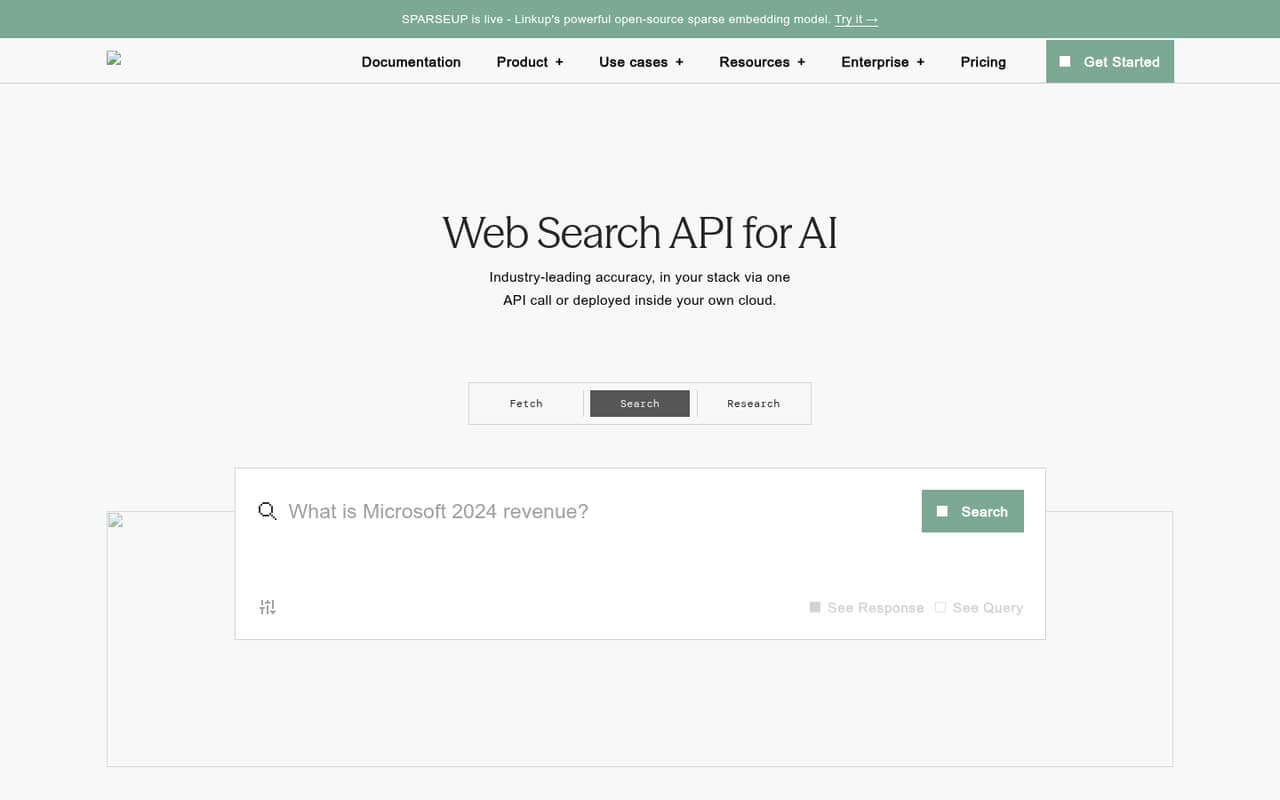
Linkup is a web search API for AI applications. It offers web search with sourced answers and full-text snippets, URL extraction, asynchronous deep research, and private indexes. Teams can also choose a bring-your-own-cloud deployment option for the indexing layer.
How much does Linkup cost?
The pricing page lists URL extraction at $0.001–$0.006 per request, AI web search at $0.005–$0.006, and asynchronous deep research at $0.25–$2.50. Enterprise pricing is custom. There are no monthly or annual subscription prices listed; your bill depends on request volume.
Does Linkup have a free plan or trial?
The pricing information lists a free plan, but does not specify its request allowance or included features. It does not list a separate free trial. Startups can apply for $5,000 in free credits, but that offer is application-based. Ask Linkup what you qualify for and which request types the credits cover.
Can Linkup run in my own cloud?
Yes. Linkup offers a bring-your-own-cloud option that runs the indexing layer inside your infrastructure. The pricing information does not list a fixed price for this option, and private managed search is under custom-priced Enterprise. Ask Linkup about deployment requirements and costs for your environment.
Can Linkup search private company data?
Linkup offers a private index for proprietary data, described as access-controlled. Enterprise also lists personalized indexes and a private environment. The public pricing details do not specify index size, refresh limits, or the cost for a particular setup, so confirm those requirements and the quote with Linkup.