
We may earn a commission if you buy through links on this page. It never changes a score or a ranking. How we make money
The bottom line
Listnr bundles voice generation and audio production, with seat costs to confirm before a team rollout.
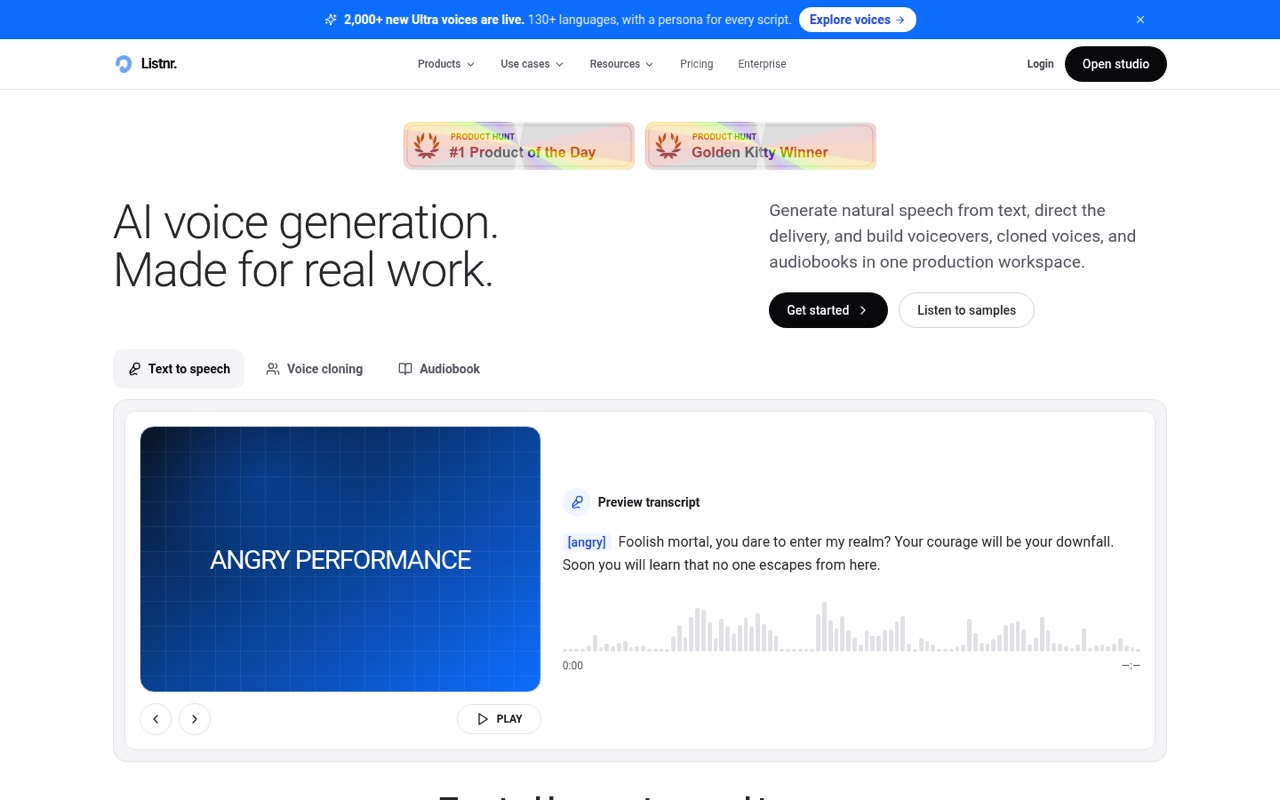
Listnr combines text-to-speech, voice cloning, audiobook narration, delivery controls, and multi-speaker scripts in one production workspace. Its free plan offers 1,000 starting credits, while paid plans start at $19 monthly or $15.83 per month with annual billing.
For a small team, the main budget question is how many subscriptions you need: the pricing page lists plan prices but not seat counts. The Individual plan can pencil out for separate producers, but confirm team access and credit needs with Listnr before committing.
Good fit if
- Solo video and podcast producers
- Teams making recurring voiceovers
- Creators testing AI narration
Skip it if
- Teams needing published seat pricing
- High-volume users on a tight budget
- Buyers needing confirmed integrations
ScoresHow it rates
What works
- Free plan includes 1,000 starting credits
- Preview more than 1,000 voices
- Supports 142+ languages and accents
- Paid plans include commercial rights
- Annual billing saves two months
What doesn't
- Free plan's generation allowance is limited
- Seat counts aren't listed on pricing
- Extra-credit prices aren't published
- Volume pricing requires a quote
- Integration details aren't listed in pricing
01Who Listnr is for
Small teams only need a voice-generation tool if they regularly produce audio and want a consistent workflow for scripts, narration, and exports. Listnr turns text into speech, supports voice cloning and audiobook narration, and lets users assign different voices to speakers and scenes. Style prompts and pacing cues can shape delivery.
That fits a solo producer or a few-person content team making videos, podcasts, training material, ads, or audiobooks. The free plan gives a team a low-cost way to preview voices; paid plans add monthly credits, storage, video allowances, and commercial rights. The catch for a 1–10-person team is that the pricing page doesn't list seat counts. We would confirm whether each producer needs an account, and whether the Solo plan supports the team's workflow, before setting a budget. If you only need occasional narration, the free allowance may be enough to start; regular production is more likely to call for a paid plan.
02Listnr free plan and trial
Listnr's Free plan costs $0 and includes 1,000 starting credits, access to Listnr Studio, previews of 1,000+ voices, and 142+ languages and accents. The pricing page says no credit card is required. It doesn't list a time-limited free trial; the free plan is the entry point.
The allowance is a starting balance, not a monthly credit allotment. Listnr doesn't publish an estimate of how much finished audio those free credits produce, so test a representative script before relying on it for a project. The Free plan's listed inclusions don't mention commercial rights; the Individual, Solo, and Agency plans do. For regular production or commercial use, the cheapest listed paid option is Individual: $19 monthly, or $15.83 per month with annual billing.
03What a small team pays for Listnr
The Individual plan is $19 per month, or $15.83 per month with annual billing. Annual billing charges 10 months up front for 12 months of service, so one Individual subscription is $190 per year. Assuming each producer needs a separate Individual subscription, three people would cost $57 monthly or $570 per year (an average $47.50 per month). Five would cost $95 monthly or $950 per year (an average $79.17 per month). The pricing page doesn't confirm seat rules, so treat these as per-subscription estimates and verify access with Listnr.
Individual includes 20,000 credits a month, about two hours of voice generation, 50GB of storage, 50 videos a month, and commercial rights. Listnr also lists Solo for creators or small teams at $39 monthly or $32.50 per month billed annually, with 50,000 credits and about five hours of generation. Agency is $99 monthly or $82.50 annually per month, with 250,000 credits. Extra credits are available, but their price isn't published; volume pricing is by quote. Compare the Solo plan and subscription requirements before buying several Individual accounts.
04Getting started with Listnr
The listed workflow is straightforward in outline: bring in text, choose a voice, direct delivery with style prompts or pacing cues, preview the result, then export audio. Multi-speaker scripts let a producer assign Listnr voices to speakers and scenes. The product description also names voice cloning and audiobook narration, so teams can consider it for more than short clips.
The pricing details don't explain how long setup takes, what onboarding includes, or which integrations are available. They also don't specify the steps or permissions needed for voice cloning. For a first project, we would prepare a short sample script, check the available voices and languages, and confirm export formats and any required integrations with Listnr. The Free plan requires no credit card, which makes it a practical place to check whether the voice options fit before a team subscribes. Don't assume a shared workspace or particular integration is included without confirming it.
05When small teams outgrow Listnr
The first pressure point is generation volume. Individual includes 20,000 credits a month, described as about two hours of voice generation; Solo lists 50,000 credits and about five hours, while Agency lists 250,000 credits and about 25 hours. A team producing more than its plan's allowance may need to upgrade or buy extra credits. Listnr doesn't publish extra-credit prices, so ask for the cost before building a high-volume workflow around it.
The other likely limit is team access. The pricing page lists seat-based licenses and large-team collaboration under Custom pricing, but doesn't state how many people can use the lower plans or what collaboration features they include. A growing team should confirm that before adding subscriptions one by one. Agency is listed at $99 monthly or $82.50 per month with annual billing, but its listed inclusions don't specify seats. For larger teams, custom pricing includes seat-based licenses, dedicated API throughput, and custom integrations; the vendor doesn't publish a price.
Questions people ask
Does Listnr have a free plan?
Yes. The Free plan costs $0 and includes 1,000 starting credits, Listnr Studio access, previews of 1,000+ voices, and 142+ languages and accents. The pricing page says no credit card is required. It doesn't list a time-limited trial; the free plan is the listed way to try the product.
How much does Listnr cost for a small team?
Individual costs $19 monthly or $15.83 per month with annual billing. If three people each need an Individual subscription, that works out to $57 monthly or $570 per year. For five, it is $95 monthly or $950 per year. Listnr doesn't publish seat counts for these plans, so confirm subscription requirements first.
Does Listnr include commercial rights?
The pricing page lists commercial rights with the Individual, Solo, and Agency plans. Commercial rights aren't listed among the Free plan's inclusions. If you plan to publish generated audio commercially, confirm the rights and any usage conditions with Listnr before using it in a production workflow.
Can Listnr create audiobooks and multi-speaker audio?
Listnr supports audiobook narration and multi-speaker scripts. Its feature description says users can assign different Listnr voices to speakers and scenes, and use style prompts and pacing cues to shape delivery. The pricing details don't specify project-length limits for audiobook work, so ask the vendor about your expected workload.
What happens when I run out of Listnr credits?
Paid plans include monthly credit allowances, and Listnr says extra credits are available for purchase. The price for extra credits isn't published, while volume pricing is available by quote. Check the cost and how additional credits work with the vendor before choosing a plan based on frequent or high-volume generation.