
We may earn a commission if you buy through links on this page. It never changes a score or a ranking. How we make money
The bottom line
Matia brings several data tools together, but the $1,250 monthly minimum is hard to justify for a tiny team.
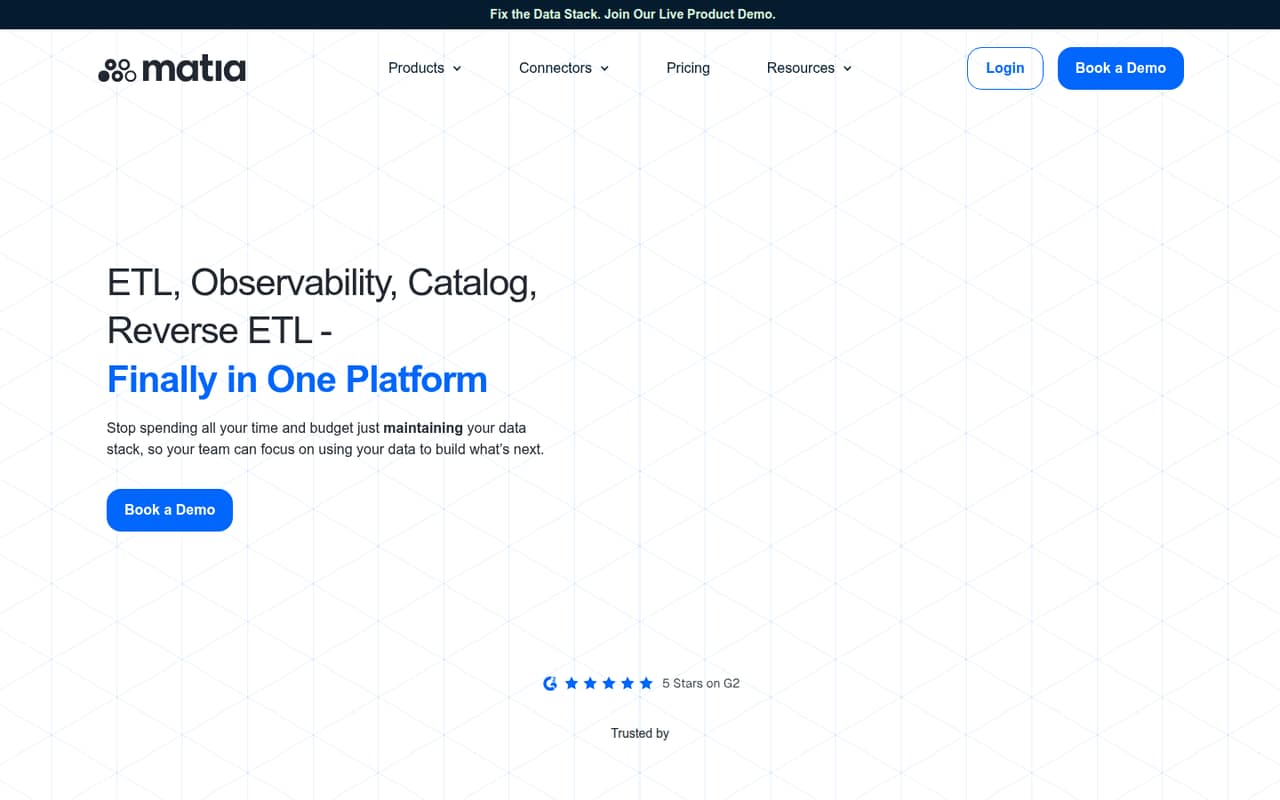
Matia combines data ingestion, reverse ETL, pipeline monitoring, lineage and cataloging. That breadth can suit a team that wants one platform to move and manage warehouse data, including context for analytics and AI work.
The trade-off is the price: the Starter plan begins at $1,250 per month for up to 10 users, and there’s no free plan. With Standard and Enterprise prices unpublished, small teams should confirm their likely total cost and connector needs before committing.
Good fit if
- Teams consolidating several data tools
- Warehouse-centered analytics teams
- Teams with a $1,250 monthly budget
Skip it if
- Teams looking for a free data tool
- One-person teams on tight budgets
- Buyers who need published annual pricing
ScoresHow it rates
What works
- Combines ingestion, reverse ETL and observability
- Starter allows up to 10 users
- Includes lineage and data catalog features
- Starter includes 100 monitored tables
- Trial lasts about two weeks
What doesn't
- No free plan
- Starter starts at $1,250 per month
- Standard and Enterprise prices aren't published
- Starter limits sync frequency and destinations
- Connector coverage and setup details need confirmation
01Who Matia is for
Matia is for teams that need to move warehouse data between systems and keep an eye on what happens to it. It combines data ingestion, reverse ETL, pipeline monitoring, lineage and a data catalog, so it may suit a small analytics or data team trying to bring several jobs under one roof.
The Starter plan supports up to 10 users, but its $1,250 monthly starting price makes it a better fit for a funded team with a real DataOps workload than for a one-person shop or a team just starting to explore data tooling. It moves data into warehouses, sends warehouse data to operational tools, and flags pipeline issues such as schema changes and anomalies. Lineage and catalog features add context for analytics and AI work. Before choosing it, make sure the included sync intervals, monitored-table allowance and reverse ETL destination count match your workload.
02Matia free plan and trial
Matia has no free plan. The pricing information lists a free trial of about two weeks, but doesn't publish what the trial includes, whether it requires a payment method, or whether any features or usage limits apply. Ask Matia to confirm those details before you plan a trial around a project deadline.
The cheapest listed way in is Starter at $1,250 per month. It includes 10 users, 7-day audit logs, hourly ETL syncs, one reverse ETL destination with 8-hour syncs, 100 monitored tables, five custom monitors and 75 dbt tests. That is a substantial commitment for a small team, even if you need only one or a few seats. Confirm whether the trial converts automatically and what the first paid invoice will be.
03What a small team pays for Matia
The pricing page lists Starter at $1,250 per month and includes up to 10 users. That means a one-person team still pays $1,250 monthly; a three-person team pays the same plan price, or about $416.67 per person; and a five-person team pays the same, or $250 per person. Those per-person figures are just the plan price divided by seats, not separate per-seat charges.
At the listed monthly rate, 12 months comes to $15,000. Matia doesn't publish an annual billing price or discount, so ask for an annual quote rather than assuming one. Standard and Enterprise prices are also not published. The pricing lists no add-ons, so we can't estimate extra charges; ask whether your needed connectors, usage, or support involve additional fees. Starter's included limits are the main costs to weigh: one reverse ETL destination, 100 monitored tables and five custom monitors.
04Getting started with Matia
Matia's job is to connect data sources, warehouses and operational destinations, then monitor pipelines and organize data context. The product description also lists CDC, configurable sync intervals, lineage and a semantic layer for AI context. Those capabilities suggest setup involves choosing the systems to connect and deciding how often data should move, but the material available doesn't specify implementation steps or time to launch.
We'd treat setup as a data project, not assume it is a quick self-serve install. Before signing, ask Matia which connectors cover your exact sources, warehouse and destinations, and whether those connections need engineering work. Also confirm how CDC is configured, how to set up monitors and lineage, and what help is available during onboarding. The vendor's site doesn't publish a connector list, setup time or learning curve, so a short trial with your actual workflow is the practical way to check fit.
05When small teams outgrow Matia
A team can outgrow Starter when it needs more than one reverse ETL destination, faster than hourly ETL syncs, more than 100 monitored tables, or more than five custom monitors. Starter also limits reverse ETL syncs to every eight hours and includes 75 dbt tests. If those caps don't fit, Standard lists 15-minute ETL syncs, two destinations with four-hour syncs, 300 monitored tables, 25 custom monitors and unlimited dbt tests.
Standard allows unlimited users, while Starter includes 10. Enterprise lists ETL syncs as frequent as every five minutes, unlimited reverse ETL destinations and monitored tables, and unlimited custom monitors and dbt tests. But neither upgrade has a published price, so the cost of growing isn't clear from the listed plans. Ask for quotes before building a workflow that depends on higher limits. If your team only needs a few seats or a narrow data workflow, the Starter floor may be the reason to choose a smaller, more focused tool.
Questions people ask
Does Matia have a free plan?
No. Matia's pricing information lists no free plan and describes a trial of about two weeks. It doesn't specify the trial's usage limits or requirements, so confirm those details with Matia. The cheapest listed paid option is Starter at $1,250 per month.
How much does Matia cost for a small team?
Starter begins at $1,250 per month and includes up to 10 users. The plan price stays $1,250 for one, three or five users; the per-person equivalents are $1,250, about $416.67 and $250 monthly. Standard and Enterprise prices aren't published.
What does Matia Starter include?
Starter includes 10 users, 7-day audit logs, hourly ETL syncs, one reverse ETL destination with 8-hour syncs, 100 monitored tables, five custom monitors and 75 dbt tests. It starts at $1,250 per month, according to the pricing information.
Does Matia support the data sources and tools we use?
Matia describes moving data between sources, warehouses and operational tools, but the available product details don't list specific connectors. Check with Matia about your exact source, warehouse and destination before signing, and confirm whether any connections have additional costs.
When should we upgrade from Matia Starter?
Consider an upgrade if you need faster ETL than hourly, more than one reverse ETL destination, or more than 100 monitored tables or five custom monitors. Standard and Enterprise list higher limits, but their prices aren't published, so request a quote before relying on them.