
We may earn a commission if you buy through links on this page. It never changes a score or a ranking. How we make money
The bottom line
Good for custom, developer-built stores; less appealing if you need a free, ready-made shop.
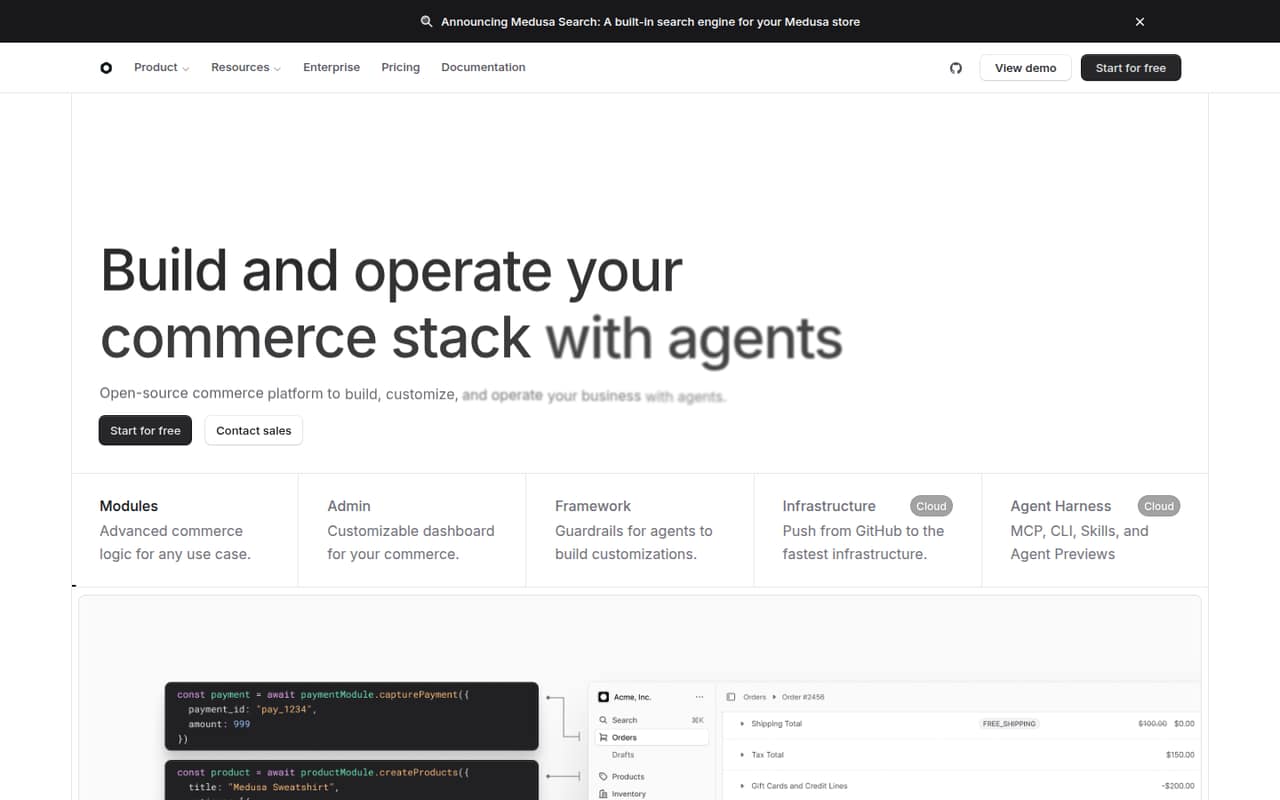
Medusa is an open-source commerce platform with product, promotion, inventory, and multi-region tools, plus a customizable admin dashboard. It’s built for teams that want to shape their store rather than settle for a fixed storefront setup.
Medusa Cloud starts at $29 per month for Develop, with one cloud seat. There’s no free Cloud plan, and costs rise with extra seats, environments, or usage. We’d shortlist it for a small team with developer time and a clear reason to customize.
Good fit if
- Developer-led ecommerce teams
- Stores needing custom commerce workflows
- Teams planning multiple sales channels
Skip it if
- Nontechnical teams seeking turnkey setup
- Stores that need free hosted software
- Teams wanting published setup estimates
ScoresHow it rates
What works
- Open-source commerce platform
- Product, promotion, and inventory modules
- Customizable admin dashboard
- Multi-region and multi-channel selling
- Cloud plans list usage allowances
What doesn't
- No free Medusa Cloud plan
- Setup effort and timeline aren’t published
- Extra cloud seats cost $30 monthly
- Usage overages can add to bills
- Annual billing isn’t listed
01Who Medusa is for
Medusa suits a small ecommerce team—roughly one to ten people—that has developer capacity and wants more control than a fixed store platform offers. It provides commerce modules for products, promotions, inventory, and multi-region selling, alongside an admin dashboard and a framework for custom work. Sales channels can include multiple stores, POS, and apps.
The open-source platform may appeal to a budget-conscious team willing to own more of the build. For hosted infrastructure, the pricing page lists Medusa Cloud from $29 per month. That entry plan is aimed at developers building a store, not a finished, hands-off shop. A team preparing to go live may find Launch at $99 per month a closer fit. Medusa is a better match when customization is part of the plan; teams without technical help should first confirm who will build and maintain the store.
02Medusa free plan and trial
There is no free Medusa Cloud plan in the listed pricing, and a free trial is not published. The platform itself is open source, so a team can build on Medusa without choosing a paid Cloud plan. That is different from getting hosted infrastructure at no cost: hosting and operating a self-managed store are separate responsibilities, and their costs aren’t listed here.
The cheapest listed Cloud option is Develop at $29 per month. It includes one cloud seat, 1 million edge requests monthly, 10,000 free-text searches, and 600 compute hours, capped. Email is limited to 100 per day and 1,000 per month. If you need a hosted development environment, that’s the lowest published price; confirm trial availability with Medusa before signing up.
03What a small team pays for Medusa
Medusa Cloud bills monthly in advance; annual pricing isn’t listed. Develop costs $29 per month and includes one cloud seat. Assuming each person needs a seat, three people cost $89 monthly ($29 plus two $30 seats), and five cost $149 ($29 plus four seats). Those totals use Develop’s listed seat add-on, not a recommendation to launch a live store on that plan.
For a store preparing to go live, Launch is $99 monthly with one seat. Three seats bring it to $159, and five to $219. Scale is $299 monthly and includes three seats, so a five-seat team would pay $359. Extra preview environments cost $10 monthly each; a long-lived environment is $60 monthly. Watch usage too: Launch and Scale charge $0.16 per compute hour beyond their included hours and $7 per 10,000 email overages. Develop has a hard monthly email limit instead.
04Getting started with Medusa
Medusa is aimed at developers, with a framework for building customizations and commerce modules to configure around a store’s needs. That points to a more involved start than choosing a hosted template and filling in products. The vendor doesn’t publish a setup-time estimate, so a small team should plan its own discovery and build work before committing to a launch date.
The product includes a customizable admin dashboard, and Medusa Cloud can host the backend and storefront. The Cloud offering also lists a CLI, development agent, skills, MCP, and agent previews. The public product details don’t name specific payment, shipping, tax, or analytics integrations, or spell out their setup steps. Confirm that your required services work with your intended Medusa setup, and who will configure them, before budgeting. We’d treat a developer as essential for a team starting from scratch.
05When small teams outgrow Medusa
A team may need to upgrade when its Cloud usage reaches the plan allowances or when more people need cloud seats. Develop includes 1 million edge requests and 600 capped compute hours monthly; Launch includes 5 million edge requests and 1,000 compute hours, with additional compute at $0.16 per hour. Scale raises those allowances to 10 million requests and 2,800 compute hours, and includes three seats. Extra seats cost $30 each monthly.
Watch the other limits as well: Develop has a 1,000-email monthly hard limit, while Launch and Scale list paid email overages. More environments, searches, storage, and data transfer can add charges. A team that needs tailored usage limits, a 99.99% uptime guarantee, 24/7 support, RBAC, SSO, audit logs, or a dedicated support engineer may need Enterprise, whose price is custom. If the team wants a simpler store without developer ownership, the issue may be fit rather than plan size.
Questions people ask
What is Medusa.js for?
Medusa is an open-source commerce platform for building, customizing, and operating ecommerce businesses. It includes commerce modules for products, promotions, inventory, and multi-region selling, plus an admin dashboard and a developer framework. Medusa Cloud is an optional hosted service for the backend and storefront.
Is Medusa a CMS?
Medusa is described as a commerce platform, not a CMS. Its listed capabilities include product management and a customizable admin dashboard, but the product details don’t establish that it provides a full content-management system. Ask Medusa how it fits with the content tools your storefront needs.
Does Medusa have a free plan or trial?
Medusa Cloud has no free plan in its listed pricing, and trial availability isn’t published. Medusa itself is open source, so teams can build with the platform outside a paid Cloud plan. The least expensive listed Cloud plan is Develop at $29 per month.
Can Medusa host my store?
Yes. Medusa Cloud is described as hosting the backend and storefront, with infrastructure that scales with traffic. Its plans have published usage limits and overage charges, so check the allowances for requests, compute, email, and other services against your store’s expected needs.
Does Medusa support AI agents?
Medusa Cloud lists agent tools including MCP, a development agent, CLI, skills, and agent previews. The product is also positioned for building and operating commerce businesses with agents. Check with Medusa for details on which plan includes each tool and any usage limits that apply.