
We may earn a commission if you buy through links on this page. It never changes a score or a ranking. How we make money
The bottom line
Worth a look for developer teams building agents; the free tier is the safest place to start.
A small team may not need a memory product if its agents can work with the context they already have. Mem0 is for teams that want AI apps to retain information across sessions, with features for extracting, updating, compressing and retrieving memories.
The pricing page lists a free plan with request limits and unlimited end users. There’s no published paid starter price: teams needing tailored volume have to ask about Custom. Expect engineering work to integrate it, and plan how your team will keep stored memories accurate.
Good fit if
- Teams building AI agents
- Developers needing cross-session context
- Projects with a free-tier budget
Skip it if
- Teams without an AI app
- Nontechnical teams seeking a ready-made app
- Buyers needing published paid pricing
ScoresHow it rates
What works
- Free plan listed at no charge
- Supports memory across sessions and agents
- Extracts, updates and retrieves memories
- Python quickstart and Node.js listed
- Kubernetes, private cloud and air-gapped options
What doesn't
- Free request limits apply
- Paid Custom price is not published
- Model calls switch to your LLM key after 30 days
- Setup requires developer integration
- Stored memories can become stale or misleading
01Who Mem0 is for
A team of one to ten people building an AI agent or app is the clearest fit. Mem0 provides infrastructure for retaining context between sessions: it can extract and update memories, compress chat history, then retrieve relevant information as people interact. That can help when an app needs more than the current conversation to respond.
But not every small team needs a memory layer. One Reddit commenter says teams can get by without one, depending on model capabilities. If your app is a simple demo or has little history to carry forward, start without another service to maintain. Mem0 makes more sense when persistent context is a product requirement and someone on the team can handle SDK integration and memory rules. Its free plan lowers the cost of evaluating that fit; the product still asks for engineering time, and a paid agreement has no published price.
02Mem0 free plan and trial
The pricing page lists Free at $0 per month. It includes 10,000 add requests and 1,000 retrieval requests per month for the first 30 days. With your own LLM key, the listed allowance is 50,000 add requests and 10,000 retrieval requests per month. The plan also lists unlimited end users; that does not mean unlimited requests.
For the first 30 days, model calls use Mem0. After that, the plan uses your LLM key. The pricing page doesn’t list a separate free-trial period, and it doesn’t publish per-unit rates for usage-based billing. Free is a sensible way to evaluate the integration, provided your expected volume fits the request limits and you can supply an LLM key after the initial period.
03What a small team pays for Mem0
The pricing page lists Free at $0 per month. That means a team of one, three or five can start at a listed subscription price of $0, as long as the free plan’s request limits work for its use. Mem0 lists unlimited end users, but it does not publish a per-seat price or clarify a separate team-seat model, so there’s no reliable per-person calculation to make.
The paid option is Custom, for teams that need tailored add and retrieval volumes or an agreement covering model calls and overages. Its price and monthly billing terms aren’t published, and annual pricing isn’t published either. Ask Mem0 for a quote based on your expected volume before budgeting a rollout. The pricing page also lists usage-based billing with a monthly cap you set, but per-unit rates aren’t published. For a small team, the practical cost question is less “how many seats?” and more “what usage and model-call terms will the vendor quote?”
04Getting started with Mem0
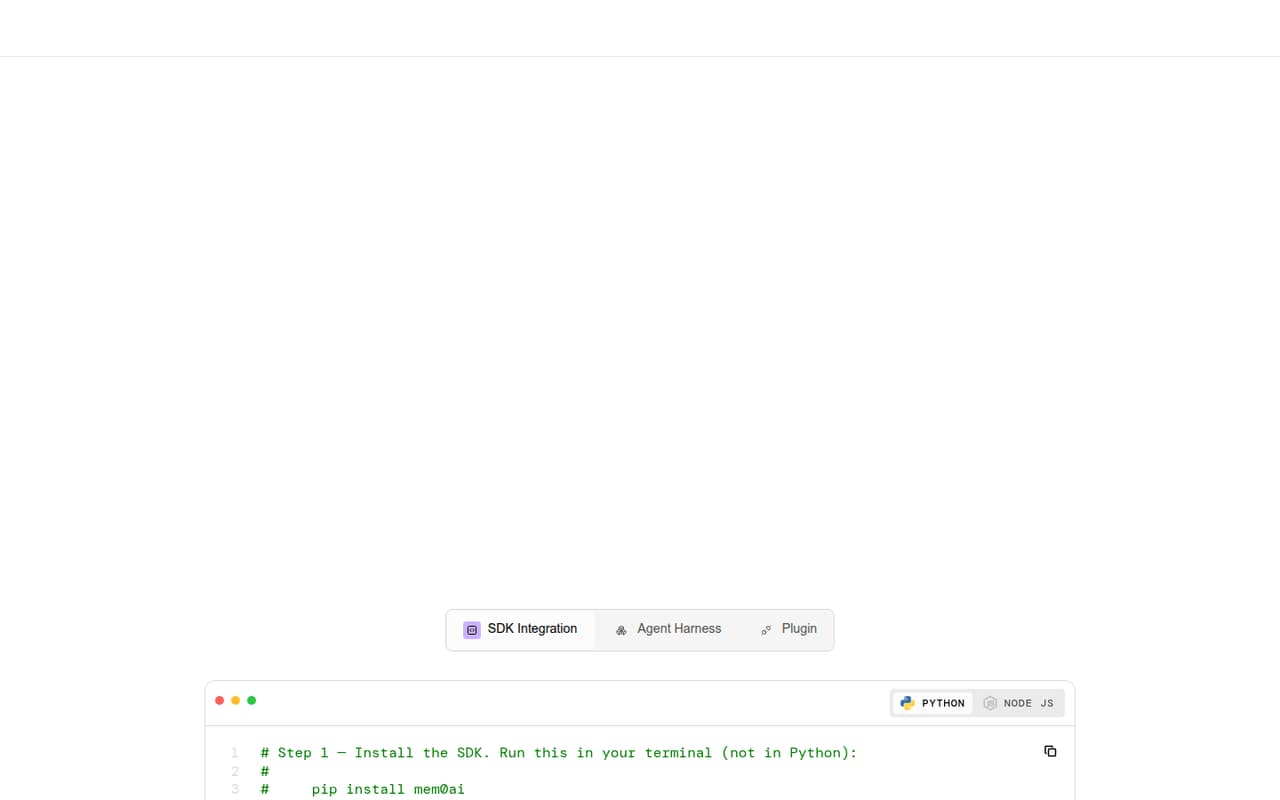
Mem0 is developer infrastructure, so expect to connect it to an AI app rather than set up a ready-made team workspace. The homepage provides a Python SDK quickstart and lists Node.js. A small team should first decide what information the app should save, when it should update a memory, and when to retrieve one. Those choices affect what context the agent carries forward.
The homepage describes memory extraction, updates, retrieval and compression, plus deployment options including Kubernetes, private cloud and air-gapped environments. Those options give teams deployment paths to consider, but they don’t establish how much setup each requires. The vendor doesn’t publish a setup-time estimate in the published material. Start with the SDK path that matches your app, confirm the request volume, and make sure someone owns review of stale or incorrect memories. Reddit commenters warn that old facts can be retrieved as if still current.
05When small teams outgrow Mem0
The first clear ceiling is request volume. Free lists 10,000 add requests and 1,000 retrieval requests per month for the first 30 days, then higher allowances with your own LLM key: 50,000 adds and 10,000 retrievals. Teams that need more can ask about Custom, where volumes and agreement terms are set with Mem0. The vendor doesn’t publish a price to compare against those limits.
A different kind of growing pain is trust in what the system remembers. Reddit commenters raise concerns about stale facts, summaries replacing original details and agent-written memories carrying bad instructions into future sessions. Those are user concerns, not proof that every Mem0 setup has the same problem. Still, teams handling changing or sensitive information should decide who can write or approve memories and how they’ll be checked. If that level of control or a specific memory model is essential, evaluate whether Mem0’s documented features and a Custom agreement fit before building around it.
From the threadsWhat users say
Reddit discussion is mixed: some builders prefer rolling their own, while one commenter calls Mem0 a developer favorite. The recurring caution is that memory quality and trust rules matter as much as the storage tool.
I do think you can get by without now, especially given the capabilities of the models
The write side is the part nobody prices in when choosing between Mem0, Zep, and files
Stale facts that look current are the one u/watch_it_burn1 named
Mem0 is the dev favorite and open source which I respect
Questions people ask
What does Mem0 do?
Mem0 provides memory infrastructure for AI agents and apps. Its homepage describes a system that extracts, updates and retrieves memories so an app can retain context across sessions. It also describes memory compression to condense chat history and lists Python and Node.js integration options.
Is Mem0 free?
The pricing page lists a Free plan at $0 per month. It includes 10,000 add requests and 1,000 retrieval requests per month for the first 30 days, then 50,000 add requests and 10,000 retrieval requests per month with your own LLM key. The plan also lists unlimited end users.
Does Mem0 have a free trial?
The pricing page lists a Free plan, but no separate free-trial period. Its request allowances change after the first 30 days: model calls use Mem0 during that period, then use your LLM key. Check the current pricing terms before planning an evaluation around those limits.
How do you integrate Mem0?
The homepage provides a quickstart for the Python SDK and lists Node.js. Mem0 is infrastructure for an AI app, so expect a developer to connect the SDK and decide how the app should add, update and retrieve memories. The vendor doesn’t publish a setup-time estimate.
Can Mem0 run in a private environment?
The homepage lists Kubernetes, private cloud and air-gapped deployment options. Ask Mem0 which deployment option fits your architecture and what it costs: the listed Custom plan leaves agreement terms to the vendor and doesn’t publish a price.
Sources
- Mem0 homepage
- Mem0 pricing, compiled via web search from mem0.ai, pricingsaas.com
- Reddit: How are you handling long-term memory for your agents? Mem0, Zep, or rolling your own?
- Reddit: Woah. Letta vs Mem0. (For AI memory nerds)
- Reddit: mem0, Zep, Letta, Supermemory etc: why do memory layers keep remembering the wrong things?
- Reddit: I tested 3 memory tools for my agents (Supermemory, Mem0, Vilix AI) and they all share one annoying flaw