
We may earn a commission if you buy through links on this page. It never changes a score or a ranking. How we make money
The bottom line
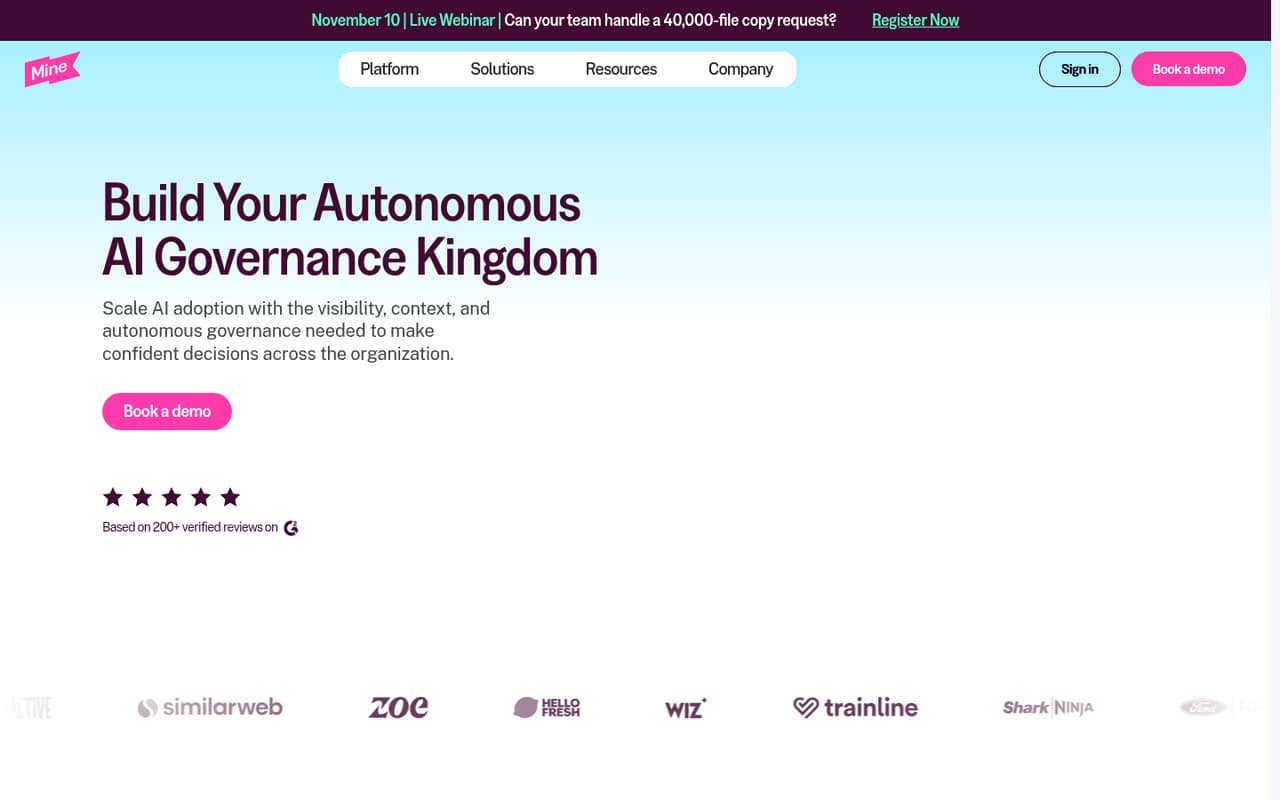
MineOS brings AI, privacy, and risk workflows together, with custom pricing and no free plan listed.
MineOS is for teams that need to discover AI tools and connect them to privacy, vendor, data, and policy context. Its listed capabilities include AI discovery, risk assessments, privacy workflows, and automation through AI agents.
The pricing page directs buyers to request a custom quote. It lists no free plan or starting price, and does not publish monthly or annual billing terms. For a small team watching seat costs, that makes the first step a sales conversation—not a simple plan comparison.
Good fit if
- Privacy teams managing AI-related assessments
- Risk teams tracking AI systems and vendors
- Organizations consolidating governance workflows
Skip it if
- Teams that need a free starting tier
- Buyers who require clear per-seat pricing
- Small teams seeking a simple AI inventory
ScoresHow it rates
What works
- Discovers AI systems, agents, vendors, and shadow AI
- Connects AI records to ownership, data, and policies
- Supports privacy assessments, RoPA, and DPIAs
- Includes risk scoring with policy-based customization
- Uses agents to automate repetitive governance work
What doesn't
- No free plan is listed
- Starting price is not published
- Trial availability is not published
- Monthly and annual billing terms are not published
- Seat limits and add-on prices are not published
01Who MineOS is for
MineOS is aimed at privacy, risk, and compliance teams that need to keep track of AI use alongside existing governance work. It can discover AI systems, agents, vendors, shadow AI, and unapproved tools, then connect those records to ownership, business purpose, data access, vendor status, policies, and privacy requirements.
That breadth may suit a small team of one to ten people if AI governance is a real responsibility and the team wants to coordinate risk and privacy workflows in one platform. It is a harder fit for a small company that just wants a basic list of AI tools: the product covers assessments, risk management, compliance workflows, and DSR automation, which may be more than that job requires. Since the vendor does not publish a starting price, a budget-conscious team should request a quote before deciding whether the scope fits its budget.
02MineOS free plan and trial
MineOS does not list a free plan. Trial availability and any trial limits are not published, so ask the vendor whether a trial is available and what it covers before planning an evaluation.
There is no published self-serve tier to start with. The vendor directs buyers to request a custom quote, making that the cheapest published way to begin a buying conversation—not a confirmed minimum purchase price. The pricing information also does not say whether a quote includes AI discovery, privacy assessments, DSR workflows, or AI agents, or whether those capabilities are packaged separately. Ask for a written breakdown of included features, user limits, onboarding, and any optional costs. Without those details, a small team cannot tell whether it can start with one workflow and add more later.
03What a small team pays for MineOS
MineOS publishes no starting price or per-seat rate; its pricing page directs buyers to request a custom quote. Monthly and annual billing terms are also not published. That means we cannot calculate the cost for one person, three seats, or five seats—or compare monthly billing with an annual commitment—without inventing numbers.
The pricing information lists no plans or add-ons with prices. It also does not publish whether the quote changes by seat count, which features are included, or whether AI agents, privacy assessments, RoPA, DPIAs, transfer reviews, or DSR automation carry separate fees. Ask for a quote that shows the total for your actual team size, which workflows are included, any minimum contract or term, and the price to add users or capabilities. Until MineOS supplies those figures, small teams should treat the cost as unknown rather than assume it is priced like a per-seat GRC tool.
04Getting started with MineOS
MineOS describes capabilities for discovering AI systems and connecting them to ownership, vendor, data, policy, and privacy context. But the vendor does not publish setup steps, implementation timelines, or a list of integrations in the pricing information available to buyers. We therefore cannot estimate the effort to connect a small team’s systems or verify which sources it can scan on day one.
Before signing, ask for a walkthrough of how AI discovery works, what access or data the team must provide, and which tools can be connected. Also ask who configures policies and risk scoring, what work is required to import existing records, and whether onboarding is included in the quote. The product’s listed workflows range from AI discovery to privacy assessments and DSR automation, so it is worth agreeing on one initial use case and the people responsible for it. Setup effort and learning curve are not published.
05When small teams outgrow MineOS
The public pricing information does not list seat limits, usage ceilings, plan tiers, or feature gates, so there is no published threshold at which a team must upgrade. It also does not show how costs change as the team adds users or expands from AI discovery into privacy and risk workflows.
For a growing team, the main pressure point may be commercial clarity: if more departments need access, ask MineOS for a revised quote and confirm the cost of additional seats and workflows. Another potential trigger is a change in governance needs, such as needing to track more AI systems, vendors, or privacy assessments; the vendor does not publish limits for those areas. Before committing, ask what happens when usage grows, whether the contract can scale, and what data can be exported if the tool no longer fits. There is not enough published pricing or limit detail to call a specific team size the point to move on.
Questions people ask
Does MineOS have a free plan?
MineOS does not list a free plan. Trial availability is not published either, so ask the vendor whether it offers a trial and what features, users, or time limits apply. The pricing page directs prospective buyers to request a custom quote.
How much does MineOS cost?
MineOS does not publish a starting price or per-seat rate. The vendor directs buyers to request a custom quote, and monthly and annual billing terms are not published. Ask for a written price for your team size and the workflows you need.
What does MineOS do?
MineOS is a governance platform for discovering AI systems and connecting them to privacy, vendor, data, and policy context. Its listed capabilities include risk assessment, privacy workflows such as RoPA and DPIAs, DSR automation, and AI agents for repetitive work.
Can MineOS help with privacy assessments?
Yes. MineOS lists automated privacy assessments, RoPA, DPIAs, transfer reviews, and internal risk workflows among its capabilities. The vendor does not publish which of these are included in a particular quote, so confirm feature availability and any additional costs before buying.
Does MineOS include AI discovery?
MineOS lists AI discovery for systems, agents, vendors, shadow AI, unapproved tools, and sensitive data. It also describes connecting findings to context such as ownership, business purpose, data access, vendor status, policies, privacy requirements, and lineage.