
We may earn a commission if you buy through links on this page. It never changes a score or a ranking. How we make money
The bottom line
Worth considering for product-led payment operations; expect engineering work and usage-based fees.
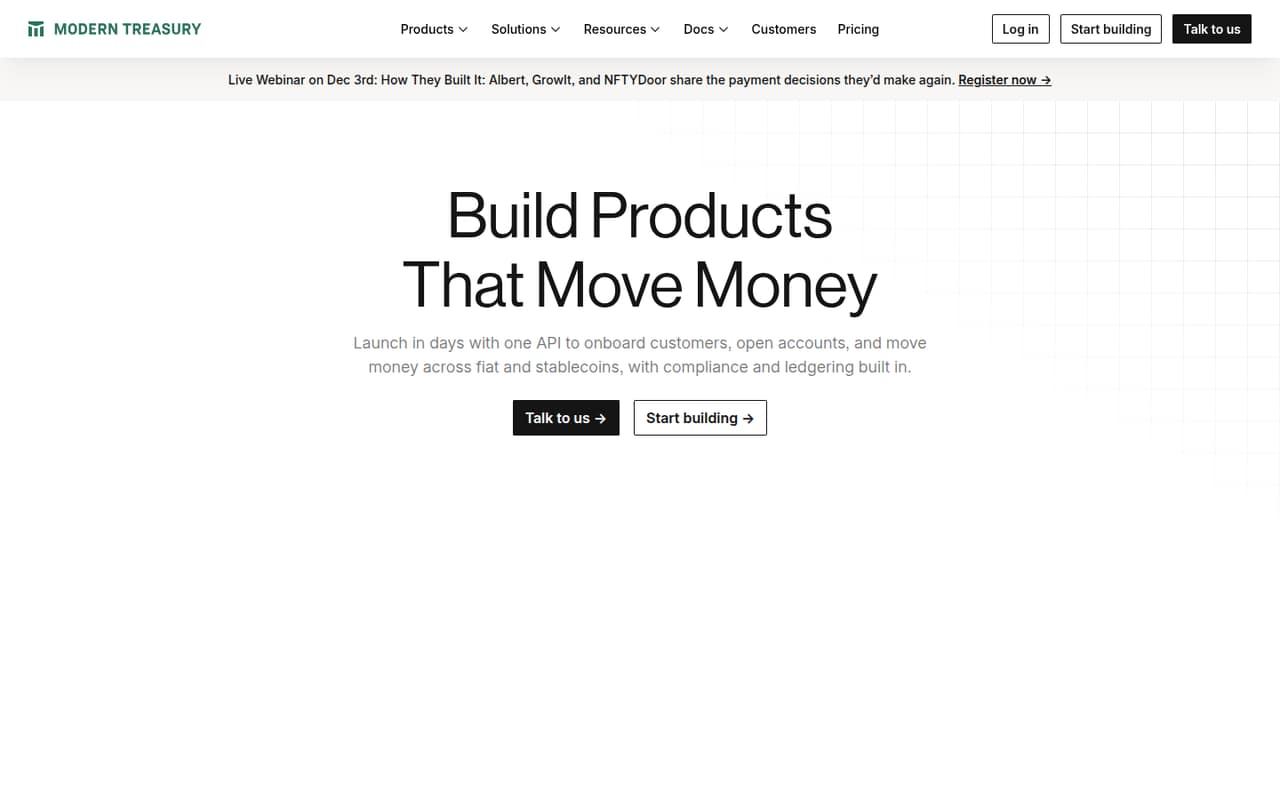
Modern Treasury is for businesses that need to build payments, accounts, compliance, and ledgering into their products. Its APIs cover ACH, instant payment rails, and stablecoin orchestration, with a dashboard and dedicated payments support listed across the pricing options.
There’s no free plan or published subscription price. ACH starts at $0.25 per transaction, while instant and stablecoin payments cost more. For a small team, the key question is whether it needs payment infrastructure enough to justify the integration work and transaction fees.
Good fit if
- Teams building payment products
- Businesses sending or receiving ACH
- Companies combining fiat and stablecoins
Skip it if
- Teams seeking free payment software
- Businesses needing simple invoicing
- Nontechnical teams avoiding API work
ScoresHow it rates
What works
- One API for payments, accounts, and ledgering
- ACH starts at $0.25 per transaction
- Options for instant payment rails
- Stablecoin orchestration is available
- Dedicated payments support is listed
What doesn't
- No free plan or free trial
- No published monthly subscription price
- Fees vary by payment method
- API setup likely needs engineering time
- Total costs depend on transaction activity
01Who Modern Treasury is for
Modern Treasury fits businesses building money movement into a product: for example, paying sellers, contractors, borrowers, or vendors, or collecting funds from customers. Its platform brings payment APIs, accounts, compliance, and ledgering together, rather than offering a general-purpose tool for a small office. The right team size depends on your payment operation, not a published seat minimum; a small product and engineering team could evaluate it if payments are central to what the business sells.
Budget-wise, this is a usage-based service, not a flat monthly subscription. The pricing page lists ACH from $0.25 per transaction, RTP/FedNow from 1% plus $0.60, capped at $5, and stablecoin orchestration from 0.30%, with a $0.50 minimum. It makes most sense when those payment capabilities are worth the engineering effort and transaction costs. If you only need basic billing or occasional transfers, this infrastructure may be more than you need.
02Modern Treasury free plan and trial
Modern Treasury does not list a free plan or free trial. That means there’s no free tier to use as a long-term solution, and no trial period listed for evaluating the platform without transaction fees. The cheapest published way in is ACH, at a starting rate of $0.25 per transaction. The pricing page also lists one API for payments, accounts, and ledgering, an operations dashboard, and dedicated support from payments experts with its ACH option.
The starting rate is not a flat monthly cost or a promise that every payment will cost exactly $0.25; the vendor describes pricing as usage-based. Before signing up, ask which transaction types and use cases qualify for the starting rate, whether any other charges apply, and what terms are available for your expected volume.
03What a small team pays for Modern Treasury
Modern Treasury does not publish per-seat prices, so a solo user, a team of three, and a team of five have no published seat-based monthly or annual total. The bill is based on payment activity. The pricing page lists ACH from $0.25 per transaction; RTP/FedNow from 1% plus $0.60, capped at $5; and stablecoin orchestration from 0.30%, with a $0.50 minimum. These are starting rates, not an all-in estimate for your use case.
For example, a team of five does not have a published five-seat fee to multiply; its cost depends on which rails it uses and how many transactions it sends or receives. Monthly subscription prices and annualized totals are not published. The vendor says annual terms are available, so ask for a quote based on your expected activity and whether annual terms change the rates. No add-ons are listed on the pricing page, but confirm any extra charges, minimums, or payment-method-specific costs before committing.
04Getting started with Modern Treasury
Modern Treasury is API infrastructure, so getting started means more than creating user accounts: your team needs to connect its product and payment workflows to the API. The platform covers payments, programmatic accounts, customer onboarding, compliance, and ledgering. The pricing page also lists a dashboard for operations and monitoring. That breadth may reduce the need to manage separate payment and ledger systems, but it still points to an engineering-led setup rather than a no-code rollout.
The exact implementation effort, supported integrations, and onboarding timeline are not published in the pricing details. Ask the vendor which payment rails and customer onboarding steps fit your use case, and what engineering work is required before the first payment. Reddit users discussing USDC on Base describe the appeal of handling fiat and onchain payments in one system; one thread highlights integration with existing payment workflows as a challenge. Treat those comments as user discussion, not implementation guidance.
05When small teams outgrow Modern Treasury
Modern Treasury is already aimed at businesses building payment operations, so the first question is less about a seat limit and more about whether the tool matches your rails and transaction needs. The vendor does not publish a seat cap, transaction-volume limit, or a tiered upgrade threshold in the listed pricing. Ask what happens to your rate as volume changes and whether your required payment methods are supported for your use case.
A small team may outgrow the cost model if transaction fees become hard to forecast, or outgrow the platform if it needs a rail, integration, or workflow the vendor cannot support. The pricing page lists no add-ons, but that does not establish that every feature is included at the starting rates. Reddit users discuss the promise of managing fiat and stablecoin flows together, including USDC on Base, but the comments are brief and positive rather than detailed reviews. Confirm technical fit and total costs before building around it.
From the threadsWhat users say
The small amount of Reddit discussion is positive about combining fiat and stablecoin workflows. It is not detailed enough to establish broader customer satisfaction or day-to-day reliability.
One of the biggest challenges with stablecoins hasn't been the technology itself : it's been integrating them into existing payment workflows
I think payments, global transfers, and creator payouts benefit most from this kind of integration
fair point!! the speed and and liquidity available on chain r difficult for traditional finance to replicate
This is the kind of integration that quietly moves the ecosystem forward
Questions people ask
Does Modern Treasury have a free plan?
No. Modern Treasury lists no free plan or free trial. The lowest published starting rate is ACH from $0.25 per transaction. Ask the vendor whether any other fees or minimums apply to your intended payment flow.
How much does Modern Treasury cost for a small team?
Pricing is usage-based, not per seat. The pricing page lists ACH from $0.25 per transaction, RTP/FedNow from 1% plus $0.60 capped at $5, and stablecoin orchestration from 0.30% with a $0.50 minimum. Your actual cost depends on payment activity and use case.
Does Modern Treasury support stablecoins?
Yes. Modern Treasury lists stablecoin orchestration for moving money across rails, borders, and currencies, including on- and off-ramps. Reddit users have discussed its support for USDC on Base. Confirm the supported assets and networks for your specific use case with the vendor.
Does Modern Treasury charge per user?
The pricing page describes transaction-based pricing and does not publish a per-seat fee. It also does not publish a seat minimum. Ask the vendor whether your account needs particular roles or access levels and whether those affect your quote.
Is Modern Treasury suitable for a nontechnical team?
It is API infrastructure for businesses building payment workflows into products, so expect engineering involvement. The platform also lists a dashboard for operations and monitoring, but the vendor does not publish a no-code setup path or implementation timeline in its pricing details.