
We may earn a commission if you buy through links on this page. It never changes a score or a ranking. How we make money
The bottom line
Useful for rules-heavy workflows, but check usage costs and the three-user Starter cap first.
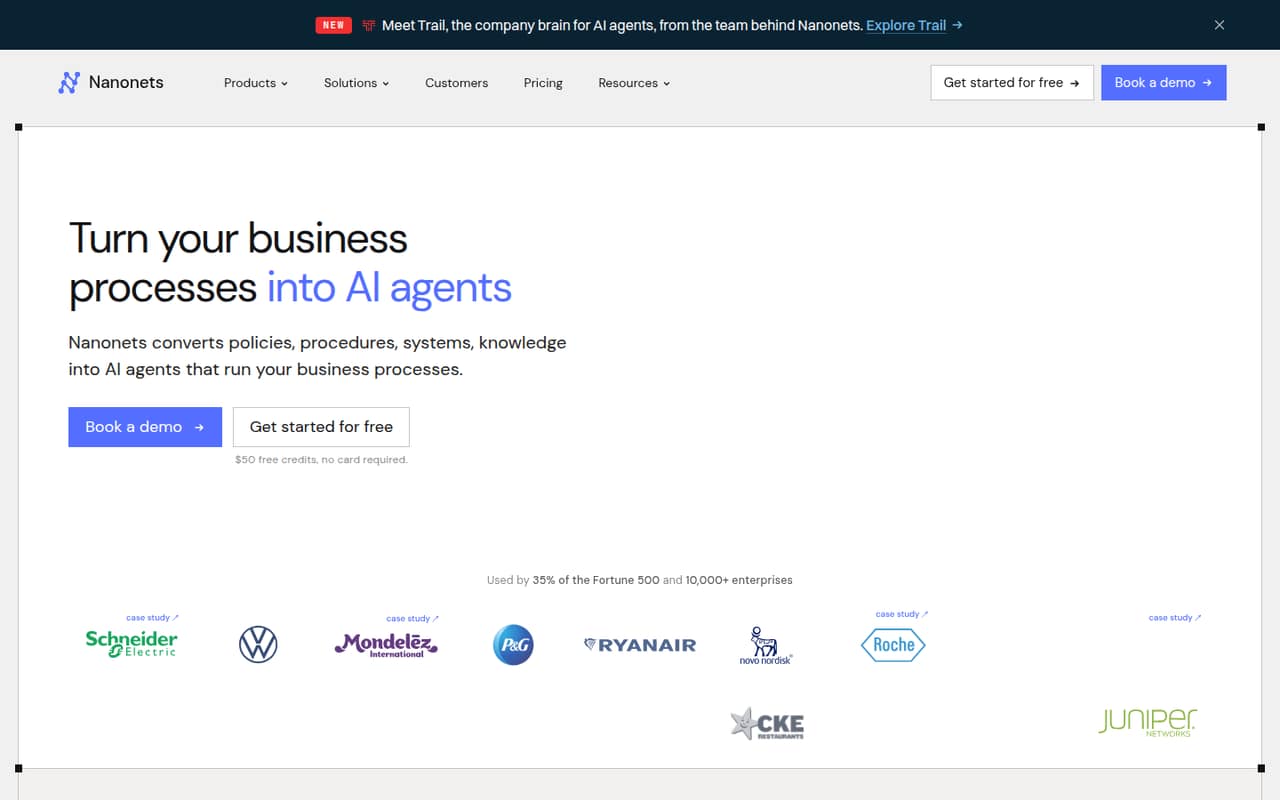
Nanonets turns business policies, procedures, systems, and institutional knowledge into AI agents for work such as accounts payable, reconciliation, and order management. Its source-linked rules and approval steps are promising for teams that need automation to follow internal processes.
The free option includes $50 in credits, but its duration is not stated. Starter costs $100 per month, covers up to three users, and includes 100 credits per month after those free credits; a five-person team needs a Growth quote. Ask for a usage estimate before committing.
Good fit if
- Teams automating accounts payable
- Policy-heavy operations teams
- Small teams with repeatable workflows
Skip it if
- Teams needing five seats at a set price
- Low-volume teams needing unlimited free use
- Buyers who need published setup guidance
ScoresHow it rates
What works
- Automates accounts payable, reconciliation, and order management
- Links extracted business rules to their sources
- Lets users approve, edit, or reject rules
- Starter includes API access and data extraction AI
- No seat-license fees are listed
What doesn't
- Starter costs $100 per month
- Starter is limited to three users
- Growth pricing is quote-based
- Free-credit duration is not stated
- Per-run charges can add to costs
01Who Nanonets is for
Nanonets is aimed at teams that want AI to handle repeatable business processes while following company rules. The homepage highlights accounts payable, reconciliation, order management, supplier onboarding, and claims processing. It also turns policies, procedures, systems, and institutional knowledge into a context graph that agents can use.
For a team of one to three, the $100-a-month Starter plan is the clearest paid entry point. It may fit a small operations or finance team with enough recurring document work to justify the spend. A team of five cannot fit under Starter’s three-user limit and would need a Growth quote. That makes Nanonets a harder fit for a very lean team that wants predictable, low-cost automation without first estimating usage. We’d start by identifying one rules-heavy workflow and asking Nanonets to estimate its credit use.
02Nanonets free plan and trial
Nanonets offers a free option with $50 in credits. The pricing details do not state how long those credits last, whether they expire, or how much processing they cover, so treat them as a way to explore the service rather than as a guaranteed ongoing free tier. The Starter plan also lists $50 in free credits alongside its paid allowance.
Once those free credits are used, Starter costs $100 per month and includes 100 credits per month, up to three users, data extraction AI, and API access. The vendor does not publish a separate free-trial duration. Before relying on the free credits for a business process, ask how credits are consumed by your document types and workflow, and whether unused credits roll over.
03What a small team pays for Nanonets
Starter is $100 per month for 100 credits per month after the initial $50 in free credits. It supports up to three users, with no separate seat-license fees listed. That means one person and a team of three both pay $100 per month for Starter, before any additional usage charges. The vendor does not state annual billing terms, so we can’t give an annual price.
A team of five exceeds Starter’s user cap and needs Growth, whose price is quote-based. The pricing page lists shared team credits and up to 40% volume discounts for Growth, but not a standard five-seat price. Usage can also be billed by run: simple operations are $0.02, standard AI is $0.10, and complex AI is $0.30 per run. Volume purchases may receive discounts. Ask for a quote based on your real workflow volume, and confirm which operations count as simple, standard, or complex.
04Getting started with Nanonets
Nanonets describes a process in which it extracts business rules from documents, parses them into a context graph, and links each rule to its source. Users can then approve, edit, or reject extracted rules. Its agents are designed to follow those rules and learn from corrections. That gives a small team a practical review step, but it also means someone needs to check the rules before depending on them in a live process.
The vendor does not publish a setup-time estimate or a day-one integration list in its pricing details. Starter includes API access, but the listed plan details do not name accounting, ERP, or ticketing integrations. Before signing up, ask which systems your workflow can connect to, what configuration your team must handle, and whether implementation help is included. We can’t put a reliable number on setup effort from the published details.
05When small teams outgrow Nanonets
The first clear boundary is user count: Starter supports up to three users. A four- or five-person team has to ask for Growth pricing, which is quote-based rather than a published per-seat rate. Growth adds classification AI, reporting and analytics, shared team credits, and volume discounts. Enterprise is custom-priced and lists SAML SSO, SCIM, compliance options, and private-cloud or on-premises deployment.
Usage is another point to watch. The listed per-run rates range from $0.02 to $0.30, so costs depend on the work being processed as well as the plan. Ask for a quote based on expected volume before scaling. Reddit discussion available to buyers focuses largely on Nanonets’ open-source OCR models rather than its business-process plans: commenters ask for comparisons, model formats, and document features. That conversation does not establish how teams fare with the paid automation product, so use a workflow-specific demo and quote to judge fit.
From the threadsWhat users say
The available Reddit discussion is mostly about Nanonets’ open-source OCR models, not its paid workflow automation plans. Comments include enthusiasm alongside requests for comparisons and additional capabilities, while a separate pricing thread asks for a ballpark cost.
Kudos to amazing work
Can we have some comparison and benchmark between the two?
footnote/reference extraction and formatting would be fantastic
Just looking for a ballpark number
Questions people ask
What is Nanonets AI?
Nanonets converts business policies, procedures, systems, and institutional knowledge into AI agents for business processes. Its homepage highlights accounts payable, reconciliation, order management, supplier onboarding, and claims processing. It also extracts business rules from documents, links rules to their sources, and lets users review them.
Is Nanonets free to use?
Nanonets lists a free option with $50 in credits. The duration and processing volume those credits cover are not stated. After the free credits, Starter costs $100 per month and includes 100 credits per month, up to three users, data extraction AI, and API access.
How much does Nanonets cost for a small team?
Starter costs $100 per month and allows up to three users, so a team of one or three pays the same listed plan price. A five-person team needs a Growth quote because Starter has a three-user cap. Extra usage may be charged by run, from $0.02 to $0.30.
Does Nanonets charge per user?
The pricing details say there are no seat-license fees, but Starter still has a limit of up to three users. Growth uses shared team credits and is quote-based. Ask the vendor to confirm the user limit and total price for your team before upgrading.
Does Nanonets offer annual billing?
The listed pricing gives Starter’s monthly price but does not state annual billing terms or an annual discount. Growth is quote-based, and Enterprise has custom pricing. Ask Nanonets whether annual billing is available and whether it changes the total cost for your expected usage.
Sources
- Nanonets homepage
- Nanonets pricing page
- Reddit: Nanonets-OCR2: An Open-Source Image-to-Markdown Model with LaTeX, Tables, flowcharts, handwritten docs, checkboxes & More
- Reddit: Nanonets-OCR-s: An Open-Source Image-to-Markdown Model with LaTeX, Tables, Signatures, checkboxes & More
- Reddit: Nanonets Pricing?