
We may earn a commission if you buy through links on this page. It never changes a score or a ranking. How we make money
The bottom line
Powerful offline forms, with a free self-hosted route and hosted plans from $199/month.
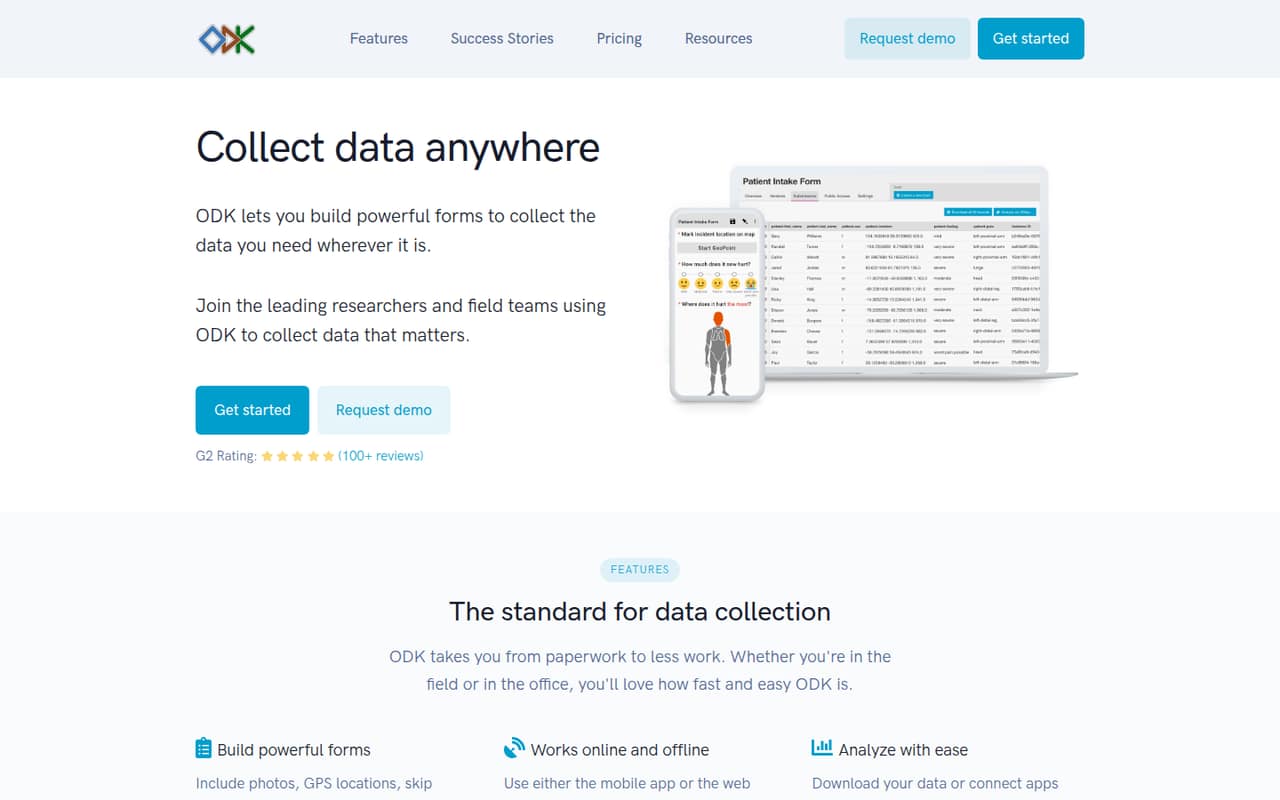
ODK is worth considering if your team collects data in places with unreliable internet. Its mobile and web apps work offline, and forms can include GPS, photos, skip logic, calculations and multiple languages.
The software is free to self-host and support yourself, but that takes technical capacity. For managed hosting, Standard is listed at $199/month with annual pricing; the page also offers monthly billing, but does not identify the displayed rate’s billing selection.
Good fit if
- Field teams collecting data offline
- Researchers building complex forms
- Technical teams comfortable self-hosting
Skip it if
- Teams wanting a simple hosted free tier
- Groups needing several projects on Standard
- Teams that need a published monthly rate
ScoresHow it rates
What works
- Mobile and web apps work offline
- Unlimited forms and users on Standard
- Forms support GPS, photos and skip logic
- Free self-hosting for technical teams
- Connects with Excel, Power BI, Python and R
What doesn't
- Self-hosting is self-supported
- Standard allows one active project
- Standard is limited to 10K monthly submissions
- Monthly Standard price is not published
- API access requires Professional
01Who ODK is for
ODK is for small teams that need to collect structured data in the field or office, especially where internet access is unreliable. A team of one to ten can use the same plan: Standard includes unlimited users, so the price does not rise with each seat. The practical constraint is its one active project and 10K monthly submissions.
Forms can include photos, GPS, skip logic, calculations, external datasets and multiple languages. Staff can collect data offline in ODK’s mobile and web apps, then sync when connected. Teams can download data or connect apps for dashboards and automations. Excel, Power BI, Python and R are listed as connections.
The budget choice is stark: technical teams can self-host and self-support for free, while teams wanting managed hosting start with Standard, listed at $199 per month with annual pricing. ODK is less suited to a group that wants a free hosted service or several active projects on its entry plan.
02ODK free plan and trial
ODK’s free route is its open-source software, which technical users can self-host and self-support. That makes the software free to use, but it is not the same as a managed ODK Cloud plan: your team takes responsibility for hosting and support. ODK does not list a free trial in the pricing details.
For a small team that wants the vendor to host and support ODK, the cheapest listed option is Standard at $199 per month with annual pricing. It includes one active project, unlimited forms and users, 10K monthly submissions, and email support with a stated response time of three business days. The pricing page offers monthly and yearly billing, but the displayed Standard rate does not identify which billing option it reflects. Confirm the charge before budgeting.
03What a small team pays for ODK
The pricing page lists Standard at $199 per month with annual pricing. That is $199 per user for one person, about $66.33 per user for three, or $39.80 per user for five, using the listed monthly rate and unlimited users. If $199 is the annual-billing monthly equivalent, twelve months would total $2,388; the page does not clearly identify the displayed rate’s billing selection. The monthly Standard rate is not published, though the page says yearly billing saves up to 20%.
Standard includes one active project and 10K monthly submissions. Professional is listed at $499 per month with annual pricing, one project, 25K monthly submissions, entities, API access and email support in one business day. Enterprise starts at 10 projects and 100K+ monthly submissions, but its price is not published.
A separate Basic add-on is listed at $199/month with yearly billing or $249/month with monthly billing. It includes one project and 10K monthly submissions. Ask ODK how that add-on relates to the hosted plans before treating it as an extra charge or an alternative.
04Getting started with ODK
Plan for more setup than you would with a basic online form builder, particularly if you choose the free self-hosted route. ODK says self-hosting and self-support are for technical users, so a small team without someone to manage hosting should budget for ODK Cloud instead. The vendor does not publish a setup-time estimate in the pricing details.
For an initial workflow, decide which form fields and rules you need, who will collect responses, and where the data should go. ODK’s forms can use photos, GPS, skip logic, calculations, external datasets and multiple languages. Its mobile and web apps work offline and sync once a connection is available, so teams should plan how collection and syncing fit their fieldwork.
ODK lists connections to Excel, Power BI, Python and R for data work. API access is included with Professional, not Standard. If those connections cover your needs, Standard may be enough; if you need the API, include the higher plan in your budget.
05When small teams outgrow ODK
The first ceiling is project count: Standard and Professional each include one active project. If your work needs multiple active projects, Enterprise lists 10 or more, but its price is not published. Check with ODK about the definition of an active project and the Enterprise quote before committing to a larger rollout.
Submission volume is another upgrade trigger. Standard includes 10K monthly submissions; Professional raises that to 25K for a listed $499 per month with annual pricing. Enterprise lists 100K or more, with pricing on request. The pricing page’s displayed rates do not clearly state the billing selection, so confirm monthly and annual totals as usage grows.
A team may also need Professional when API access or entities become necessary. User count alone is less likely to force an upgrade: the listed plans include unlimited users. If the team lacks technical support for self-hosting, the free route may stop being practical even before it hits a usage limit.
Questions people ask
What does ODK do?
ODK is an open-source platform for building forms and collecting data in the field or office. Its mobile and web apps work offline and sync when connected. Teams can download collected data or connect apps to build dashboards and automations.
Can ODK collect data without internet?
Yes. ODK’s mobile and web apps work offline, then sync data when an internet connection is available. That makes it a fit for field collection where connectivity is intermittent. The product details do not specify how long data can remain unsynced.
Is ODK free?
ODK’s open-source software can be self-hosted and self-supported for free by technical users. Managed ODK Cloud is paid, with Standard listed at $199 per month with annual pricing. The page also offers monthly billing but does not identify the displayed Standard rate’s billing selection.
How much does ODK Standard cost for a small team?
Standard is listed at $199 per month with annual pricing and includes unlimited users, one active project and 10K monthly submissions. That works out to about $66.33 per person for three users or $39.80 for five, using the listed rate. Confirm the billing option with ODK.
What is included in ODK Standard?
Standard includes one active project, unlimited forms and users, 10K monthly submissions, standard features and email support with a stated response time of three business days. It does not list API access; that is included with Professional, alongside a 25K monthly submission allowance.