
We may earn a commission if you buy through links on this page. It never changes a score or a ranking. How we make money
The bottom line
Good for model choice and routing; budget for model charges plus credit-purchase fees.
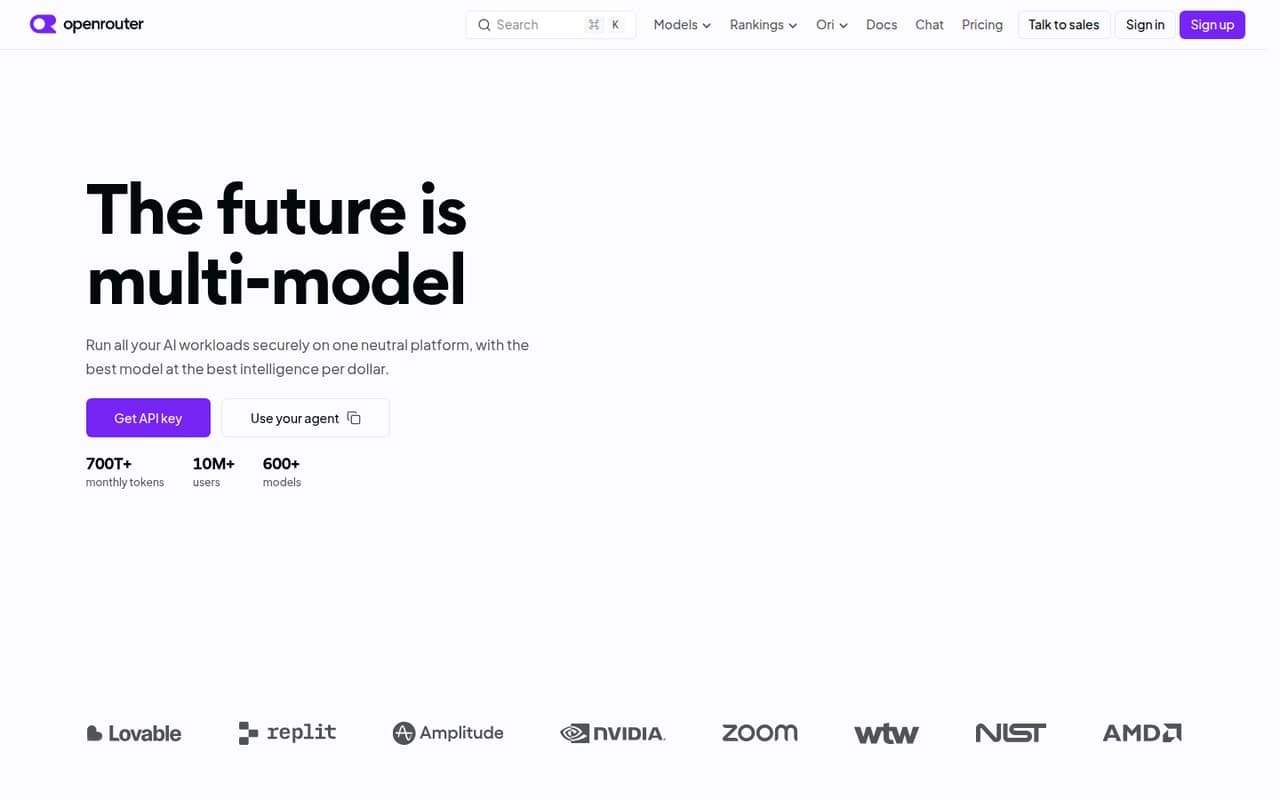
A small team does not need OpenRouter if it relies on one model provider. If you want to compare models or manage several providers through one API, OpenRouter brings 600+ models from 80+ providers into one place, with routing, failover and usage controls.
The free plan is useful for trying the service, but it is capped at 50 requests a day. Paid plans have no listed subscription price: you pay model list prices plus a credit-purchase fee. That makes costs flexible, but not necessarily lower than going direct.
Good fit if
- Teams comparing models from different providers
- Developers building API-based AI features
- Small teams wanting shared usage controls
Skip it if
- Teams using one provider exclusively
- People wanting a fixed monthly AI bill
- Workloads that need guaranteed fastest routing
ScoresHow it rates
What works
- One API connects to 600+ models and 80+ providers
- Free plan includes 25+ models and 50 daily requests
- Automatic routing and default failover
- Bring your own provider keys for extra capacity
- Usage dashboard shows team requests, models and spend
What doesn't
- Paid use adds a fee when buying credits
- Model charges vary with usage
- Free plan stops at 50 requests per day
- Routing between providers may affect caching and performance
- Enterprise private endpoint pricing is not published
01Who OpenRouter is for
OpenRouter fits a developer or a small team of roughly one to ten people that wants to try models from different providers without wiring up a separate API for each one. It offers one API for 600+ models across 80+ providers, with automatic routing, default failover and a dashboard for requests, models and spend.
The best reason to use it is choice, not a promise of savings. A team building an AI feature can compare models or use provider keys to access existing deals and extra capacity. Teams can also set rules for providers, data retention and processing regions. If your team already relies on one provider and its model meets your needs, a separate gateway may add little. One commenter on r/openrouter said the main draw was being able to try different models without being tied to one company.
02OpenRouter free plan and trial
The Free plan costs $0 and includes chat and API access, 25+ free models, four free providers, five workspaces and community support. Its main limit is 50 requests per day, so it works for initial exploration or a small prototype rather than sustained production use. The listed plan includes no paid-model allowance.
There is no separate free-trial period listed. When you need paid models, Standard is pay as you go: the pricing page lists a 5.5% fee on credit purchases, with model list prices charged separately. You do not move into a fixed monthly subscription, but your bill depends on which models you call and how much you use them. Set usage controls before connecting a production workflow so model costs do not surprise the team.
03What a small team pays for OpenRouter
There is no listed per-seat subscription, so one person, a team of three and a team of five do not have separate monthly or annual seat prices. Free costs $0 in subscription fees. Standard and Business are pay as you go, and the pricing page lists no annual subscription price or discount. For paid models, budget for model list prices plus Standard’s 5.5% credit-purchase fee; Business lists an 8% fee.
In practice, a three-person team using paid models does not pay three times a seat price. Its total depends on credit purchases and usage. Standard includes five workspaces and $25,000 per month of BYOK inference without fees; a 5% fee applies above that allowance. Business adds 1,000 workspaces and EU and US in-region routing, with the same BYOK allowance and overage fee. Enterprise is contract-priced. Private endpoints are an add-on, and their price is not published.
04Getting started with OpenRouter
OpenRouter is an API gateway, so expect a developer to handle the initial setup rather than treating it like a no-code team app. The basic decision is which model to call and whether to let OpenRouter route requests or choose a provider. The product also supports bringing your own provider keys, which can help teams use existing deals or add capacity.
A small team can begin with chat or API access on the Free plan. Before a production rollout, decide who manages credits and usage controls, and review the provider, data-retention and processing-region rules your requests need. One r/openrouter discussion described the appeal as avoiding the hassle of managing several API keys and APIs. We would still plan time to check model and provider choices: Reddit users report that providers for the same model can differ in price, uptime and behavior.
05When small teams outgrow OpenRouter
You may outgrow the Free plan once 50 daily requests are not enough or you need paid models. Standard raises the usage ceiling through pay-as-you-go access and offers email support, but it does not turn variable model usage into a fixed monthly bill. If the team needs EU or US in-region routing or more workspaces, Business is the listed step up; it has 1,000 workspaces and an 8% credit-purchase fee.
You may also move away if a direct provider gives your main workload better pricing, caching or performance. In one Reddit thread, a user reported lower costs after switching providers, while commenters questioned whether the comparison controlled for provider routing and caching. Other commenters described added latency and variable provider performance as concerns. Those are user reports, not guaranteed outcomes, but they are reasons to pin a provider and compare your actual workload before standardizing on a route.
From the threadsWhat users say
Reddit sentiment is mixed: users value the broad model selection and one-place credit top-ups, while others flag variable provider performance, caching and costs. Comments also suggest OpenRouter suits exploration better than every production workload.
only have to top up in one place
Second, sometimes when the model has very few providers you may not want to use it if uptime is important
OpenRouter kills all the cache by sending it to different providers
open router is for API
Questions people ask
Is OpenRouter free?
Yes. The Free plan costs $0 and includes 25+ free models, four free providers, five workspaces, chat and API access, and community support. It is limited to 50 requests per day. Paid models are not included as a listed allowance.
Is OpenRouter cheaper than using a provider directly?
Not necessarily. OpenRouter charges model list prices plus a fee on credit purchases for paid plans. Your total depends on the models, providers and usage. A Reddit cost comparison drew comments about routing and caching, so compare the same workload and provider setup before deciding.
Does OpenRouter charge per seat?
The listed plans do not have per-seat subscription prices. Free, Standard and Business include different workspace limits, but paid plans charge by credit purchases and model usage. For a team of several people, the bill depends on usage rather than a listed seat multiplier.
Can OpenRouter route requests automatically?
Yes. OpenRouter says it selects a model and provider for each request using live marketplace data. Failover is on by default, and the homepage says failed requests are not charged. Teams can also choose providers and set provider-related data policies.
Can I use my own provider API keys?
Yes. OpenRouter supports bringing your own provider keys for extra capacity and existing negotiated deals. Standard and Business list $25,000 per month of BYOK inference without fees, then a 5% fee above that allowance.
Sources
- OpenRouter homepage
- OpenRouter pricing page
- Reddit: Made entirely with Opus 5.5 + $3.21 of OpenRouter API usage
- Reddit: Do you use OpenRouter? What are the pros and cons? Is there a good open source replacement?
- Reddit: Moving from OpenRouter to OpenAI cut my AI costs by 80% and made the same workload faster.. HOW???
- Reddit: I spent $100+ in 3 weeks on OpenRouter (vs. $33/month for Claude)