
We may earn a commission if you buy through links on this page. It never changes a score or a ranking. How we make money
The bottom line
Payabli covers payments and payouts, but quote-based pricing leaves small-team costs unclear.
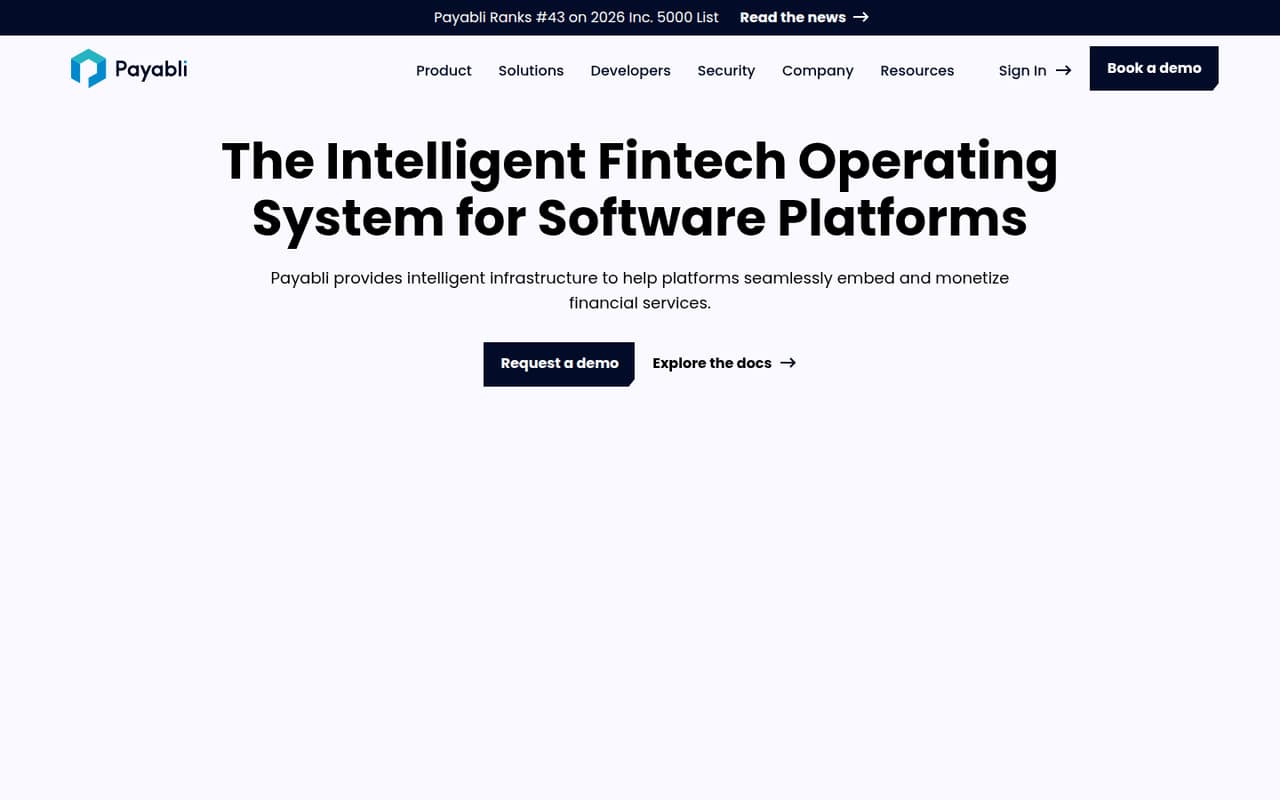
Payabli gives software platforms tools to embed payment acceptance, payouts and payment operations, with APIs and no-code components. It is aimed at companies building payments into their own products, not teams looking for a simple standalone payment app.
There is no public starting price or free plan, and a free trial is not published. Ask Payabli for a quote that spells out costs for your expected volume, features and team.
Good fit if
- Platforms embedding payments in software
- Teams needing acceptance and payouts
- Companies building with payment APIs
Skip it if
- Teams seeking a free payment tool
- Buyers needing published per-seat pricing
- Small businesses wanting a standalone gateway
ScoresHow it rates
What works
- Combines payment acceptance, payouts and operations
- Supports online and in-person payments
- Offers APIs, webhooks and query APIs
- Includes low- and no-code components
- Covers merchant onboarding, risk and reporting
What doesn't
- No public starting price
- Pricing is custom and quote-based
- No free plan
- Free-trial availability is not published
- Seat and add-on costs are not published
01Who Payabli is for
Payabli fits software companies that want payments inside their own product. It combines payment acceptance, payouts and payment operations, so a platform can offer financial workflows without presenting users with a separate payment service. Listed acceptance options include online and in-person payments, wallets, bill pay, lockbox, remote deposit capture, invoicing and pay links. Payout tools include managed payables, on-demand payouts, spend management and vendor portals.
For a team of one to ten, the key question is whether embedded payments are part of the product you sell. A small product or engineering team building that capability may find the APIs, webhooks and no-code components relevant. A small business that only needs to collect its own payments is a different fit: Payabli is described as infrastructure for software platforms, not as a basic standalone checkout app. With custom pricing and no published starting price, budget-conscious teams should get a quote before planning around it.
02Payabli free plan and trial
Payabli does not list a free plan. A free trial is not published, so we would not count on testing the full service at no cost. The pricing information describes Payabli as custom and quote-based, with no public starting price.
That makes a sales quote the cheapest way to find out what access would cost; there is no listed entry-level plan to compare. Ask whether the quote includes the features your platform needs, such as acceptance, payouts, onboarding tools or reporting, and whether any minimums apply. Payabli does not publish those details in the pricing information, so get the terms in writing before budgeting. If you only need to accept payments for your own small business, first check whether a standalone payment provider better matches that job.
03What a small team pays for Payabli
The pricing page lists custom, quote-based pricing, but it does not publish a starting price or per-seat rate. That means we cannot calculate a supported monthly cost for one person, three people or five people, or compare monthly and annual billing. The billing cadence is not published either.
Payabli is payments infrastructure for platforms, so ask for a quote based on your planned product and payment workflows rather than assuming a conventional seat-based subscription. The pricing information does not publish transaction fees, minimums, included volume or pricing by feature. It also does not list add-on prices. Ask whether acceptance, payouts, merchant onboarding, risk tools, reporting and any AI features are included or priced separately. For a small team watching each subscription, request an itemized quote for your expected usage and a scenario showing how the bill changes as activity grows. Until you have that, the cost for a few seats is unknown.
04Getting started with Payabli
Payabli lists direct APIs, webhooks, query APIs, documentation and low- or no-code embeddable components. That gives a platform a choice between building a more tailored integration and using components to add payment functions. The product also covers operational work such as merchant onboarding, pricing and billing, risk and underwriting, and reporting.
Setup still depends on what you plan to embed and how your software is built. Payabli does not publish a typical setup time in the pricing information, so a small team should ask for implementation requirements, technical support options and a project plan before committing. For day one, identify the payment and payout flows your product needs, then confirm which APIs or components cover each one. The listed materials do not name specific third-party integrations, so ask about compatibility with your existing systems rather than assuming a connector is available.
05When small teams outgrow Payabli
Payabli is built to support payment acceptance, payouts and payment operations within a software platform. The product description does not publish seat limits, transaction limits or feature thresholds that would mark a specific upgrade point. Its pricing is custom, so there is no public seat-cost ladder to use for forecasting a larger team.
For a growing company, the first pressure may be budget predictability rather than a published product cap. If you cannot get an itemized quote that explains how costs change with usage, features or additional team members, it may be hard to plan expansion. Before signing, ask what happens as payment volume rises, whether the quote changes when you add workflows, and what support is included. A move to another tool makes sense only if it fits your platform needs and gives clearer costs or terms; the published information does not establish a specific point when Payabli becomes insufficient.
Questions people ask
What does Payabli do?
Payabli provides payment infrastructure for software platforms. It lists payment acceptance, payouts and payment operations, along with APIs and embeddable components. Its features cover workflows such as online and in-person payments, vendor payouts, merchant onboarding, risk and reporting.
Does Payabli have a free plan?
No free plan is listed. A free trial is not published either, so ask Payabli directly whether a trial or evaluation option is available. Pricing is custom and quote-based, with no public starting price.
How much does Payabli cost?
Payabli's pricing is custom and quote-based. The pricing information does not publish a starting price, per-seat rate, monthly or annual billing option, transaction fees, minimums or add-on prices. Request an itemized quote for your planned usage and features.
Can a small team use Payabli without developers?
Payabli lists low- and no-code embeddable components as well as APIs, webhooks and query APIs. The amount of technical work depends on what you are embedding and how your software is built. Ask Payabli about implementation requirements and support for your setup.
What payment workflows does Payabli support?
Payabli lists online and in-person acceptance, wallets, bill pay, lockbox, remote deposit capture, invoicing and pay links. Its payout offerings include managed payables, on-demand payouts, spend management and vendor portals. Confirm which workflows are included in your quote.