
We may earn a commission if you buy through links on this page. It never changes a score or a ranking. How we make money
The bottom line
A capable set of research APIs, with no published Sonar price to budget around.
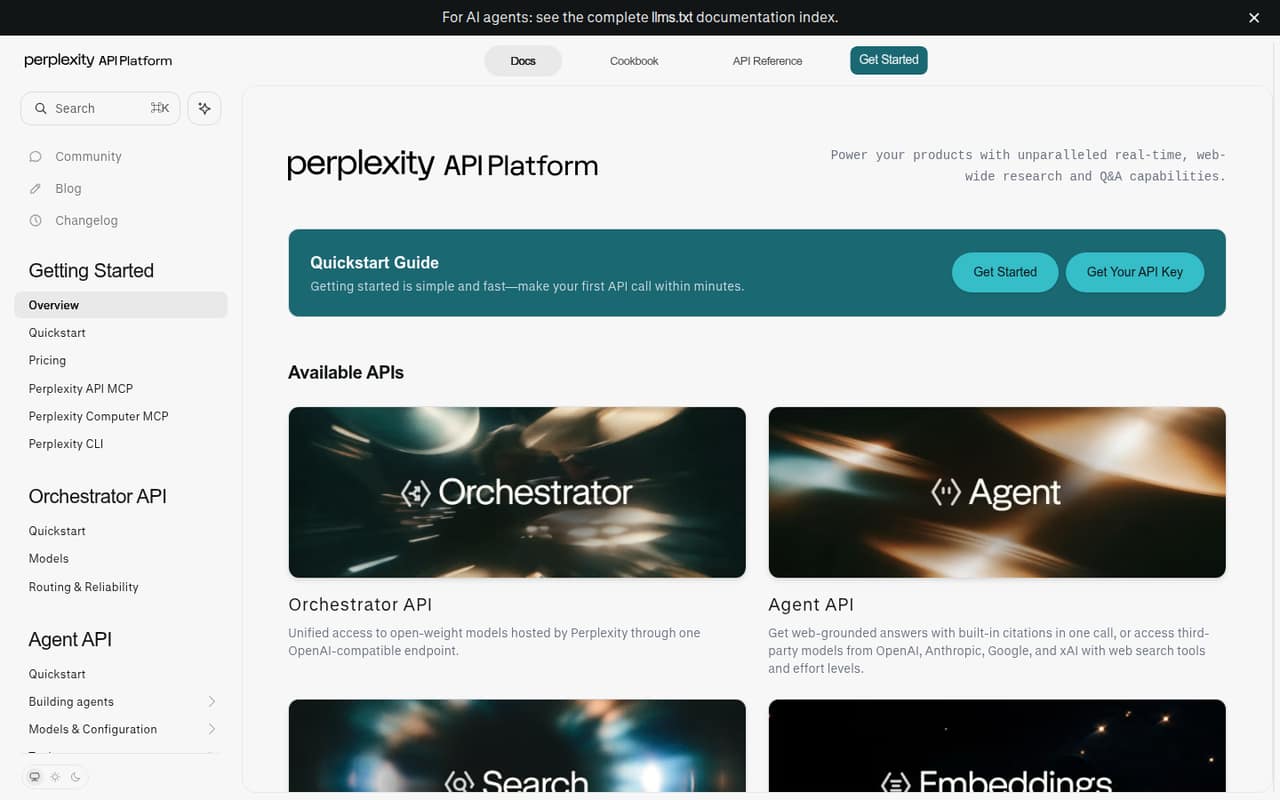
Perplexity's API suite covers cited answers, ranked search results, embeddings, structured decisions, and model access. The product homepage describes several APIs but does not identify Sonar as a separate product, so check which API you need before building around that name.
The pricing page lists no Sonar-specific plan or billing schedule. Agent API model rates vary and are token-based, but the starting price isn't published. That makes it hard for a small team to estimate a monthly bill before choosing an API and expected usage.
Good fit if
- Developers adding web-grounded answers
- Teams building search or RAG features
- Products that need cited results
Skip it if
- Teams needing a ready-made team app
- Buyers requiring predictable seat pricing
- Nontechnical teams without development help
ScoresHow it rates
What works
- Agent API answers include web citations
- Search API returns ranked results and extracted text
- Embeddings support semantic search and RAG
- Structured decisions return typed answers with probabilities
- Orchestrator API offers OpenAI-compatible access
What doesn't
- No Sonar-specific plans or billing schedule are listed
- Agent API model rates vary by token use
- A starting price is not published
- The homepage does not identify Sonar as a separate product
- Per-seat costs for small teams can't be calculated
01Who Perplexity Sonar API is for
Perplexity's API suite is for small product teams that want to add research or question-answering features to their own software, rather than buy a ready-to-use app for a ten-person team. It can return web-grounded answers with citations, supply ranked search results and extracted page text, create embeddings for search or RAG, and produce typed decisions about text and images.
That breadth could suit a startup or a small engineering group building a feature that depends on current web information. The Agent API also provides access to third-party models and web search tools; the Orchestrator API gives OpenAI-compatible access to open-weight models hosted by Perplexity. The main budget catch is that the pricing page lists no Sonar-specific plan or starting price. If you need a firm monthly cap before you build, ask Perplexity for rates that match your chosen API and expected usage. The homepage describes several APIs without presenting Sonar as a separate product, so confirm the product and endpoint names first.
02Perplexity Sonar API free plan and trial
Per the published pricing information, there is no listed Sonar-specific free plan, and Perplexity does not publish a trial offer. That means a small team should not budget on having a free tier for development or launch.
The cheapest way in is to price the API you plan to use. The pricing page says Agent API model rates vary and are token-based, but it does not list a starting rate or a Sonar billing schedule. So we can't give a reliable cost for a prototype, one developer, or a production workload. Before committing, ask Perplexity which API rates apply, how usage is measured, and whether your intended models or tools add costs. Don't treat the lack of a published starting price as evidence that usage is free.
03What a small team pays for Perplexity Sonar API
The pricing page lists no Sonar-specific plans, seat prices, or monthly or annual billing schedule. It says Agent API model rates vary and are token-based. Perplexity does not publish a starting price in the pricing information, so there is no supported dollar figure for one person or for a team of three or five.
These APIs are product components, not a published per-seat subscription. Adding two or four teammates therefore doesn't give us a price to multiply by a seat count. Monthly and annual totals for those team sizes are also not published, and we can't calculate them without the rates and expected usage. The product description includes several APIs—Agent, Search, embeddings, structured decisions, and Orchestrator—but it doesn't list separate add-on prices for them. Ask Perplexity for rates tied to the exact API, models, and tools you expect to use, plus any minimums or billing commitments. Until then, budget estimates are guesswork.
04Getting started with Perplexity Sonar API
This is a developer-facing API suite, so a small team should plan for engineering work to connect it to its product, rather than a quick setup for coworkers in a browser. The right starting point depends on the job: Agent API for web-grounded answers and model access, Search API for ranked results and extracted text, or embeddings for semantic search and RAG.
The Orchestrator API offers OpenAI-compatible access to open-weight models hosted by Perplexity, which may fit a team already building around that interface. But the published product details don't specify setup time, prerequisites, SDKs, or step-by-step integration work, so we can't promise a short learning curve. Before implementation, choose the specific API and confirm its documentation, authentication requirements, rate limits, and billing. The available product description doesn't establish a one-click integration or a ready-made workflow for small teams.
05When small teams outgrow Perplexity Sonar API
The likely breaking point is not a published seat limit: the pricing page doesn't list seats, plans, or usage thresholds for Sonar. Instead, a team may outgrow the fit when it needs a predictable monthly bill, a published rate card for its usage, or a clear way to forecast costs across several APIs. Agent API rates vary and are token-based, while the starting price is not published.
A growing product team may also need capabilities beyond the listed jobs, such as a particular integration, service commitment, or usage limit. The vendor's site does not specify those terms, so ask Perplexity before relying on them at higher volume. If your team needs web-grounded answers, search, embeddings, or structured decisions, the suite covers those categories. If the product name, pricing model, or required terms remain unclear, compare alternatives with explicit usage rates before expanding deployment. There is no published per-seat upgrade path to use as a budget trigger.
Questions people ask
What is Perplexity Sonar API?
Perplexity's API suite provides tools for web-grounded answers with citations, ranked search results, embeddings, structured decisions, and model access. The homepage describes several APIs but does not identify Sonar as a separate product, so confirm which API and endpoint you mean before planning an integration.
Does Perplexity Sonar API have a free plan?
The published pricing information lists no Sonar-specific free plan, and Perplexity does not publish a trial offer. It also does not list a Sonar starting price. Ask Perplexity what rates apply to the API and models you want to use before estimating prototype or production costs.
How much does Perplexity Sonar API cost?
Perplexity does not publish a Sonar-specific plan price or starting price. Its pricing page says Agent API model rates vary and are token-based. There are no published per-seat totals for one, three, or five people, so request a quote or rate details based on your expected API usage.
Which APIs are included in Perplexity's API suite?
The described suite includes Agent API for web-grounded answers and model access, Search API for ranked results and extracted page text, embeddings, structured decisions, and Orchestrator API for OpenAI-compatible access to open-weight models hosted by Perplexity. Confirm which specific API you need for your use case.
Does Perplexity Sonar API return citations?
The Agent API returns web-grounded answers with built-in citations. The Search API instead returns ranked web results as JSON with extracted page text. Choose the API based on whether your product needs cited answers, search results, or another capability such as embeddings or structured decisions.