
We may earn a commission if you buy through links on this page. It never changes a score or a ranking. How we make money
The bottom line
Strong social data coverage, but no public production price or free plan for a small team to budget around.
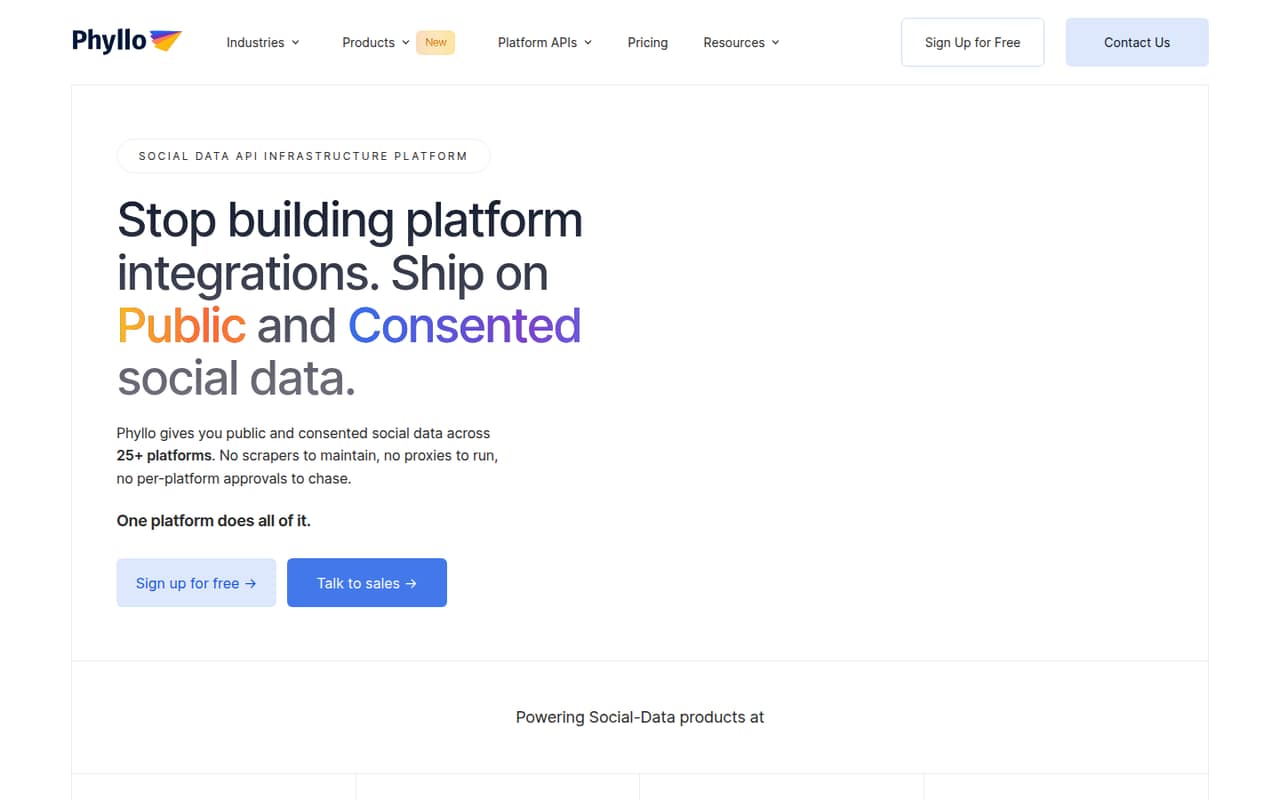
A small team should consider Phyllo if it needs social data inside a product or workflow. Its APIs cover public and creator-approved data across 25+ platforms, with tools for discovery, analytics, listening, screening, and identity checks.
The free sandbox is for API testing and development, not production use. Production plans are quote-based, and the vendor does not publish usage limits or monthly and annual rates. Get a quote before committing engineering time.
Good fit if
- Creator-tool product teams
- Social data API developers
- Teams needing consented creator data
Skip it if
- Teams wanting a free production plan
- Occasional manual social research
- Buyers needing published seat prices
ScoresHow it rates
What works
- Public and consented social data APIs
- Coverage across 25+ platforms
- Creator search across 470M+ profiles
- Free sandbox for API testing and development
- Several creator-data use cases in one offering
What doesn't
- No production free plan listed
- Production pricing requires a custom quote
- Usage limits are not published
- Monthly and annual rates are not published
- Setup time and required integrations are not published
01Who Phyllo is for
Phyllo is for a small product, trust-and-safety, or creator-tools team that needs social data inside its own workflow—not a team looking for a ready-made social dashboard. Its APIs cover public profile data and creator-approved data across 25+ platforms, with use cases including creator discovery, profile analytics, listening, screening, social KYC, and verified income and audience insights. The shared data standard is intended to make outputs consistent across platforms.
For a 1–10-person team, the fit depends on whether those data capabilities are central enough to justify a custom API contract. A lean team building creator search, audience analysis, or identity checks may value one vendor covering several jobs. A team that only needs occasional manual research may be paying for more technical plumbing than it needs. Budget-conscious buyers should treat the free sandbox as development access, not a production budget plan, and request a quote before building around it.
02Phyllo free plan and trial
Phyllo does not list a free production plan. The pricing information lists a free sandbox for API testing and development, but it does not state a free-trial period or a production usage allowance. That makes the sandbox useful for checking an integration path, not for running a live product indefinitely.
The cheapest way in is to ask about the Startup option under Customized Plans. The vendor does not publish a price, usage limits, or a trial length, so get those details in writing before you plan a launch. Ask whether the sandbox has any time or request limits, and what changes when you move to production.
03What a small team pays for Phyllo
Phyllo lists Customized Plans for Startup, Growth, and Enterprise, with pricing by quote. The vendor does not publish a starting price or monthly and annual rates, so we cannot calculate a reliable cost for one person or compare a three-person and five-person team. Per-seat pricing is not published either; the plans may be quoted around usage or another scope rather than headcount.
For a small team, that means the one-, three-, and five-person monthly totals are all quote-only, and there is no annual-versus-monthly comparison to make from public rates. The vendor also does not publish usage limits. No add-ons are listed in the pricing information. Before signing, ask for the production price at your expected usage, what counts toward that usage, whether seats affect the quote, and whether there are separate charges for platforms, environments, or support. Treat those as quote questions, not confirmed fees.
04Getting started with Phyllo
Phyllo is an API product, so a team should expect to involve someone who can evaluate and integrate APIs. The free sandbox is listed for testing and development, which gives a team a place to explore the API before committing to production. The product covers both public data and creator-approved data; consent is part of the latter, so clarify the required creator-permission flow for your use case.
The vendor does not publish a setup-time estimate or a day-one integration checklist in the available product details. The exact work will depend on which APIs and data types your product needs, so ask for implementation guidance and technical requirements during the sales process. For a first project, define the platforms, data fields, consent flow, and production usage you need before estimating engineering effort.
05When small teams outgrow Phyllo
Phyllo does not publish a seat cap or a usage ceiling, so there is no public threshold at which a small team must upgrade. The practical pressure point is likely to be production scope: as your product needs more data or traffic, you will need to confirm how the quote changes. Since pricing is custom and usage limits are unpublished, budget planning can get harder as demand grows.
A growing team should revisit its contract when it expands beyond sandbox testing, adds new use cases, or needs more production usage. Ask whether Startup can cover the expected volume and what would trigger a move to Growth or Enterprise. Also confirm any support and technical requirements before relying on Phyllo for a larger workflow. If your needs remain occasional research rather than product infrastructure, a paid API contract may be more than the job requires.
Questions people ask
Does Phyllo have a free plan?
The pricing information lists a free sandbox for API testing and development, but no free production plan. A sandbox can help a team explore the API, but it is not listed as an option for running a live product. Ask the vendor about any sandbox limits and the cost of moving to production.
What data can Phyllo provide?
Phyllo offers APIs for public social data and creator-approved, consented data across 25+ platforms. Its stated use cases include creator discovery, profile analytics, social listening, screening, social KYC, verified income, and audience insights. The specific fields available will depend on the relevant API and data access.
Does Phyllo provide verified creator income data?
Phyllo describes verified income as part of its consented-data offering. That data requires creator permission, according to the product description. A buyer should confirm which income fields are available for the platforms and creator permissions relevant to their use case.
How much does Phyllo cost?
Phyllo lists Startup, Growth, and Enterprise options under Customized Plans, with pricing by quote. Monthly and annual rates, a starting price, and usage limits are not published. Ask for a quote based on expected production usage and confirm whether team size affects the price.
Can a small team use Phyllo without building an integration?
Phyllo is described as a set of social data APIs, and its free sandbox is for API testing and development. The vendor does not publish a setup-time estimate or a day-one integration checklist in the available product details. Ask what technical work and implementation support your chosen use case requires.