
We may earn a commission if you buy through links on this page. It never changes a score or a ranking. How we make money
The bottom line
A strong fit for AI billing needs; check transaction and payout fees before committing.
A small team may not need Polar unless it sells subscriptions, prepaid credits, or usage-based products. For those businesses, Polar combines event metering, usage billing, cost insights, and merchant-of-record services for payments and sales tax handling in over 100 markets.
The free Starter plan has no monthly charge and lists all features to sell, but its transaction fee is 5% + $0.50. Pro costs $20 a month and lowers that fee. Prices are monthly, not per seat, and annual prices are not published.
Good fit if
- AI teams billing by usage
- Small teams selling credits
- Startups wanting merchant-of-record services
Skip it if
- Teams without billing needs
- Businesses needing published annual pricing
- Teams seeking named integrations upfront
ScoresHow it rates
What works
- Free Starter plan with all features to sell
- Meters calls, tokens, and GPU seconds
- Combines plans, credits, and metered usage
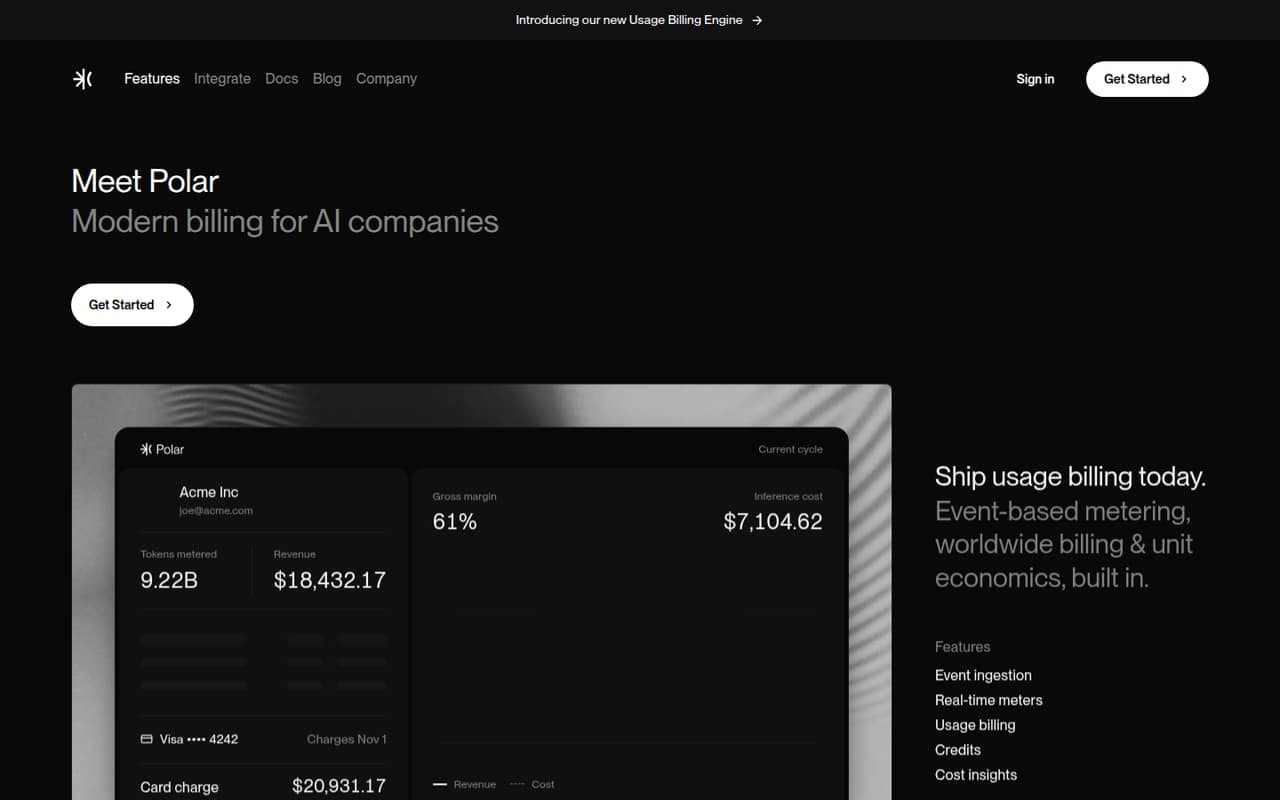
- Shows revenue, inference costs, and gross margin
- Merchant-of-record services cover over 100 markets
What doesn't
- Starter charges 5% + $0.50 per transaction
- International cards add a 1.5% fee
- Payouts add monthly and per-payout charges
- Annual plan prices are not published
- Setup time and named integrations are not published
01Who Polar is for
Polar is for a small product team—perhaps a founder and a few developers—selling software with subscriptions, prepaid credits, or usage-based charges. It supplies billing and payment infrastructure, so the team can record events such as customer calls, tokens, or GPU seconds and bill for usage at the end of a cycle.
It may suit an early-stage AI company that wants to combine a base plan with credits and metered use, or that needs merchant-of-record services for payments and sales tax handling. Polar also lists cost insights for revenue, inference costs, and gross margin by customer. That is more machinery than a team needs for a simple one-time checkout. For a 1–10 person company with these billing needs, Starter offers a way in without a monthly subscription; the tradeoff is its higher transaction fee. The plans are monthly prices, not published per-seat prices.
02Polar free plan and trial
Starter is Polar’s free plan, listed at $0 per month. It includes all features to sell and standard support, so the free tier is not described as a limited-feature preview. The main catch is its transaction fee: 5% + $0.50 per transaction, with no subscription fee listed for Starter. Other charges can still apply, including international-card and payout fees.
Polar does not publish a free-trial period. If Starter’s fee is too high for your sales volume, Pro is the cheapest paid plan at $20 per month. It lowers the transaction fee to 3.8% + $0.40, while retaining a 0% subscription fee. Whether that saves money depends on your transaction volume and size; compare your expected fees before switching. Annual billing prices are not published.
03What a small team pays for Polar
Polar’s listed prices are monthly, and the pricing does not specify a per-seat charge. So one person, a team of three, and a team of five each pay the same plan subscription: Starter is $0 per month, Pro is $20, Growth is $100, and Scale is $400. That is the plan fee, not the total cost of processing payments. Annual prices are not published.
Starter charges 5% + $0.50 per transaction; Pro charges 3.8% + $0.40; Growth charges 3.6% + $0.35; Scale charges 3.4% + $0.30. Each lists a 0% subscription fee. For example, a three-person team on Pro pays $20 monthly before transaction and other fees—not $60. All plans add 1.5% for international cards. Active payouts cost $2 per month, plus 0.25% + $0.25 per payout; cross-border currency conversion adds 0.25% to 1%. Disputes cost $15 each.
04Getting started with Polar
A team using Polar for usage billing will need to decide what counts as a billable event, connect those events to a product or customer, and set how usage is charged. That follows from Polar’s listed event metering and billing capabilities; the vendor does not publish a setup-time estimate here. Allow time to map your product’s usage and check the resulting charges before relying on them for customer invoices.
Polar also lists credits, cost insights, merchant-of-record services, and an MCP server for access to customer, usage, and revenue data, plus product, discount, and refund actions. Those features may broaden the setup work if you plan to use them. Polar does not publish a named integration list or a specific onboarding effort in its pricing details. Before choosing a plan, ask which SDKs or integrations match your stack, what event format you need, and what support is included for your rollout.
05When small teams outgrow Polar
Polar’s published plans do not set out seat limits, so adding teammates does not create a listed per-seat price jump. The more immediate pressure is transaction cost. Starter’s 5% + $0.50 fee is higher than Pro’s 3.8% + $0.40, while Growth and Scale list lower rates alongside monthly plan charges of $100 and $400. Compare the plan fee with your actual transaction mix before upgrading; the lower rate alone does not show which plan costs less overall.
A growing company may also want clearer annual pricing, setup guidance, or a named integration list before standardizing its billing stack. Those details are not published in the pricing information. Scale adds a shared Slack channel, P1 support, and Single Sign-On; Growth and Pro list prioritized support. If the team needs those features, or outgrows what its current plan offers, review the higher tier. Ask Polar about any limits or requirements that matter to your product before moving.
Questions people ask
What does Polar do?
Polar provides billing and payment infrastructure for companies selling subscriptions, credits, or usage-based products. It lists event metering, usage billing, cost insights, and merchant-of-record services, including payment and sales tax handling in over 100 markets.
Is Polar a merchant of record?
Yes. Polar lists merchant-of-record services that handle payments, sales tax, fraud, refunds, and chargebacks in over 100 markets. Check with Polar about the details and eligibility for the markets where your customers are located.
How much does Polar charge per transaction?
Starter lists 5% + $0.50 per transaction, Pro 3.8% + $0.40, Growth 3.6% + $0.35, and Scale 3.4% + $0.30. All plans add 1.5% for international cards. Payout and dispute fees may also apply.
Does Polar bill usage at the end of a cycle?
Polar lists usage billing that adds metered usage to invoices and settles it at the end of each cycle. Its event metering records customer calls, tokens, and GPU seconds as usage happens.
Does Polar have a free plan?
Yes. Starter costs $0 per month and lists all features to sell plus standard support. It still charges 5% + $0.50 per transaction, and other fees can apply. Polar does not publish a free-trial period.