
We may earn a commission if you buy through links on this page. It never changes a score or a ranking. How we make money
The bottom line
PostgreSQL costs nothing to license, but your team still needs to set it up and run it.
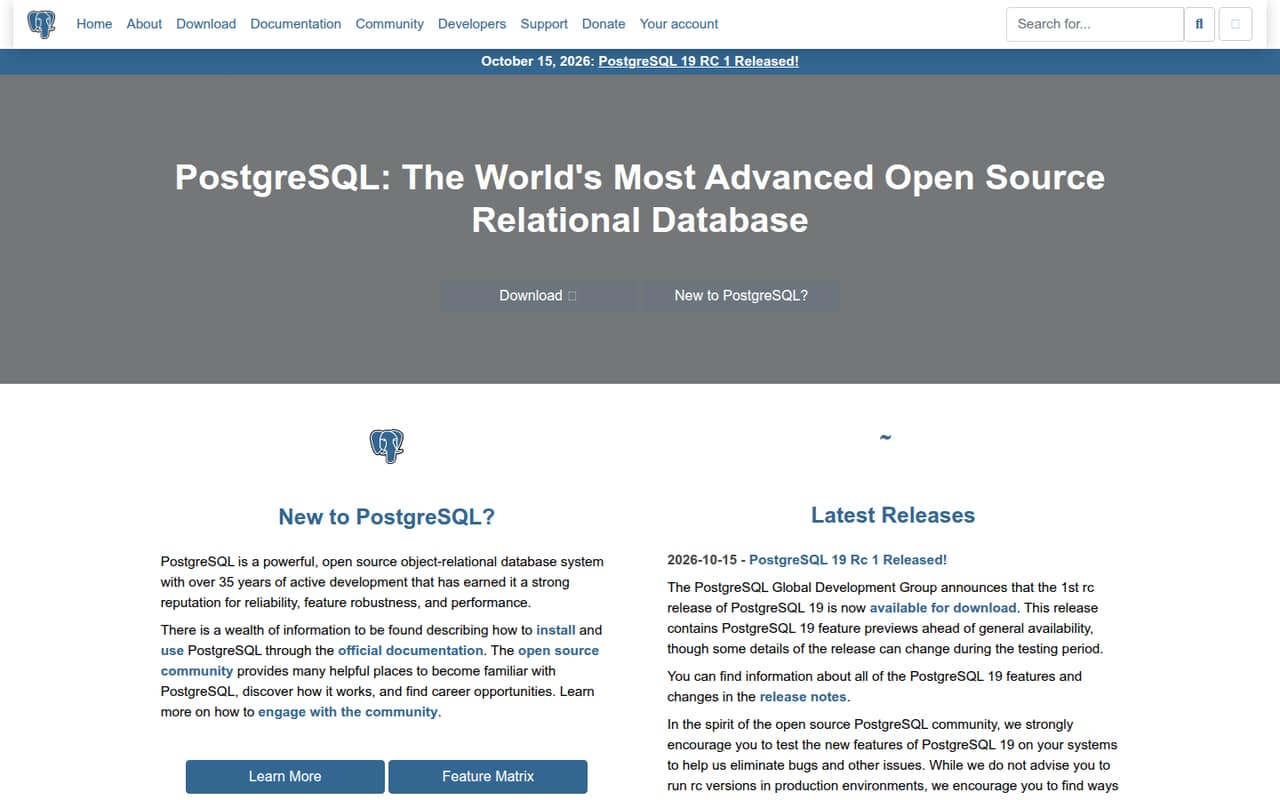
PostgreSQL is an open-source object-relational database with more than 35 years of active development. The pricing page lists it as free for commercial and noncommercial users, with no published seat or usage limits.
For a small team, the price is hard to beat. The trade-off is practical: PostgreSQL is database software, not a ready-made team service, so plan for setup and ongoing operations. Official docs and community resources are available for learning and support.
Good fit if
- Small teams watching software costs
- Teams building database-backed apps
- Developers who can manage setup
Skip it if
- Teams seeking a turnkey database service
- Buyers needing published support pricing
- Teams without database setup capacity
ScoresHow it rates
What works
- Free for commercial and noncommercial users
- No published seat or usage limits
- Open-source with an OSI-approved license
- More than 35 years of active development
- Official documentation and community resources
What doesn't
- No paid plans are listed
- Hosting and operating costs aren't published
- Seat and usage limits aren't published
- Setup effort depends on your team's skills
- No team-specific pricing is listed
01Who PostgreSQL is for
PostgreSQL can suit a one-person project or a small team of up to ten people that needs a database for an application and wants to keep software licensing costs down. In plain terms, it stores and organizes data so an app can save, retrieve, and work with it. The project describes PostgreSQL as an open-source object-relational database system.
It is a good fit when someone on the team can take responsibility for choosing how to install and operate the database. The official site points new users to documentation and community resources for installing, using, and learning PostgreSQL. That gives a small team somewhere to start, but it still means the team needs to make its own setup decisions.
The homepage says PostgreSQL has a reputation for reliability and performance. Those are the project’s claims, not a promise that every setup will meet your needs. If you want a database without taking on setup and operational work, first check whether your chosen provider offers a managed PostgreSQL service and what that service costs.
02PostgreSQL free plan and trial
The listed PostgreSQL plan is open-source software, free for commercial and noncommercial users under the OSI-approved PostgreSQL License. The pricing information lists no paid plans, so there is no paid tier to trial or upgrade from. It also lists no published seat or usage limits.
That makes the license price straightforward for a small team: $0 whether one person or five people use the software. The trade-off is that this is database software, not a priced bundle of setup, hosting, or support. The pricing information does not publish costs for those services, so budget for them separately if your team needs them.
The cheapest way in is the free PostgreSQL software itself. The official site points users to documentation and community resources for installation and learning. Before settling on a deployment, check what operating and support responsibilities your team can handle.
03What a small team pays for PostgreSQL
The pricing page lists PostgreSQL as free of charge for commercial and noncommercial users. At the software-license level, one person costs $0 per month and $0 per year. Three people cost $0 per month and $0 per year; five people cost the same. Those figures are license-cost arithmetic, not quotes for hosting or a managed service.
Monthly and annual billing do not apply because the listed software has no paid plans. The pricing information says there are no published seat or usage limits, so it does not give a per-seat rate or a threshold where a team has to upgrade. It lists no add-ons.
For a real budget, the missing line item is operations: the pricing information does not list hosting, administration, or support charges. Those costs depend on how your team chooses to run PostgreSQL and whether you use outside services. Ask a provider for a full quote if you need a hosted or managed setup; the open-source license price alone does not tell you that total.
04Getting started with PostgreSQL
PostgreSQL’s official site points users to documentation and community resources covering installation, use, and learning. That is a useful starting point, but the sources do not publish a typical setup time or describe a one-click setup path. A team should plan for someone to follow the installation guidance and decide how the database will be operated.
For a small team, the learning curve depends on whether anyone already understands databases and the needs of the app. PostgreSQL is described as an object-relational database system; it is not presented as a complete app-building package. Before launch, make a list of the application, deployment, and access needs your team has, then check the docs for the relevant setup guidance.
The sources do not name specific integrations or a standard day-one integration checklist. A Reddit commenter praised PostgreSQL’s JSON support, but that is one user’s view, not a full compatibility guide. Confirm that your app framework and hosting choice support the PostgreSQL setup you plan to use.
05When small teams outgrow PostgreSQL
There is no published seat or usage ceiling in the listed pricing, and no paid PostgreSQL plan to move up to. So growing from one user to five does not, by itself, create a software-license upgrade bill. The sources also do not publish capacity thresholds or a point at which a team should move to another database.
The more practical trigger is whether your team can keep handling setup and operations as the application grows. The official site points to documentation and community resources, but the pricing information does not list a paid support tier or operating service. If your team needs a managed environment or contracted support, compare providers and ask for those costs directly.
Reddit discussions are mostly favorable but not unanimous. One commenter said PostgreSQL was solid, while another discussion raised cases where MongoDB may suit a specific workload. Those comments are opinions, not a sizing guide. Revisit your choice when your app’s data needs or operating requirements change, rather than assuming team size alone means you have outgrown PostgreSQL.
From the threadsWhat users say
The Reddit threads we read lean positive, with users praising PostgreSQL and describing it as reliable in their work. Some users also note that the right database depends on the project’s goals and requirements.
Working on a backend project and went with PostgreSQL. It's been solid, but I'm always curious what others in the community prefer
Let me introduce you to my friend JSONB
depends on your goals if you like your data to become less coherent after each schema change - nosql have you covered
Hard to say without knowing your use case, but PostGIS - geospatial storage and operations
Questions people ask
Is PostgreSQL free?
Yes. The pricing information lists PostgreSQL as free of charge for commercial and noncommercial users under the OSI-approved PostgreSQL License. It lists no paid plans, and monthly or annual billing does not apply. Hosting, administration, and support costs are not included in that software-license price.
Does PostgreSQL charge per user?
The pricing information lists no published seat or usage limits and no per-seat price. At the software-license level, one person, three people, or five people do not add a license charge. If you use a hosting or managed service, ask that provider whether its own pricing depends on users or usage.
What does the PostgreSQL free plan include?
The listed offering is the PostgreSQL open-source software, free for commercial and noncommercial use under the OSI-approved PostgreSQL License. The pricing information lists no paid tiers or add-ons. It does not give a separate allowance for hosting, setup, administration, or support, so check those needs separately.
Where can I find PostgreSQL installation help?
The official PostgreSQL site points users to documentation and community resources covering installation, use, and learning. The sources do not publish a standard setup time or a single setup path for every team. Start with the official documentation and identify who on your team will handle installation and ongoing operations.
What kind of database is PostgreSQL?
PostgreSQL describes itself as an open-source object-relational database system. Its homepage says it has more than 35 years of active development and a reputation for reliability and performance. Those are the project’s descriptions; check the documentation and your application’s requirements to judge whether it fits your use case.
Sources
- PostgreSQL homepage
- PostgreSQL pricing, compiled via web search from capterra.com, postgresql.org
- Reddit: As of nowadays, is there any reason to use MongoDB over PostgreSQL?
- Reddit: PostgreSQL user here—what database is everyone else using?
- Reddit: What are the reasons *not* to migrate from MySQL to PostgreSQL?
- Reddit: Convince me to choose PostgreSQL over MySQL