
We may earn a commission if you buy through links on this page. It never changes a score or a ranking. How we make money
The bottom line
Useful data tools and a free plan, but unpublished paid prices make the real cost hard to judge.
Private AI is aimed at teams that turn unstructured information into datasets, explore data connections, or buy and sell proprietary data. Its free plan lists file uploads, shared articles and knowledge graphs, and research tools.
The catch for a budget-conscious team is pricing clarity: the vendor doesn’t publish prices for Premium or Enterprise, or explain seat billing. We’d confirm total costs, limits, and setup requirements before relying on it for a team workflow.
Good fit if
- Teams building datasets from unstructured data
- Researchers exploring connected information
- Data owners interested in selling assets
Skip it if
- Teams needing predictable seat costs
- Buyers seeking a standard office AI assistant
- Teams needing published setup instructions
ScoresHow it rates
What works
- Free plan lists file uploads and research tools
- Generates datasets from user-provided unstructured data
- Knowledge graphs visualize connections across data
- Marketplace lets contributors earn from data
- Describes access controls and data deletion
What doesn't
- Premium and Enterprise prices aren't published
- Per-seat costs can't be calculated
- Plan limits aren't stated
- Setup steps and integrations aren't published
- Support details aren't published
01Who Private AI is for
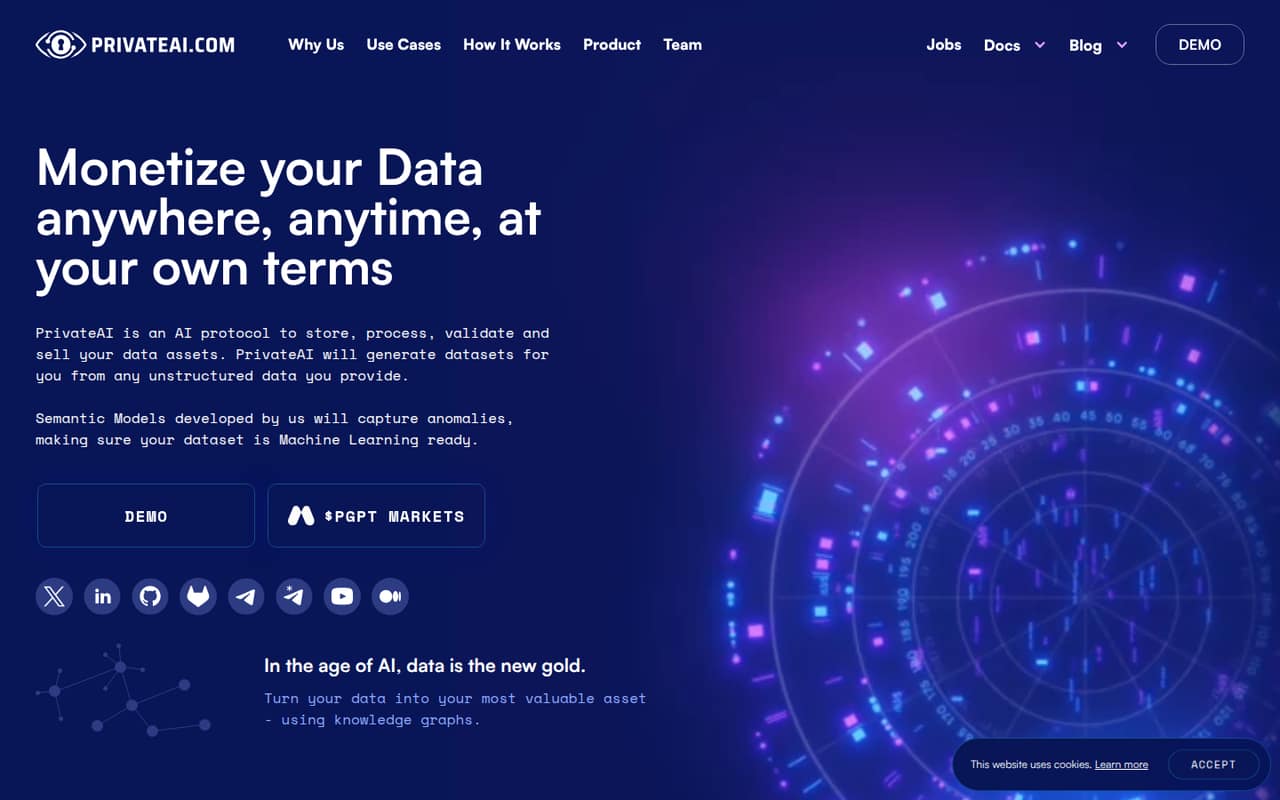
Private AI is for small teams working with information they want to organize, analyze, or offer as a data asset—not teams looking for a general-purpose writing assistant. It describes a process for turning unstructured data into datasets, using semantic models to flag anomalies, and mapping connections in knowledge graphs.
That could suit a research group, a data-focused startup, or a small business with useful proprietary information. The marketplace also gives data contributors a way to earn proceeds, while buyers can find and purchase proprietary data. PGPT is used for platform payments and rewards.
For a team of one to ten watching its software budget, the free plan is a sensible place to assess the fit. But the paid plans’ prices and seat rules aren’t published, so a growing team should confirm costs before building a recurring workflow around the platform.
02Private AI free plan and trial
The listed Free plan is the entry point for individuals or small teams. It includes file uploads, access to shared articles and knowledge graphs, and free research tools. That gives a small team a way to explore the core data and discovery features without a stated subscription charge.
The vendor doesn’t publish the free plan’s usage caps, storage limits, or API allowance, so ask what happens as your data volume or team use grows. The plan list describes Premium as adding higher API rate limits, faster data encryption, instant knowledge graph generation, and exclusive knowledge clusters. It doesn’t state a free trial for paid plans. If you need those Premium features, the vendor doesn’t publish the price.
03What a small team pays for Private AI
The plan list names Free, Premium Subscription, and Enterprise Solutions, but the vendor doesn’t publish monthly or annual prices, billing intervals, or whether paid plans charge per seat. Free is the listed $0 entry point; the cost of Premium or Enterprise is not published.
That means we can’t give a reliable bill for one person or calculate what three or five seats would cost. There’s no defensible monthly-versus-annual comparison without prices and billing terms. Ask the vendor for a written quote covering your team size, usage, and renewal terms before budgeting for a paid plan.
The feature list says Premium offers higher API rate limits and faster encryption. Enterprise lists unlimited API requests, multiple user accounts, dedicated integration support, and early access to real-world data. The pricing notes list no add-ons, but that isn’t a published guarantee that extra charges won’t apply. Confirm any marketplace, payment, or integration fees directly.
04Getting started with Private AI
The vendor describes the main workflow at a high level: provide unstructured data, generate datasets, use semantic models to identify anomalies, and explore relationships through knowledge graphs. The free plan lists file uploads, shared articles, knowledge graphs, and research tools, so a small team can begin by trying those capabilities.
The vendor doesn’t publish setup steps, a learning curve, or a list of integrations in the available plan details. It also doesn’t specify how to connect existing storage or data systems. Before choosing it, ask what file types and integrations are supported, who needs an account, and how long initial configuration usually takes.
Private AI describes access controls, minimal data retention, data management and deletion, and elements of fully homomorphic encryption for privacy-focused model training. Teams handling sensitive information should ask how these controls apply to their particular workflow and plan.
05When small teams outgrow Private AI
A team may need to consider Premium when the Free plan’s unknown usage limits become a constraint, or when it needs the higher API rate limits, faster encryption, instant graph generation, or exclusive knowledge clusters listed for that tier. The vendor doesn’t publish the Free plan’s caps or Premium’s price, so there’s no clear threshold or upgrade cost to plan around.
Enterprise is positioned for businesses and large organizations. Its listed features include unlimited API requests, multiple user accounts, dedicated integration support, and early access to real-world data. Those could matter as more people need access or a project requires integration help, but seat limits and pricing aren’t stated.
If your team depends on predictable per-seat billing, published usage limits, or specific integrations, get those details in writing before scaling up. Without them, it’s difficult to estimate when an upgrade will be necessary—or whether the budget still works.
Questions people ask
Does Private AI have a free plan?
Yes. The listed Free plan includes file uploads, access to shared articles and knowledge graphs, and free research tools. The vendor doesn’t publish its usage or storage limits, so ask what caps apply before putting a regular team workflow on the free tier.
How much does Private AI cost for a team?
The vendor doesn’t publish prices for Premium or Enterprise, and it doesn’t state whether paid plans are priced per seat. The Free plan is the listed no-cost option. Ask for a quote that covers your team size, usage, billing interval, and any additional charges.
What does Private AI do with uploaded data?
Private AI says it turns user-provided unstructured data into datasets and uses semantic models to identify anomalies. It also describes access controls, minimal data retention, and the ability to manage and delete data. Ask the vendor how those controls apply to your data and plan.
Can teams buy or sell data through Private AI?
Private AI describes a data marketplace where users can find and purchase proprietary data, while contributors can earn proceeds. The platform also uses PGPT for payments and rewards. The vendor doesn’t publish marketplace fees or transaction terms in the plan details, so confirm those before buying or listing data.
Does Private AI support privacy-preserving AI?
The vendor says the platform uses elements of fully homomorphic encryption for privacy-preserving AI model training. It also describes minimal data retention and access controls. Ask for technical and contractual details about encryption, data handling, and deletion before using sensitive information.