
We may earn a commission if you buy through links on this page. It never changes a score or a ranking. How we make money
The bottom line
Strong enterprise CMS features; no public price makes a small-team budget hard to plan.
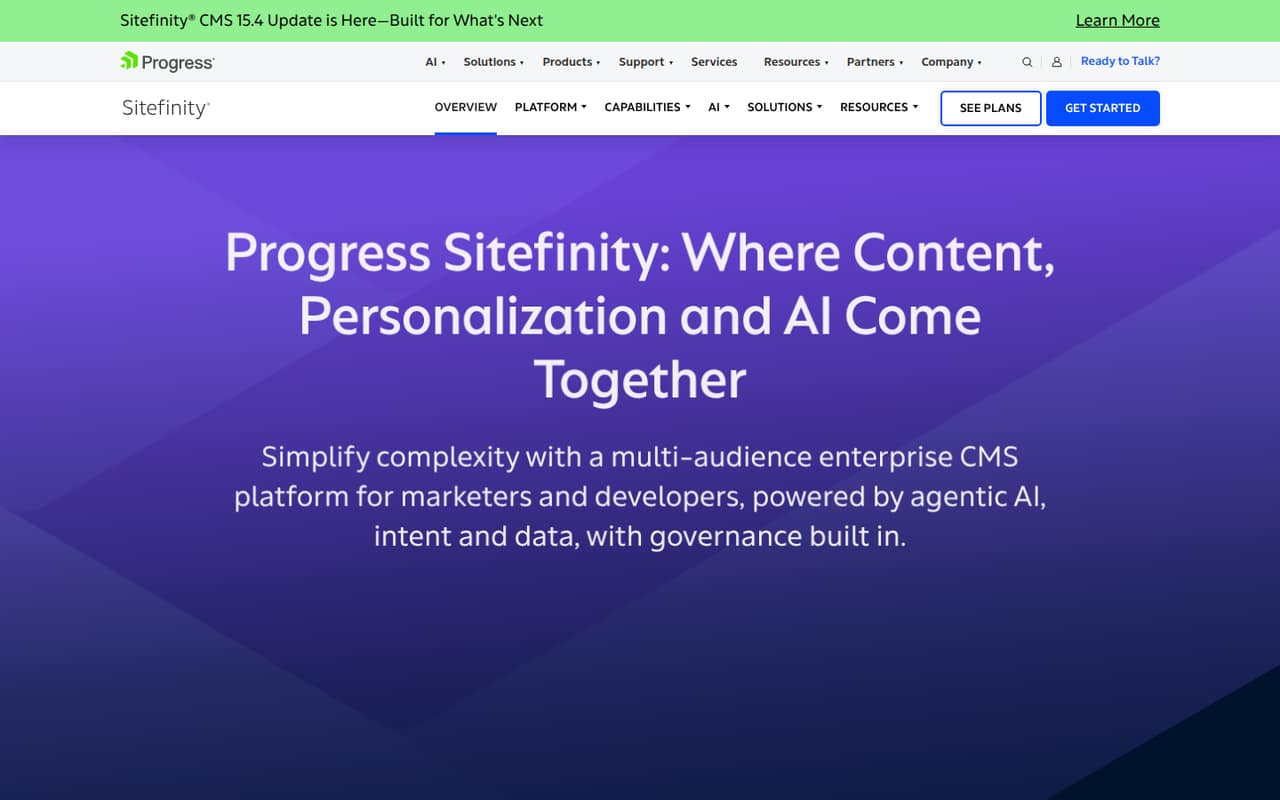
Progress Sitefinity combines structured content, workflows, personalization, customer insights and AI search. It supports headless delivery through ASP.NET Core or Next.js, plus APIs, webhooks and micro apps for connecting other systems.
There’s no free plan, and the vendor doesn’t publish monthly or annual prices. Sitefinity DX lists 10 concurrent backend users; a 30-day CMS trial and a 14-day Cloud trial offer a way to evaluate it before requesting a custom quote.
Good fit if
- Teams with enterprise CMS needs
- Marketing and development teams
- Organizations needing headless delivery
Skip it if
- Teams needing a free CMS
- Buyers requiring public seat prices
- Teams with simple publishing needs
ScoresHow it rates
What works
- Structured content, components and built-in workflows
- Headless options include ASP.NET Core and Next.js
- Sitefinity DX lists 10 concurrent backend users
- Enterprise package includes unlimited languages
- CMS and Cloud trials are available
What doesn't
- No free plan
- Monthly and annual prices aren’t published
- Add-on and overage costs aren’t published
- Personalization is an add-on
- Setup effort and time aren’t published
01Who Progress Sitefinity is for
Sitefinity is for marketing and development teams that need more than a basic website editor: structured content, workflows, personalization, customer insights and delivery across channels. It can suit a small team of one to ten people if those enterprise capabilities are central to the job and the budget can accommodate a custom quote.
The core Sitefinity DX plan lists 10 concurrent backend users, one production domain or server, and unlimited content types. Its Cloud base includes 1 million annual page views, 5 million annual API calls and 50GB of search storage. The Enterprise Package adds unlimited concurrent backend users and languages, plus one Integration Hub connector.
This is a lot of capability for a small team to evaluate and budget. If your main need is straightforward publishing at a known per-seat price, Sitefinity is a harder fit: the vendor doesn’t publish prices, and personalization and several other capabilities are add-ons.
02Progress Sitefinity free plan and trial
Sitefinity has no free plan. The vendor lists a 30-day trial for CMS and a separate 14-day trial for Cloud. Those trial periods let a team evaluate the product, but they aren’t a permanent free tier; the available pricing details don’t specify the trial’s feature or usage limits.
The cheapest listed way in is Sitefinity DX, the core CMS plan. Its listed allowances include 10 concurrent backend users, one production domain or server and unlimited content types. Cloud base allowances are 1 million annual page views, 5 million annual API calls and 50GB of search storage.
Before starting a trial, ask the vendor which capabilities and Cloud allowances are enabled, whether trial data carries over, and what the quoted plan would cost after the trial. The vendor doesn’t publish a starting price.
03What a small team pays for Progress Sitefinity
Sitefinity DX is the core plan, but the vendor doesn’t publish its monthly or annual price. That means we can’t calculate a reliable cost for one person, three people or five, or compare monthly and annual billing. The plan lists 10 concurrent backend users, so it may cover a small team’s listed user allowance, but that isn’t the same as a published per-seat price.
The Enterprise Package has unlimited concurrent backend users, one production domain or server, unlimited content types and languages, unlimited free non-production domains or servers, and one Integration Hub connector. Its price is also custom quoted.
Budget for a vendor quote if you need more production domains or connectors, or add-ons such as personalization, A/B testing, translation management, Ecommerce, Chat Bot, Marketo Integration or Developer Extensions. Prepurchased page-view and consumption add-ons are available, but overage costs aren’t published. Ask for a written quote covering your users, domains, traffic, integrations and required add-ons.
04Getting started with Progress Sitefinity
The vendor doesn’t publish a setup-time estimate, so a small team should ask what implementation and onboarding involve before committing. Sitefinity brings together structured content, components and workflows; teams will need to decide how content is organized and governed, and which channels they plan to serve.
The product supports headless delivery with ASP.NET Core or Next.js, as well as websites, mobile apps and other channels. Those choices give developers flexibility, but they also mean the setup depends on the frontend and delivery approach your team selects. The vendor lists APIs, webhooks and micro apps for extending the CMS.
For day one, settle the production domain or server, content model, user needs and any required integrations. The Enterprise Package includes one Integration Hub connector; additional connectors and Marketo Integration are listed separately. Confirm which integrations are included in your quote and what help is available for configuration.
05When small teams outgrow Progress Sitefinity
Sitefinity DX lists 10 concurrent backend users. If your team needs more, the vendor lists additional backend users in five-user increments or unlimited access as an add-on; the Enterprise Package includes unlimited concurrent backend users. Since neither plan’s price is public, get the cost of the next user tier before your team approaches that limit.
You may also need a different package or add-ons as your publishing needs grow. The Enterprise Package lists unlimited languages and unlimited free non-production domains or servers, while additional production domains or servers are add-ons. Personalization, A/B testing, translation management and extra Integration Hub connectors can add to the quote.
Traffic and consumption can also affect the bill: Cloud base allowances are listed, and prepurchased page-view and consumption add-ons are available. Overage costs aren’t published. Ask the vendor to model expected usage and add-ons in writing. If your team doesn’t need enterprise content governance or multichannel delivery, the custom-quote model may be more complexity and budget uncertainty than you need.
Questions people ask
Does Progress Sitefinity have a free plan?
No. The vendor lists no free plan. It offers a 30-day CMS trial and a 14-day Cloud trial. The available pricing details don’t state the trials’ feature or usage limits, so ask the vendor what you can evaluate and what the paid plan will cost afterward.
How much does Progress Sitefinity cost?
The vendor doesn’t publish monthly or annual prices. Sitefinity DX and Sitefinity DX + Enterprise Package are custom quoted, and add-on and overage costs aren’t published. Request a quote that covers your backend users, production domains, expected usage, integrations and any add-ons you need.
How many users are included with Sitefinity DX?
Sitefinity DX lists 10 concurrent backend users and one production domain or server. The vendor lists additional backend users in five-user increments or unlimited access as an add-on. The Enterprise Package lists unlimited concurrent backend users; ask for pricing for the tier that fits your team.
What are Sitefinity Cloud’s base limits?
The listed Cloud base includes 1 million annual page views, 5 million annual API calls and 50GB of search storage. The vendor also lists prepurchased page-view and consumption add-ons, but overage costs aren’t published. Ask how your projected traffic and API use affect your quote.
Can Progress Sitefinity deliver content headlessly?
Yes. Sitefinity lists headless delivery using ASP.NET Core or Next.js, with content delivery for websites, mobile apps and other channels. Its listed extension options include APIs, webhooks and micro apps. Confirm with the vendor which plan and implementation services cover your intended delivery setup.