
We may earn a commission if you buy through links on this page. It never changes a score or a ranking. How we make money
The bottom line
A useful menu of proxy and scraping options, with a free API tier and usage-based costs.
Rayobyte is worth considering if your small team collects web data and needs proxies, a scraping API, or both. The Scraping API free plan includes 5,000 requests, and paid options charge by successful request or proxy usage rather than by seat.
The trade-off is a busy price list and a $100 monthly starting point for Scale proxy plans. Small teams can start cheaper with pay-as-you-go services, but should estimate request or bandwidth needs before committing.
Good fit if
- Small teams collecting web data
- SEO and market research projects
- Teams needing multiple proxy types
Skip it if
- Teams shopping for per-seat software
- People who need a simple flat fee
- Projects with no proxy or scraping needs
ScoresHow it rates
What works
- Free Scraping API plan includes 5,000 requests
- Residential, ISP, datacenter, and mobile options
- Pay-as-you-go tiers avoid monthly commitments
- Premium residential supports city and ZIP targeting
- Scraping API handles proxies, browsers, and retries
What doesn't
- Scale proxy plans start at $100 per month
- Static datacenter prices vary by country
- Scraping API rates depend on the site
- No annual billing is listed for Scale plans
- Setup time and integrations are not published
01Who Rayobyte is for
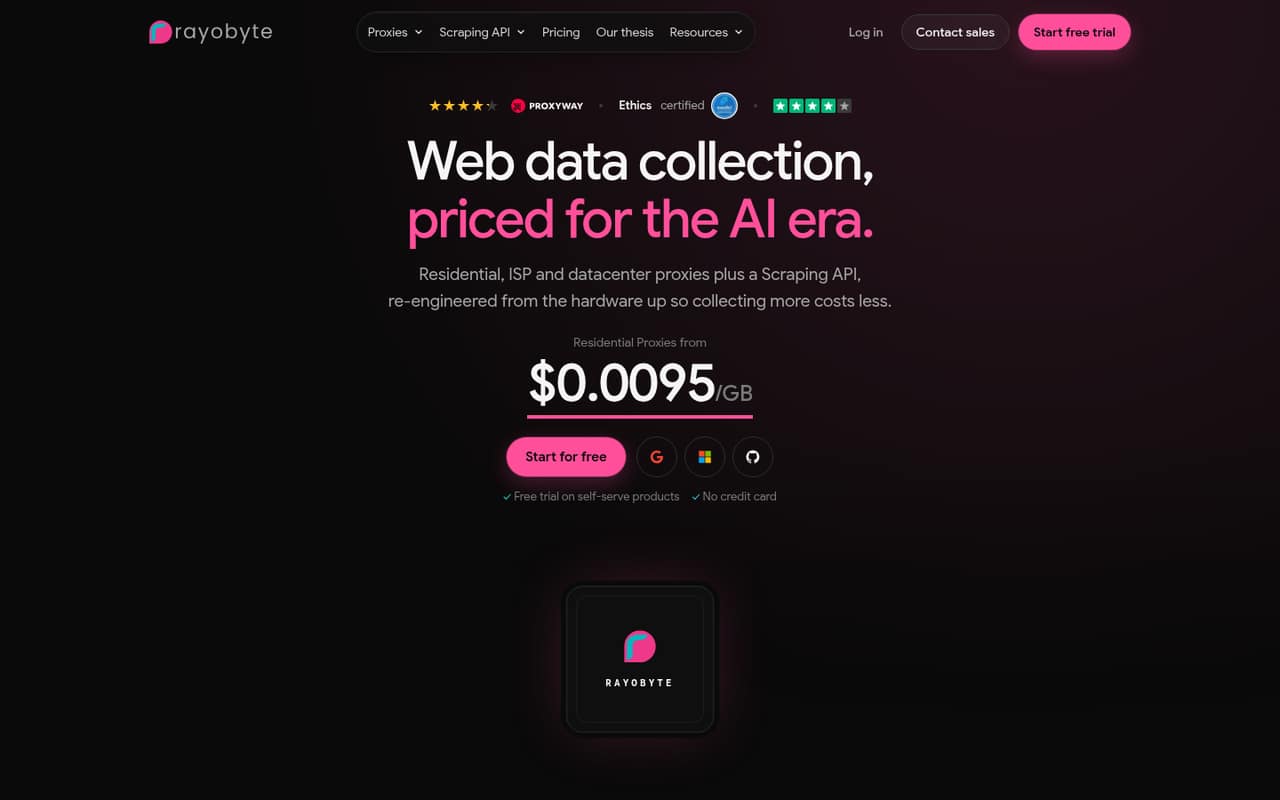
Rayobyte is for small teams that gather information from websites and need a way to access pages at scale. Its products include residential, ISP, and datacenter proxies, plus a Scraping API that takes a URL and returns the page while handling proxies, browsers, and retries.
A team of one to ten could use it for work such as SEO tracking, e-commerce research, market research, or collecting data for AI training. The right budget depends more on request volume and proxy type than on headcount. The Scraping API has a free tier, while its paid self-serve plan charges per successful request. Proxy Scale plans begin at $100 monthly; several pay-as-you-go proxy options are also listed.
This is infrastructure for data collection, not a general-purpose team app. If your team does not need proxies or automated page collection, there is little reason to add it to the budget.
02Rayobyte free plan and trial
The Scraping API free plan includes 5,000 requests and requires no plan. That gives a small team a way to try URL-based page collection before paying. The listed plan information does not specify a separate free trial for paid proxy services.
The free API tier stops being enough once you need more than 5,000 requests. The self-serve paid API rate is $0.0018 per successful request, for up to 500,000 requests per month. Above that, the volume rate is listed as $0.00004 per request at 500,000 or more monthly requests, with the rate depending on the site.
For proxy access, the cheapest listed entry points vary by product: static ISP proxies start at $5 per IP per month, while Scale proxy plans start at $100 monthly. Pay-as-you-go options are priced by gigabyte.
03What a small team pays for Rayobyte
Rayobyte charges by requests, bandwidth, or IPs—not by user seats. So one, three, and five teammates cost the same if they share the same account and usage; the vendor does not list per-seat prices. For a rough dedicated-IP comparison, Static ISP proxies cost $5 per IP monthly for 5–99 IPs: one IP is $5, three are $15, and five are $25. Those are IP costs, not seat fees, and each person does not necessarily need a separate IP.
For the Scraping API, 5,000 requests are free. The self-serve rate is $0.0018 per successful request, so 10,000 paid requests would cost $18; the listed monthly cap is 500,000 requests. Scale residential, rotating ISP, and rotating datacenter plans start at $100 per month. The pricing page lists monthly Scale billing and no annual billing. Static datacenter customers can pay three, six, or 12 months ahead for discounts of 5%, 10%, or 15%. Mobile add-on bandwidth is available, but its price is not listed.
04Getting started with Rayobyte
The Scraping API has a straightforward basic workflow: send a URL, and Rayobyte returns the page while handling proxies, browsers, and retries. That may reduce the number of moving parts a small team needs to manage, but the listed product details do not give a setup-time estimate or name specific integrations.
The pricing material also does not spell out a step-by-step onboarding process, required technical skills, or a learning curve. Teams should confirm those points with Rayobyte before choosing a plan, especially if they need to connect results to an existing data pipeline. Ask whether the API supports your target sites and how its site-dependent rates apply to sample URLs.
For day one, decide which product fits the job—API requests, residential proxies, or static IPs—and estimate expected usage. That matters more than counting seats because costs are based on requests, bandwidth, or IPs.
05When small teams outgrow Rayobyte
The first clear limit is the Scraping API free plan: it includes 5,000 requests. Teams that exceed that move to the $0.0018-per-successful-request self-serve rate, which covers up to 500,000 requests monthly. Higher-volume pricing is listed from 500,000 requests, but the rate depends on the site and sales provides quotes from sample URLs. A team with growing or unpredictable demand should price that workload before it scales.
Proxy costs can also rise with traffic. Scale plans start at $100 monthly, while pay-as-you-go prices vary by product and volume. Static datacenter pricing depends on country, so ask for a quote if the displayed price details do not cover your target location.
Rayobyte's pricing is organized around usage, not seats. That can suit a small team sharing infrastructure, but it makes budgeting less predictable as requests and bandwidth climb. Get a site-specific estimate before committing to larger volumes.
Questions people ask
Does Rayobyte have a free plan?
Yes. The Scraping API Free plan includes 5,000 requests and does not require a plan. The listed free option is for the API; it is not a free proxy plan. The pricing information does not list a separate trial for paid proxy services.
How much does Rayobyte cost for a small team?
There is no listed per-seat price. The Scraping API includes 5,000 free requests, then lists $0.0018 per successful request for up to 500,000 requests monthly. Static ISP proxies start at $5 per IP per month, and Scale proxy plans start at $100 monthly.
What does the Rayobyte Scraping API do?
You send it a URL, and Rayobyte returns the page while handling proxies, browsers, and retries. The free plan includes 5,000 requests. Paid self-serve use is priced per successful request, and volume pricing depends on the site.
Which Rayobyte proxy should I choose?
That depends on your collection needs. Rayobyte lists residential, ISP, datacenter, and mobile proxies. Premium Residential includes country, city, ZIP code, and ASN targeting; static options provide fixed IPs. Check the relevant product pricing and targeting details before buying.
Does Rayobyte charge per user or per usage?
The listed pricing is based on usage, not seats. Scraping API plans charge by successful request, while proxy plans charge by bandwidth, IP, or monthly tier. For a team sharing an account, adding teammates does not change the listed price by itself; usage and product choice determine the bill.