
We may earn a commission if you buy through links on this page. It never changes a score or a ranking. How we make money
The bottom line
A broad application platform, but unclear pricing and setup effort make it a tough budget pick.
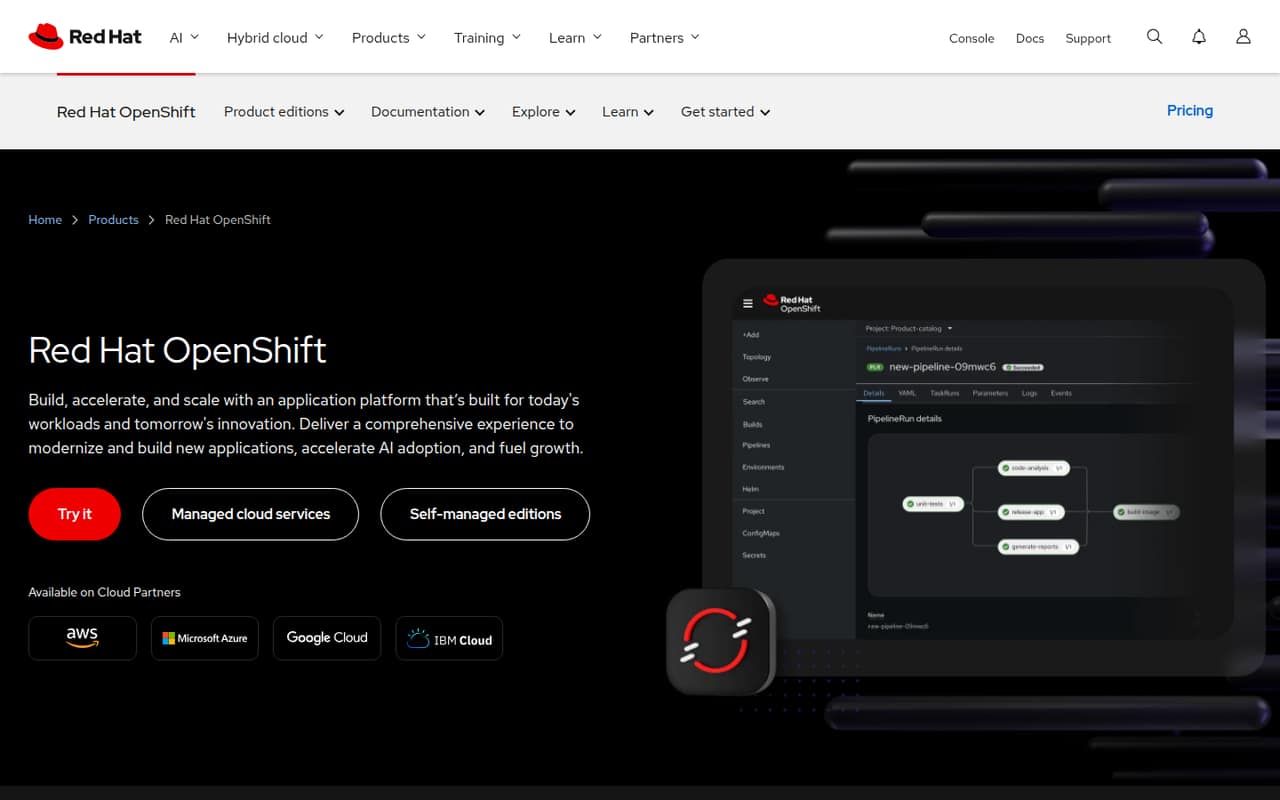
Red Hat OpenShift brings application development, deployment, operations, CI/CD, and GitOps capabilities into one platform. Teams can choose managed cloud services or self-managed editions, including options for Kubernetes applications and virtual machines.
For a small team, the trade-off is cost and effort: there’s no free plan, and the vendor doesn’t publish standard monthly or annual prices for its subscriptions. Reddit users describe a learning curve and meaningful compute needs, so OpenShift makes the most sense when your team already needs its enterprise platform capabilities.
Good fit if
- Teams already running Kubernetes
- Organizations standardizing app operations
- Teams with virtual machine workloads
Skip it if
- Newcomers learning containers
- Teams needing a free platform
- Buyers requiring predictable seat pricing
ScoresHow it rates
What works
- Managed editions available on major cloud platforms
- Self-managed editions support varied infrastructure
- Container Platform includes developer and operations tools
- CI/CD and GitOps are listed use cases
- Dedicated virtualization edition targets VM workloads
What doesn't
- No free plan is listed
- Subscription prices vary and aren’t published
- Cloud infrastructure charges may be separate
- Users describe a steep learning curve
- Reddit users report significant compute needs
01Who Red Hat OpenShift is for
OpenShift is an application platform for building, modernizing, and deploying applications. It fits teams that need a shared platform for development and operations, rather than a lightweight place to host a small app. The Container Platform edition includes developer and operations services and tools; the homepage also lists CI/CD and GitOps among its use cases.
For a team of 1–10, the seat count matters less than the infrastructure and expertise you already have. OpenShift could suit a small engineering group inside a larger organization that needs enterprise Kubernetes, managed cloud options, or virtual machine workloads. It is harder to justify if your team has a tight software budget, little Kubernetes experience, or only a basic deployment need. Subscription costs vary, and the vendor doesn’t publish standard monthly or annual prices, so budget approval may take a vendor conversation. Think of it as a platform decision, not a cheap per-user tool.
02Red Hat OpenShift free plan and trial
Red Hat OpenShift has no free plan listed. The pricing information lists an 8-hour Red Hat OpenShift Service on AWS (ROSA) hands-on experience, which is a short way to explore the managed service, not an ongoing free tier for a team’s production work.
A Reddit commenter says Red Hat offers a 30-day trial cluster, but that is user-reported and differs from the listed 8-hour experience. Confirm current trial terms with Red Hat before planning a project around one. For a longer evaluation, ask the vendor which trial or subscription fits your intended edition and cloud. The cheapest ongoing option isn’t clear from published prices: self-managed subscription prices vary, and managed cloud services are billed through their cloud provider or by Red Hat, depending on the edition.
03What a small team pays for Red Hat OpenShift
There is no published per-seat price to multiply for one person, three people, or five. OpenShift subscriptions are listed as pricing varies, while managed services use different billing arrangements: AWS and Azure bill pay-as-you-go through their platforms, IBM Cloud bills for its edition, and Red Hat bills OpenShift Dedicated separately from Google Cloud infrastructure. Ask for a quote based on your edition, cluster sizing, and cloud usage; the vendor doesn’t publish a standard monthly-versus-annual comparison.
The pricing information lists reserved cloud instances starting at $0.076 per hour on a three-year contract. That is not a universal OpenShift starting price or a per-user rate, and it doesn’t give a total for a cluster or a small team. Container Platform includes Kubernetes Engine, developer console, Serverless, Service Mesh, Pipelines, and GitOps. Platform Plus adds Advanced Cluster Management, Advanced Cluster Security, OpenShift Data Foundation Essentials, and Red Hat Quay. These are editions, not published per-seat add-on prices. Get a quote that separates the subscription from infrastructure and any required services.
04Getting started with Red Hat OpenShift
Plan for a real learning curve, especially if nobody on the team already knows Kubernetes. In a Reddit thread, a commenter says OpenShift Local is heavy and needs significant compute, while another says newcomers may find its security and SELinux configuration frustrating. Those are user reports, not a guarantee of what every setup will involve.
Your first choice is whether to use a managed service or run OpenShift on your own infrastructure. Managed options are available on AWS, Azure, Google Cloud, and IBM Cloud; self-managed editions can run on your infrastructure, in the cloud, on a computer, or in a datacenter. The Container Platform includes Pipelines and GitOps, but the published information doesn’t spell out a day-one integration checklist or setup time. Before committing, confirm the supported configuration, cluster sizing, security requirements, and the people who will maintain it. The 8-hour ROSA hands-on experience offers a short evaluation path.
05When small teams outgrow Red Hat OpenShift
OpenShift isn’t a simple tool that a small team outgrows by adding a few seats. The bigger pressure points are likely to be operational complexity, infrastructure needs, and a price that depends on the chosen edition and sizing. If your team only needs basic container deployment, the platform’s broader developer and operations tooling may be more than you need. If your team grows into more clusters, security, or virtualization requirements, compare editions and get a quote before changing plans; standard upgrade costs aren’t published.
Reddit users report that OpenShift Local can require significant compute, and one commenter warns that its security configuration can frustrate people new to containers. A separate virtualization discussion describes hands-on challenges because the platform is primarily designed for Kubernetes use cases. These are individual reports, not universal limits, but they are good reasons to test your actual workload. Ask Red Hat how subscription and infrastructure costs change with your planned sizing, and whether a managed service or a focused edition better fits the team.
From the threadsWhat users say
Reddit sentiment is mixed: users share learning resources and praise labs, while others flag a steep learning curve, resource demands, and virtualization challenges. These comments reflect individual experiences, not a broad satisfaction measure.
it’s heavy and requires significant amount of compute ( storage, memory and cpu )
OpenShift will be likely be very frustrating
The labs are really well designed and give you a strong hands-on foundation
I found a lot of "challenges" due to the obvious fact that OpenShift is primarily designed and developed for K8s use case
Questions people ask
Does Red Hat OpenShift have a free plan?
No free plan is listed. The pricing information lists an 8-hour Red Hat OpenShift Service on AWS hands-on experience. A Reddit commenter mentions a 30-day trial cluster, but that is a user report; confirm current availability and terms with Red Hat.
How much does Red Hat OpenShift cost for a small team?
The vendor doesn’t publish standard monthly or annual subscription prices, and the listed plans aren’t priced per seat. Managed editions have different billing arrangements, and infrastructure charges may be separate. Ask Red Hat and the relevant cloud provider for a quote based on your edition and sizing.
Can a small team run OpenShift on its own infrastructure?
Yes. The vendor's site says self-managed editions can run on your own infrastructure, in the cloud, on a computer, or in a datacenter. Subscription pricing varies, so ask the vendor to quote your intended deployment and sizing.
Does OpenShift support virtual machines?
Yes. Red Hat OpenShift Virtualization Engine focuses on virtual machine workloads, and Kubernetes Engine includes Virtualization Engine. The listed plans don’t publish prices, so ask Red Hat which edition fits your workload and how it will be billed.
Is OpenShift suitable for teams new to Kubernetes?
It can be learned, but Reddit commenters describe a separate learning curve around OpenShift’s security and SELinux configuration, as well as meaningful compute needs for OpenShift Local. If your team is new to containers, plan time for learning and confirm the system requirements before starting.