
We may earn a commission if you buy through links on this page. It never changes a score or a ranking. How we make money
The bottom line
A strong free starting point for rental books; pay for Professional when you want automation.
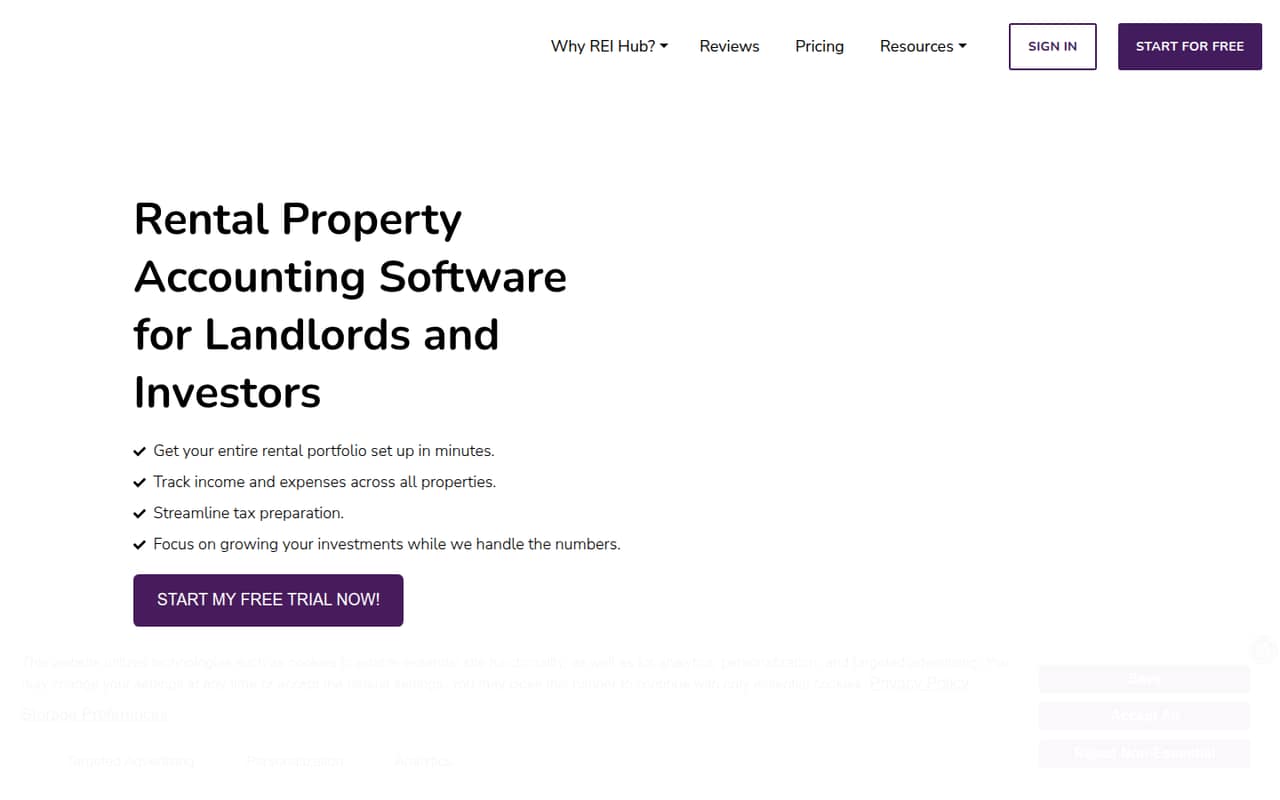
REI Hub handles rental-property income and expenses, bank connections, payout imports, and tax reporting, including Schedule E. The free plan lists tracking and tax reports for up to 3, 10, 20, or unlimited units, depending on the tier you choose.
We’d start here if rental bookkeeping is the main job and you want to keep software costs down. Professional adds automatic transaction imports and booking rules, with pricing based on unit count rather than published per-seat rates.
Good fit if
- Landlords tracking rental finances
- Investors filing Schedule E
- Small portfolios on a budget
Skip it if
- Teams needing broad property management
- Businesses requiring published seat pricing
- Owners wanting documented setup steps
ScoresHow it rates
What works
- Free plans cover up to unlimited units
- Schedule E and tax reports are included
- Tracks income and expenses by property
- Imports Airbnb and VRBO payout statements
- Professional adds transaction imports and rules
What doesn't
- Automatic imports require a paid plan
- Seat limits and seat prices aren't published
- Setup time and learning curve aren't published
- Support options and response times aren't published
- Property-management functions aren't the main focus
01Who REI Hub is for
REI Hub fits a solo landlord or a small team that needs to keep rental books organized without adding a costly accounting subscription. It tracks income and expenses by property or across a portfolio, and offers property-level or portfolio-wide financial reports. For tax time, it produces Schedule E reports and other rental-property tax documentation.
It covers short-term rentals, long-term rentals, and mixed portfolios. Bank connections can include rental, mortgage, loan, and credit card accounts; payout imports cover Airbnb and VRBO statements. The free plan can work for a budget-conscious owner with minimal transactions, while Professional is aimed at investors who want automatic transaction imports and booking rules. Pricing is based on unit tiers, not published staff-seat tiers, so a team of 1–10 should confirm user access details with the vendor before choosing. If you mainly need accounting for rentals, it has a clear fit; if you need a broader resident and property-management system, check whether those jobs are covered before committing.
02REI Hub free plan and trial
The pricing page lists four free options: up to 3 units, up to 10 units, up to 20 units, or unlimited units. Each includes revenue and expense tracking, real-estate-specific categorization, loan and fixed-asset tracking, and Schedule E and tax reports. That makes the free plan a useful starting point for landlords who can categorize transactions without automation.
The listed free plans do not include Professional’s automatic transaction import or automatic booking rules. The pricing page also lists a 14-day free trial, but doesn’t publish which plan it applies to or what happens when it ends. Ask the vendor to confirm those terms if you want to try Professional. For basic tracking and tax reports, there’s no paid-plan charge to get started.
03What a small team pays for REI Hub
REI Hub prices by unit count, not by published per-seat rates. For up to 3 units, Professional lists at $15 per month with monthly billing or $9 per month when billed annually. That is the same subscription price whether one person manages the books or a team of three or five; seats, access limits, and separate user charges aren’t published. As a simple division—not a quoted seat rate—that works out to $15 or $9 per person for one user, $5 or $3 per person for three, and $3 or $1.80 per person for five.
For portfolios of 4–10 units, Professional lists at $25 monthly or $15 per month billed annually. The 20-unit tier is $45 monthly or $27 annually per month, and unlimited units cost $80 monthly or $48 annually per month. The annual prices are shown per month. The pricing page lists no add-ons. Choose the smallest unit tier that fits your portfolio, and confirm seat access before budgeting for multiple staff.
04Getting started with REI Hub
A practical first step is to organize properties and connect the accounts used for rental income and spending. REI Hub’s listed bank integration covers rental bank, mortgage, loan, and credit card accounts. If you take short-term rental bookings, payout imports can bring in Airbnb and VRBO statements for property-level financial breakdowns.
The product also lists transaction rules that categorize matching activity and payment templates, while Professional adds automatic imports and booking rules. Those features can reduce repeated categorization work after the books are organized, but the vendor doesn’t publish a setup-time estimate or detailed learning-curve information. We’d plan to review imported transactions and set rules as part of rollout, rather than assume everything will categorize correctly without oversight. One Reddit poster praised REI Hub’s simplicity for pulling bank transactions and categorizing them. The vendor doesn’t publish specific setup requirements in the pricing details, so ask about account connections and migration needs before switching.
05When small teams outgrow REI Hub
The first reason to upgrade is workload, not headcount: the free plan lists tracking and reports, while Professional adds automatic transaction import and booking rules. The paid price rises with the unit tier, from $9 per month billed annually for up to 3 units to $48 per month for unlimited units. Those prices are per month on annual billing; monthly billing costs more. If multiple staff need access, confirm seat limits and any access charges, since the pricing page doesn’t publish them.
A team may also need a broader tool if it wants resident or property-management functions alongside accounting. In one Reddit thread, an investor asked whether AppFolio could replace REI Hub; a commenter said yes if running accounting and property/resident management out of AppFolio. Another commenter said they chose DoorLoop. That’s anecdotal, not a feature comparison, but it shows that growing teams may weigh an all-in-one system against keeping accounting separate. Check your required workflows before moving.
From the threadsWhat users say
The Reddit discussion includes praise for REI Hub’s simplicity and transaction categorization, but also questions about whether a broader platform can replace it. The evidence is limited and mixed, with commenters mentioning other tools without a detailed comparison.
I enjoy REI HUB's simplicity to grab transactions from bank accounts and categorize them
I wanted to know if Appfolio replaces REI HUB fully or not
We ended up going with DoorLoop
Like, as in run both the accounting and property/resident management out of AppFolio? If so, the answer is yes
Questions people ask
What does REI Hub do?
REI Hub is rental-property accounting software for short-term rentals, long-term rentals, and mixed portfolios. It tracks income and expenses by property, connects rental-related bank and credit accounts, and provides financial and tax reports. Its listed tax features include Schedule E reporting.
Does REI Hub have a free plan?
Yes. The pricing page lists free tiers for up to 3, 10, or 20 units, plus an unlimited-units option. They include income and expense tracking, real-estate-specific categorization, loan and fixed-asset tracking, and Schedule E and tax reports. Automatic imports and booking rules are listed with Professional.
How much does REI Hub Professional cost?
Professional starts at $15 per month for up to 3 units with monthly billing, or $9 per month when billed annually. Higher unit tiers cost more: up to 10 units is $25 monthly or $15 per month billed annually. Prices are based on units, and published per-seat rates aren’t listed.
Can REI Hub import Airbnb or VRBO payouts?
Yes. REI Hub lists payout imports for Airbnb and VRBO statements, which provide property-level financial breakdowns. The product also lists bank integrations for rental, mortgage, loan, and credit card accounts. Confirm the specific accounts and import details you need with the vendor before relying on them.
How do you reconcile in REI Hub?
REI Hub lists bank integrations and transaction imports, but the vendor doesn’t publish detailed reconciliation steps in the pricing information. It’s worth asking whether your bank and account types are supported, how imported transactions are matched, and what review or correction steps are available before you move your books.