
We may earn a commission if you buy through links on this page. It never changes a score or a ranking. How we make money
The bottom line
Worth exploring for an AI-built MVP; check credit use before making it a team subscription.
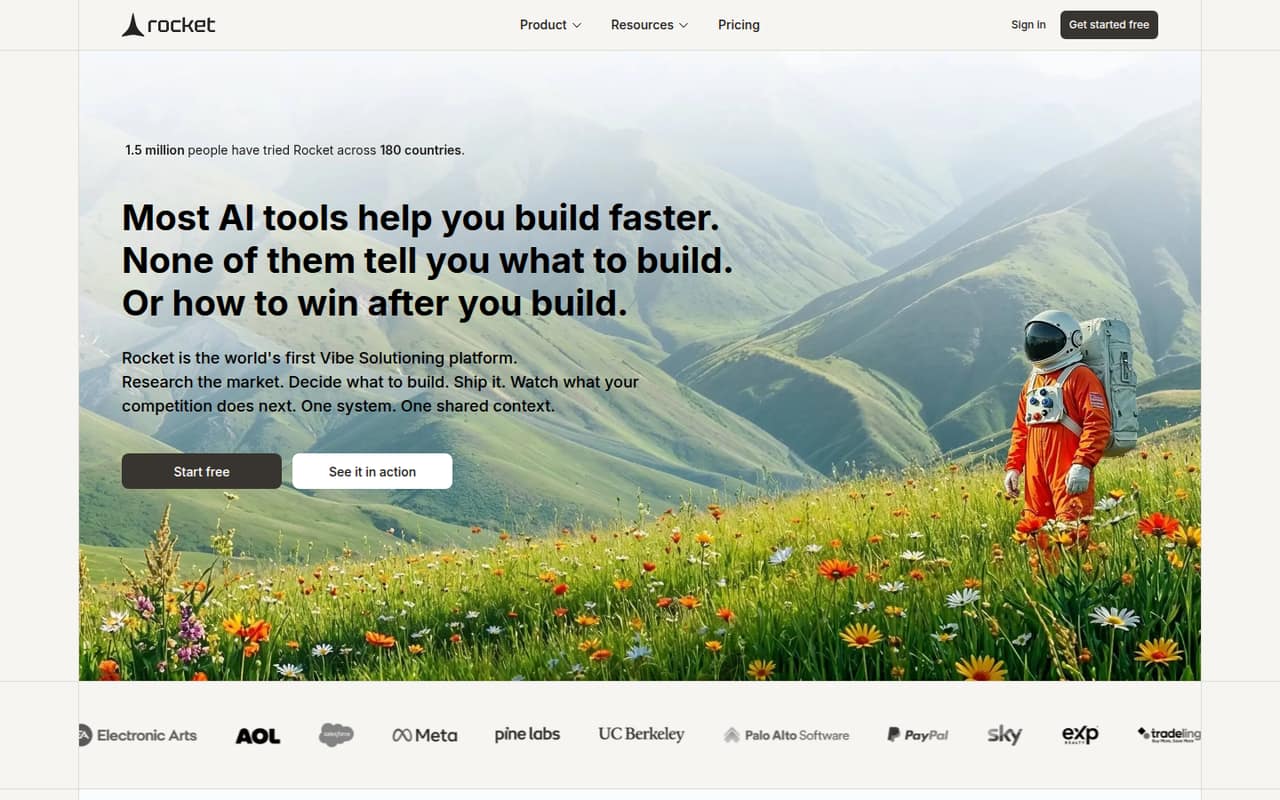
Rocket.new combines market research, AI-assisted app building and competitor monitoring, with shared project context intended to carry decisions between them. For a small team, that breadth is appealing if you’re shaping an idea and building a first version in one place.
The free plan includes 20 one-time credits and unlimited team members, so it’s a low-cost way to assess the workflow. Pro starts at $25 monthly, or $20 per month with annual billing. Reddit reports range from a quick start to frustration with credit use and output quality, so we’d validate it on a small project before paying.
Good fit if
- Small teams shaping an MVP
- Founders exploring app ideas
- Teams tracking competitors too
Skip it if
- Teams needing predictable usage costs
- Production-critical apps without review
- Buyers requiring published support terms
ScoresHow it rates
What works
- Free plan includes 20 one-time credits
- Unlimited team members on listed plans
- Research, building and monitoring share context
- Builds web and mobile apps from prompts
- Staging and production have one-click deployment
What doesn't
- Free credits are limited to 20
- Additional credit prices are not published
- Credit needs may vary by project
- Reddit reports include poor build experiences
- Some business add-ons require a sales conversation
01Who Rocket.new is for
Rocket.new is aimed at people who want to research an idea, make an app and keep an eye on competitors in one platform. That can suit a founder or a small team of one to ten people building an MVP, landing page, internal tool or dashboard. Its plans list unlimited team members, so the subscription price doesn’t rise just because you invite a few coworkers.
The main budget question is credits, not seats. The Free plan gives you 20 one-time credits; Pro costs $25 per month, or $20 per month with annual billing, and includes 100 monthly credits. Rocket also includes market research and competitor monitoring in the broader platform description, alongside app building. That combination may be useful if the same team is deciding what to build and then making a first version. If you only need a basic site or have a fixed production workflow, the wider toolkit may be more than you need.
02Rocket.new free plan and trial
The Free plan costs $0 and includes 20 one-time credits, unlimited team members and the ability to build websites, landing pages, web apps and mobile apps. The pricing page says those credits never expire. That makes it a reasonable place for a solo founder or small team to explore the workflow without starting a subscription.
The catch is the small credit allowance: it is not a recurring monthly allocation. Once those credits are used, the next listed option is Pro at $25 per month, or $20 per month with annual billing. Pro includes 100 monthly credits, and unused credits carry forward while you remain subscribed. The pricing page does not list a free trial period, and it does not publish the price for buying additional credits. We’d use the free allowance to check whether Rocket fits your project before budgeting for ongoing work.
03What a small team pays for Rocket.new
Rocket.new lists Pro at $25 per month, or $20 per month with annual billing. Because Pro includes unlimited team members, one person, a team of three and a team of five all pay the same listed subscription price: $25 monthly or $20 per month on annual billing. Those figures are for the whole plan, not per seat. The same applies to the higher tiers: Rocket is $50 monthly or $40 per month with annual billing, and Booster is $250 monthly or $200 per month with annual billing.
For regular app and site building, Pro is the cheapest paid plan, with 100 monthly credits. Rocket offers 250 monthly credits, while Booster offers 1,500. The pricing page says unused credits carry forward while subscribed on these paid tiers. Additional credits are available to buy, but their price is not published. SSO, data localization, premium support and onboarding assistance are sales-led, with pricing not published. The listed plans can be canceled anytime, per the pricing note.
04Getting started with Rocket.new
Rocket.new’s described workflow starts with a prompt or project context and can produce web apps, mobile apps, landing pages, SaaS, internal tools and dashboards. The platform also describes market research and recommendations that can inform what to build, plus shared context across its research, building and intelligence work. Templates and connections to internal systems, APIs and third-party tools are listed as starting points.
A Reddit poster describes preparing a detailed product requirements document, then using Rocket to analyze it and create a to-do list of screens. That suggests a team can begin with a clear brief rather than configuring a long technical setup, but it is one user’s account, not a guarantee of the same experience. The poster also says free credits went quickly on a project with more than five screens. The vendor’s listed plans don’t specify a learning curve or setup time. Teams should confirm which connectors they need and test a representative task before committing.
05When small teams outgrow Rocket.new
The first constraint to watch is credits. Free includes 20 one-time credits; Pro includes 100 monthly, Rocket 250 and Booster 1,500. If a project regularly needs more than its plan allowance, Rocket says additional credits are available, but the price is not published. That makes it harder to forecast the cost of a busy build cycle. Unlimited team members mean adding seats alone does not force an upgrade; heavier usage may.
The other trigger is how much trust your team can place in AI-generated work without developer review. In one Reddit thread, a commenter advised treating an app as an MVP and having a developer build a scalable first version. Other Reddit users report problems with unfinished outputs, wasted credits and customer service, while one poster described getting a working start quickly. These are individual experiences, not a reliable measure of every project. If your app has demanding backend, security or maintenance needs, get a developer to review the output and ask Rocket about support and business requirements before relying on it.
From the threadsWhat users say
Reddit feedback is sharply mixed: some users describe a quick start, while others report wasted credits, poor results or frustrating support. The posts are anecdotal, so we’d treat them as a reason to test a real task on the free plan rather than as a settled verdict.
Rocket.new felt pretty smooth at the start, like you can get something working really quickly without overthinking too much
For free users, they give you 1M tokens, which sounds like a lot but honestly gets eaten up pretty fast if your app has more than 5 screens
I spend 6 million credits for a mockup with zero backend, zero frontend and virtually no functionality
I'd work out your MVP with it. Iterate until you have your perfect MVP. Then pass it to a developer to create a first version that's scalable
Questions people ask
Does Rocket.new have a free plan?
Yes. The Free plan costs $0 and includes 20 one-time credits, unlimited team members and the ability to build websites, landing pages, web apps and mobile apps. The pricing page says credits never expire. It does not list a separate free trial period.
How much does Rocket.new cost for a small team?
Pro costs $25 per month, or $20 per month with annual billing. It includes unlimited team members, so a team of one, three or five pays the same listed plan price. Rocket costs $50 monthly or $40 per month with annual billing; Booster costs $250 or $200, respectively.
What can you build with Rocket.new?
Rocket.new lists website, landing page, web app and mobile app building on its Free plan. The platform description also includes SaaS, internal tools and dashboards, built from prompts or project context. It describes one-click deployment to staging and production environments.
Do unused Rocket.new credits expire?
Free-plan credits never expire, according to the pricing page. On Pro, Rocket and Booster, unused monthly credits carry forward while you remain subscribed. The page lists 100 monthly credits on Pro, 250 on Rocket and 1,500 on Booster.
Can Rocket.new build a production-ready app?
Rocket.new describes its paid Pro plan as being for regular production-ready app and site building, and lists staging and production deployment. That does not guarantee an app will meet your security, scaling or maintenance needs. For a critical app, have a developer review the output and confirm requirements with Rocket.
Sources
- Rocket.new homepage
- Rocket.new pricing page
- Reddit: Rocket.new vs Lovable vs Bolt – Which No-Code Builder Do You Prefer?
- Reddit: Rocket.new vs Emergent - anyone here actually used both?
- Reddit: Is it possible to build a complex web app with Rocket.new?
- Reddit: Tried rocket.new for app building – sharing my experience