
We may earn a commission if you buy through links on this page. It never changes a score or a ranking. How we make money
The bottom line
Worth pricing for GPU-heavy work; less compelling if your team needs a free, simple starting point.
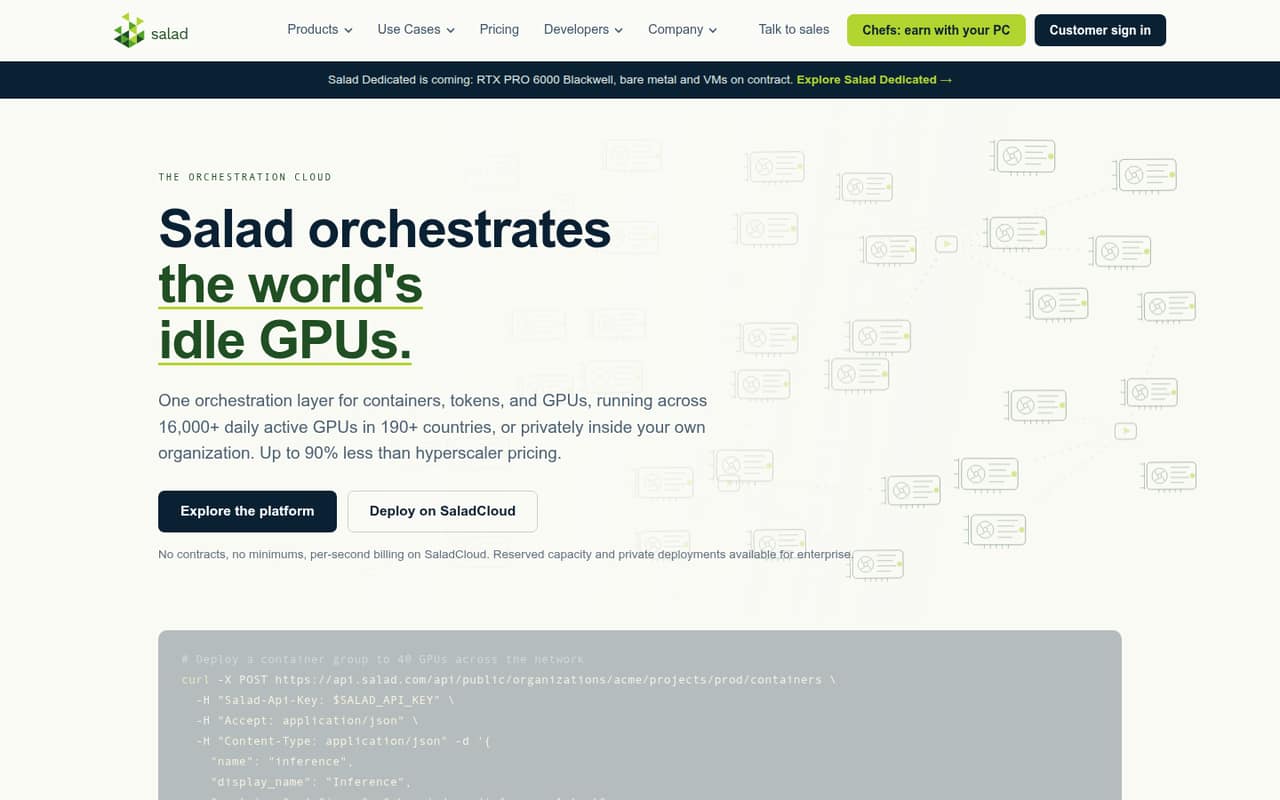
SaladCloud is GPU infrastructure for AI inference and container workloads, not a general-purpose team app. Its options include an OpenAI-compatible model API, Docker workload scheduling, on-demand GPU access, reserved capacity, and private cloud on your own devices.
There’s no free plan listed, and cost depends on GPU type, usage level, and running time rather than team seats. The lowest model-based monthly figure is $43.80 per GPU for an RTX 3080 at the listed Lowest rate. That can suit a small team with a real GPU workload, but setup effort and support terms are worth checking with SaladCloud.
Good fit if
- Small teams running AI inference
- Docker workloads that need GPUs
- Teams comparing GPU-hour costs
Skip it if
- Teams seeking a free GPU plan
- Nontechnical teams avoiding infrastructure
- Workloads needing published service limits
ScoresHow it rates
What works
- OpenAI-compatible endpoint for open-weight models
- Container Engine schedules and reallocates Docker workloads
- On-demand and reserved GPU capacity
- Private Cloud runs on your own devices
- Listed GPU rates include vCPU and RAM
What doesn't
- No free plan or free trial is listed
- Costs vary by GPU and usage level
- Annual billing is not shown
- Setup effort and support terms are not published
- No per-seat pricing for easy team budgeting
01Who SaladCloud is for
SaladCloud is for small engineering or AI teams that need GPU capacity for inference or container workloads—not for every 1–10 person business. It can make sense when a few people share compute for an open-weight model API, Docker jobs, or speech transcription. The AI Gateway offers an OpenAI-compatible endpoint, while the Container Engine schedules and reallocates Docker workloads across distributed GPU pools.
The budget depends on GPU choice and usage, not the number of logins. The pricing page lists an RTX 3080 from $43.80 per GPU per month at the Lowest rate, based on 730 hours; a higher rate for that model is $0.155 per GPU-hour. Community Cloud is listed as starting at $0.015 per GPU-hour, a separate entry point whose exact conditions are worth confirming. SaladCloud also offers reserved capacity and a private-cloud option for an organization’s devices. If your team only needs occasional general computing, this is likely more infrastructure than you need.
02SaladCloud free plan and trial
SaladCloud does not list a free plan or free trial. The cheapest model-based way in on the pricing page is an RTX 3080 at $0.060 per GPU-hour at the Lowest rate, or $43.80 for 730 hours. Usage is charged for running seconds, so that monthly figure is a full-hours reference, not a required monthly commitment. The page also lists Community Cloud starting at $0.015 per GPU-hour; ask SaladCloud what capacity and conditions that starting rate covers before budgeting around it.
For a team that wants to test a workload without committing to a full month, usage-based billing may be a fit, but the vendor does not list a trial allowance or a guaranteed minimum spend. Check the GPU availability, rate level, and billing details for your intended workload before deploying.
03What a small team pays for SaladCloud
SaladCloud charges for compute, not seats. At the listed Lowest RTX 3080 rate, one GPU costs $0.060 per hour, or $43.80 for 730 hours. If a three-person team needs three GPUs running for that full period, the example total is $131.40 monthly; five GPUs would be $219. These are GPU-count examples, not per-person charges: several teammates can share a workload, or one person may need multiple GPUs. Actual charges follow running seconds and the selected rate level.
For more memory, the RTX 3090 is listed at $65.70 per GPU per month at Lowest, with 24 GB VRAM; the RTX 5090 is $182.50 with 32 GB VRAM. The listed monthly figures use the Lowest hourly rate multiplied by 730 hours. No annual billing or discount is shown. The pricing material lists no add-ons, but the AI Gateway can be billed per token or through a flat monthly plan, and exact prices for those options are not published. Transcription is listed from $0.16 per audio hour.
04Getting started with SaladCloud
Expect an engineering-led setup rather than a plug-and-play team workspace. SaladCloud describes an OpenAI-compatible API for its AI Gateway and a Container Engine that schedules Docker workloads. Those are familiar starting points for a team already working with APIs and containers, but they still call for someone to configure the model or image, workload, and GPU needs.
The vendor does not publish a setup-time estimate or a list of required integrations in the pricing material. It also does not specify here how much configuration is needed to move from the API to containers or to run Private Cloud on your own devices. Before choosing a plan, confirm supported deployment steps, access controls, monitoring, and the process for selecting GPU availability. A small team without an engineer comfortable with Docker or API configuration should ask for a walkthrough and a clear estimate of the initial setup work.
05When small teams outgrow SaladCloud
A team is more likely to outgrow SaladCloud’s fit than hit a published seat ceiling: the pricing is based on GPU use, and the pricing material does not list a user limit. Costs can rise as you add GPUs, choose higher hourly rate levels, or move to more capable hardware. For example, the listed Lowest monthly figure is $43.80 for an RTX 3080 and $182.50 for an RTX 5090, each based on 730 hours.
If your workload needs reserved bare metal or virtual machines, Salad Dedicated is available on contract, but contract prices are not published. Private Cloud may suit organizations that want orchestration on their own devices. SaladCloud does not publish workload, capacity, or service limits in the pricing material, so a growing team should ask about availability, support commitments, and scaling before relying on it for production. If you need predictable per-seat billing or a free tier, this pricing model may not be a fit.
Questions people ask
Does SaladCloud have a free plan?
No free plan or free trial is listed. SaladCloud’s pricing page lists GPU usage rates, with the RTX 3080 starting at $0.060 per GPU-hour at the Lowest level. Community Cloud is separately listed as starting at $0.015 per GPU-hour; confirm the conditions for that rate with SaladCloud.
How does SaladCloud charge for GPU use?
The pricing page lists hourly rates by GPU model and usage level. It says usage is charged for running seconds; monthly figures are the Lowest hourly rate multiplied by 730 hours. The listed monthly amount is therefore a full-hours comparison, not a per-seat subscription.
Does SaladCloud work with Docker?
Yes. SaladCloud describes its Container Engine as scheduling, monitoring, and reallocating Docker workloads across distributed GPU pools. The published feature description does not give a setup-time estimate, so teams should confirm deployment steps and workload requirements with the vendor.
Can SaladCloud run on our own devices?
SaladCloud offers Private Cloud, which runs Salad orchestration on an organization’s own devices and keeps company data on those devices. Ask the vendor about device requirements, configuration effort, and pricing for your setup; those details are not listed in the pricing material.
What does SaladCloud’s AI Gateway cost?
SaladCloud describes AI Gateway billing as per token or through a flat monthly plan, but does not publish the exact rates in the pricing material. Ask for the current token price or monthly fee and confirm which open-weight models and usage levels are included.