
We may earn a commission if you buy through links on this page. It never changes a score or a ranking. How we make money
The bottom line
Sardine covers fraud and AML work, but small teams must request a quote to learn the cost.
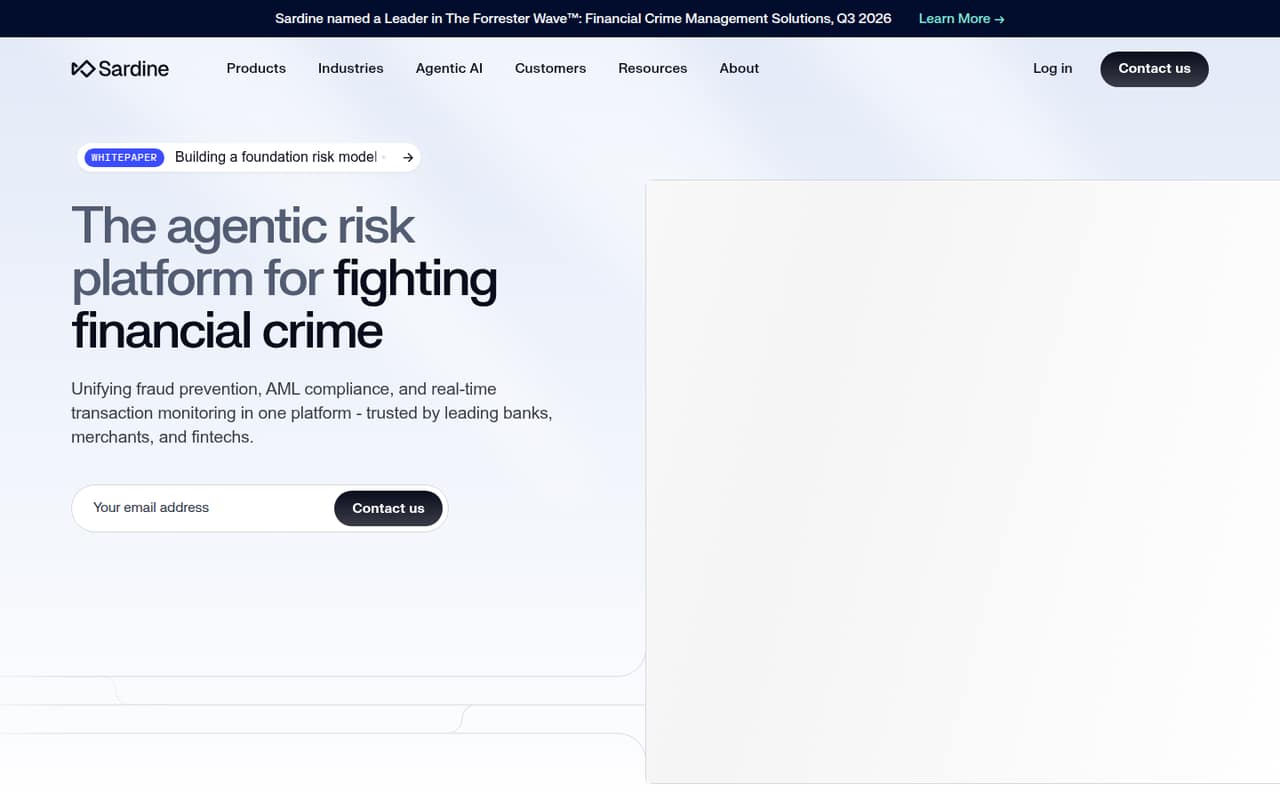
Sardine brings identity checks, payment fraud detection, AML monitoring, and investigations into one financial-crime platform. Its feature set suits teams that need these workflows together, rather than a simple standalone tool.
The pricing page lists custom enterprise quotes, with no public starting price, free plan, or published trial. For a team of one to ten, the main hurdle is knowing whether the platform fits the budget before speaking with sales.
Good fit if
- Fintech fraud and compliance teams
- Banks with AML monitoring needs
- Merchants managing payment risk
Skip it if
- Teams needing a free tool
- Buyers who require public pricing
- Businesses seeking basic fraud checks
ScoresHow it rates
What works
- Combines fraud prevention and AML workflows
- Covers identity and document verification
- Monitors card and bank payment activity
- Includes investigation and case-management tools
- Risk agents can review alerts and analyze data
What doesn't
- No free plan is listed
- Starting price is not published
- Monthly and annual terms are unpublished
- No trial details are published
- Setup requirements and integrations need clarification
01Who Sardine is for
Sardine is built for financial institutions, fintechs, and merchants that need to manage fraud and financial-crime risk. For a small team of one to ten, it may fit when the same people handle identity checks, payment risk, transaction monitoring, and investigations—and want those jobs covered by one platform.
In plain terms, Sardine checks people and businesses during onboarding, looks for risky devices and suspicious payment activity, and supports AML monitoring and case management. Its risk agents can review alerts and analyze data, and can be called through a customer's systems. That breadth may be useful for a small compliance or fraud team with complex work. It is harder to recommend for a tight budget or a team needing only a basic fraud check: the pricing page lists custom enterprise quotes, not a public entry tier. Ask Sardine whether its scope and quote fit your transaction volume and team before budgeting.
02Sardine free plan and trial
Sardine does not list a free plan, and a free trial is not published. The pricing page directs banks, merchants, and fintechs to sales for a custom enterprise quote. That means there is no stated no-cost tier for a one-person team to start with, and no published trial period to evaluate the platform before buying.
The cheapest way in is to request a quote from Sardine; the vendor does not publish a minimum price or a named entry plan. Ask sales whether the quote includes the specific capabilities you need, such as identity verification, payment fraud detection, or AML monitoring. Also confirm whether onboarding or any add-ons carry separate charges. Without those details, a small team cannot tell from public pricing whether Sardine fits its budget.
03What a small team pays for Sardine
The pricing page lists custom enterprise quotes for banks, merchants, and fintechs. It does not publish a starting price, a named plan, a per-seat rate, or monthly and annual billing terms. So we cannot give a reliable cost for one person—or calculate what three or five seats would cost. There is no published per-seat math to apply.
For a small team, that makes the first useful step a sales conversation, not a seat-count comparison. Request written quotes for one, three, and five users, and ask whether the price changes with users, transaction volume, or the features selected. The pricing information does not list add-on prices, so ask whether device intelligence, identity checks, payment fraud, AML tools, case management, and risk agents are included or priced separately. Confirm contract length, billing frequency, implementation charges, and any minimum commitment before comparing Sardine with tools that publish rates. Until Sardine provides those figures, the cost for a few seats is not published.
04Getting started with Sardine
Sardine spans onboarding checks, device intelligence, payment fraud, AML monitoring, investigations, and risk operations. A team adopting several of those workflows should plan to define which alerts it needs, who reviews them, and how cases move between people. The amount of setup work and the learning curve are not published, so we would not assume this is a plug-and-play tool for a small team.
Sardine says its risk agents can be called through a customer's systems, but public setup steps and a list of integrations are not published. Before signing, ask Sardine which systems it connects to, what information your team must supply, and whether it helps configure rules and alert reviews. Also request an implementation timeline and training details. Those answers will help a one-to-ten-person team estimate the work alongside the custom quote.
05When small teams outgrow Sardine
Sardine is already aimed at financial institutions, merchants, and fintechs, so a growing team may not outgrow its feature scope in the usual way. The more immediate pressure point is commercial: the pricing page lists only custom enterprise quotes, with no public seat limits, volume thresholds, or published plan tiers. A team cannot tell from public information when it would need a more expensive tier or what growth would cost.
As transaction activity, users, or compliance needs increase, ask Sardine whether those changes affect the quote and whether the platform supports the added workload. If the quote requires a commitment your team cannot justify, or the setup does not cover the systems you rely on, it may be time to compare other options. The public pricing information does not identify specific limits that trigger an upgrade, so get those limits and any renewal terms in writing before your team depends on the platform.
Questions people ask
Does Sardine have a free plan?
No free plan is listed. The pricing page directs banks, merchants, and fintechs to sales for a custom enterprise quote. Sardine also does not publish a free-trial period. Ask the vendor whether it can offer an evaluation or a limited-scope quote for your team.
How much does Sardine cost?
Sardine's pricing page lists custom enterprise quotes but does not publish a starting price, per-seat rate, or monthly and annual terms. The cost for one, three, or five users is therefore not published. Request a quote that spells out included features, contract terms, and any additional charges.
What does Sardine do?
Sardine is an agentic platform for fraud prevention, AML compliance, and transaction monitoring. Its tools cover identity and business checks, device risk, card and bank payment fraud, investigations, customer risk ratings, sanctions screening, and case management.
Can Sardine's risk agents review alerts?
Yes. Sardine describes risk agents that can review alerts and analyze data. It also says customers can call the agents through their own systems. Ask the vendor how that works with your existing tools and what configuration or technical work is required.
Does Sardine offer a trial?
A trial is not published in Sardine's pricing information. The vendor directs prospective buyers to sales for a custom enterprise quote. Ask whether Sardine can provide a trial, a guided evaluation, or another way to assess the specific fraud and AML features your team needs.