
We may earn a commission if you buy through links on this page. It never changes a score or a ranking. How we make money
The bottom line
Capable data governance, with a $20,000 annual starting commitment and no published seat limit.
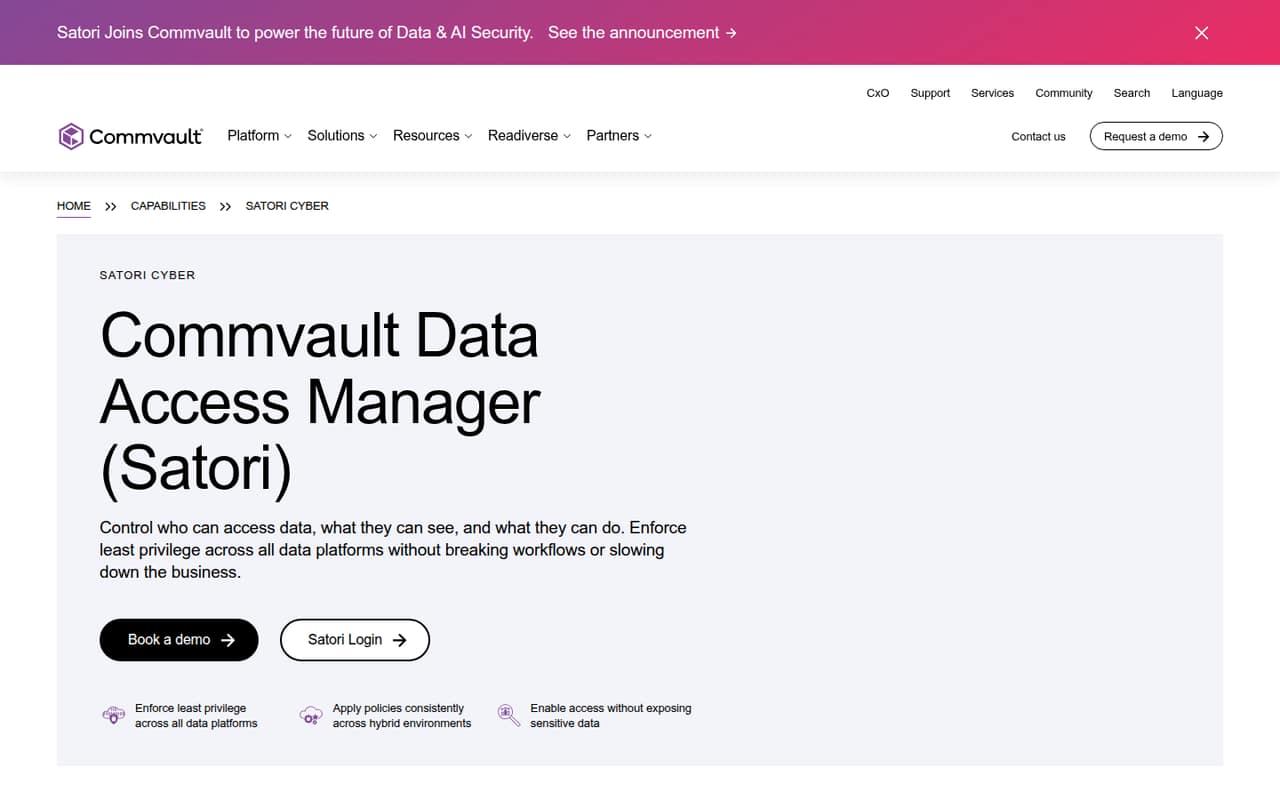
Satori applies access policies across cloud, on-premises, and hybrid data environments. It can mask sensitive fields, restrict rows, classify data, and route just-in-time access requests for approval.
The Small plan covers three data stores and 50,000 fields, but costs $20,000 per year. There’s no free plan, and the vendor doesn’t publish a seat limit or monthly-billing price. For a small team, the fit depends more on the value of governing sensitive data than on headcount.
Good fit if
- Teams governing sensitive data
- Environments with three or fewer data stores
- Organizations needing runtime masking
Skip it if
- Teams looking for a free plan
- Small budgets under $20,000 annually
- Buyers needing published seat-based pricing
ScoresHow it rates
What works
- Policies cover cloud, on-premises, and hybrid environments
- Masks sensitive fields at query time
- Supports row-level access controls
- Includes data discovery and classification
- Offers just-in-time access workflows
What doesn't
- Small plan costs $20,000 per year
- No free plan is listed
- Monthly billing prices are not published
- Seat limits are not published
- Trial length and terms are not published
01Who Satori is for
Satori is for teams that need to govern access to sensitive data across cloud, on-premises, or hybrid environments. It evaluates queries in real time and can mask or filter sensitive information without changing schemas, queries, or applications. That makes it relevant when different people need different views of the same data, or when a team needs a record of who accessed it.
The Small plan is aimed at smaller data environments, with three data stores and 50,000 fields. The vendor doesn’t publish a seat limit, so a team of one to ten should confirm how many users the plan supports before budgeting. At $20,000 a year on annual billing, this is not an inexpensive general-purpose security tool. It makes more sense for a small data team with a specific governance requirement and enough risk or compliance pressure to justify the spend.
02Satori free plan and trial
Satori does not list a free plan. The pricing material lists a free trial or test drive for its plans, including Small, but the vendor doesn’t publish the trial’s length, limits, or eligibility terms. Ask what data stores and features the test drive includes, and whether you can use your own environment, before planning an evaluation.
The cheapest listed way in is Small: three data stores and 50,000 fields for $20,000 per year, shown as a $1,666.67 monthly equivalent with annual billing. A monthly payment price is not published. The seat limit is also not published, so teams should confirm user coverage with Satori before treating the plan as suitable for a particular headcount.
03What a small team pays for Satori
The pricing material lists Small at $1,666.67 per month on an annual-billing basis, or $20,000 for the year. That’s the same plan price whether one person manages it or a team shares it; Satori’s seat limit and per-seat rate are not published. As simple budget allocation, the annual cost averages $1,666.67 per person monthly for one person, $555.56 for three, or $333.33 for five. Those are not actual per-seat prices, and the vendor should confirm how many users are covered.
Monthly billing prices are not published, so don’t assume you can pay $1,666.67 month to month. Medium is listed at $4,166.67 monthly equivalent, billed annually, for 10 data stores and 100,000 fields. No add-ons are listed in the pricing material. The key cost question for a small team is whether the Small plan’s environment limits fit; extra seats or data-store pricing isn’t published.
04Getting started with Satori
Satori’s feature description says it evaluates queries in real time and applies controls without changing schemas, queries, or applications. That may reduce the need to rework those parts of a data stack, but it doesn’t establish how long setup takes or what technical work is required. The vendor doesn’t publish a standard implementation timeline or a complete integration list in the pricing details.
Before signing, ask Satori to confirm that your data platforms are supported, what access or permissions setup requires, and whether policies need to be configured separately for each store. Also ask what the free test drive covers and whether it can use your own data environment. The product description includes discovery and classification, masking, row-level controls, approval workflows, and audit logging; it doesn’t specify which setup tasks are automated. Budget time for a technical walkthrough rather than assuming setup is plug-and-play.
05When small teams outgrow Satori
The first clear limit is data-environment size: Small covers three data stores and 50,000 fields. A team that needs more is pointed toward Medium, listed for 10 stores and 100,000 fields at $4,166.67 per month equivalent on annual billing. Large covers 25 stores and 250,000 fields for $8,333.33 monthly equivalent, while XL covers 100 stores and one million fields for $25,000 monthly equivalent. Each listed price is an annual-billing equivalent, not a published month-to-month rate.
Seat capacity is not published for any tier, and the pricing material doesn’t list add-on prices. That makes headcount growth harder to budget than data-store growth. Before expanding, ask for written pricing based on your expected stores, fields, and users. If your environment stays within Small’s limits but the annual commitment is too high, Satori may already be more tool than a small team can justify; the available pricing does not show a lower paid tier.
Questions people ask
Does Satori have a free plan?
No free plan is listed. Satori’s pricing material does list a free trial or test drive, but the vendor doesn’t publish its length, limits, or terms. Ask what’s included and whether your team can evaluate Satori with its own data environment before committing to a paid plan.
How much does Satori cost for a small team?
The Small plan is listed at $1,666.67 per month as an annual-billing equivalent, or $20,000 for the year. It covers three data stores and 50,000 fields. Monthly billing prices and the plan’s seat limit are not published, so confirm the full cost and user coverage with Satori.
Does Satori charge per user?
The pricing material does not publish a per-seat rate or seat limit. The listed Small price is for the plan, not a stated price per user. Ask the vendor how many users are included and whether adding users changes the annual quote.
What does Satori Small include?
The Small plan is listed for three data stores and 50,000 fields, with a free trial or test drive available. Satori’s product features include access policies, dynamic masking, row-level security, data discovery, approval workflows, and access logging. Confirm which features and user limits apply to your proposed plan.
When should a team move beyond Satori Small?
Small is listed for up to three data stores and 50,000 fields. If your environment exceeds those limits, Medium is listed for 10 stores and 100,000 fields. Its annual-billing equivalent is $4,166.67 per month. Ask Satori for a quote that reflects your data stores, fields, and users before upgrading.