
We may earn a commission if you buy through links on this page. It never changes a score or a ranking. How we make money
The bottom line
A broad scraping API with a real free tier; paid plans start at $30/month.
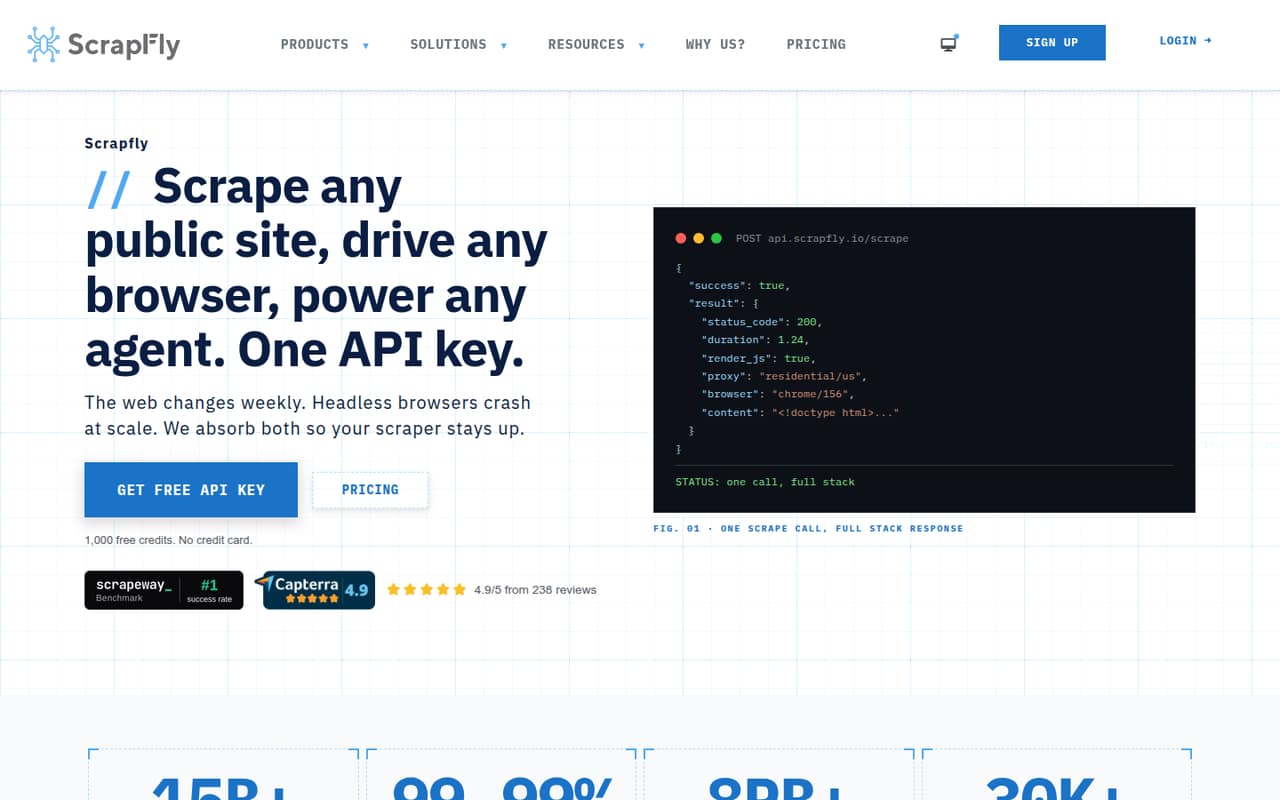
Scrapfly is worth considering if your small team needs more than a basic scraper: it combines scraping, browser automation, screenshots, extraction, crawling and AI browser agents under one API key. The free plan gives you 1,000 signup credits to try every product, with no time limit.
Paid plans start at $30/month for 200,000 credits and five concurrent requests. Plans are not priced per seat, so the bill depends on the tier and credit use, not whether one or five people share the work. Check your expected workload before committing: credits and concurrency are the practical limits.
Good fit if
- Teams combining several scraping jobs
- Prototypes that need browser automation
- Production jobs needing managed proxies
Skip it if
- Teams needing published per-seat pricing
- Projects that need guaranteed support
- Scraping tasks with unpredictable credit use
ScoresHow it rates
What works
- Free plan includes every product and 1,000 signup credits
- One API platform covers scraping, browsers, screenshots and crawling
- Paid plans list monthly credits and concurrency limits
- Cloud browser works with Playwright and Puppeteer
- Failed requests are free, per the homepage
What doesn't
- Free credits are a signup allotment, not a monthly allowance
- Discovery costs $30/month and has no pay-as-you-go
- Paid plans cap concurrent requests
- The pricing page does not list annual billing rates
- Premium Support appears only on Enterprise
01Who Scrapfly is for
Scrapfly suits a small team that needs to collect public web data and would rather use a managed API than assemble separate scraping infrastructure. Its products cover fetching URLs with proxy rotation and optional JavaScript rendering, running a managed Chromium browser, taking screenshots, extracting typed data, crawling sites and powering AI browser agents.
For a team of one to ten, the fit depends more on workload than headcount: the listed plans cap credits and concurrent requests, but the pricing page does not list a per-seat charge. A solo founder can start with the free plan for a prototype; a team running internal jobs can look at Discovery at $30/month. Production work has a Pro tier at $100/month. Scrapfly is less suitable if you need a predictable per-seat bill or cannot estimate how many credits your jobs will consume.
02Scrapfly free plan and trial
The Free plan costs $0 and includes 1,000 signup credits across every product. Scrapfly lists no credit card and no time limit, so you can try scraping, browser automation, screenshots, extraction and crawling without starting a paid subscription. Its homepage also says failed requests are free.
The allowance is a signup credit pool, not a stated monthly refill. Once it is used, the next listed tier is Discovery at $30/month for 200,000 credits, five concurrent requests and one-week log retention. Discovery does not include pay-as-you-go, so check how your intended jobs use credits before relying on it. Scrapfly does not list a separate free trial in the published pricing details; the Free plan is the way in.
03What a small team pays for Scrapfly
Discovery is the cheapest paid plan at $30/month, with 200,000 credits and five concurrent requests. That is $30 for one person, or an equivalent $10 per person for three and $6 for five if you divide the subscription evenly. Scrapfly lists plan limits rather than per-seat pricing, so those are budgeting comparisons, not seat prices.
For production, Pro is $100/month for 1,000,000 credits and 20 concurrent requests: an equivalent $33.33 per person for three, or $20 for five. At the listed monthly rate, Discovery comes to $360 over 12 months and Pro to $1,200; the pricing page gives no annual rate and says no annual contract is required.
Watch overflow costs: Pro lists $3.50 per extra 10,000 credits; Startup lists $2 and Enterprise $1.20. Discovery has no pay-as-you-go. Ask Scrapfly how your products and jobs consume credits before choosing a tier.
04Getting started with Scrapfly
Scrapfly describes its products as API-based and says one API key can power them. That is a straightforward starting point for a developer who already knows how to make API requests, but the pricing details do not publish setup time or the amount of coding needed for a particular job. We would budget for implementation and a credit check rather than assume a no-code setup.
If your workflow needs a browser, Scrapfly lists managed Chromium with Playwright and Puppeteer compatibility. For other integrations, the vendor does not publish a list in the pricing details; check the docs for your language, framework and authentication needs before buying. A small team should first connect one representative URL or workflow, then confirm its credit use and concurrency needs. Reddit users discuss results from scraping APIs, but those accounts are not a substitute for checking fit with your own targets.
05When small teams outgrow Scrapfly
You may need to upgrade when your jobs exceed a plan’s credit pool or concurrency cap. Discovery has 200,000 credits and five concurrent requests; Pro raises that to 1,000,000 and 20, while Startup lists 2,500,000 and 50. Moving up also raises the monthly bill: Pro is $100 and Startup is $250. Discovery has no pay-as-you-go, while Pro’s listed overflow rate is $3.50 per 10,000 credits.
A team may also outgrow the lower tiers if it needs team management: that feature is listed on Startup, at $250/month. Premium Support is listed for Enterprise at $500/month, not the lower plans. In one Reddit thread, a real estate company commenter reported improved results after moving about 80 targets to Scrapfly; other commenters cautioned that scraping needs vary by site. Treat those as individual reports, not a guarantee for your targets.
From the threadsWhat users say
The Reddit discussion includes a strongly positive account of switching to Scrapfly and a separate view that scraping tools can be too one-size-fits-all. That makes sentiment encouraging but not conclusive for a different team’s targets.
switching to their solution was day and night for us
If you're running a legitimate business just hire a developer
In the scraping world, that pretty much means 1 size fits none
domain knowledge is quite hard
Questions people ask
Is Scrapfly free?
Yes. Scrapfly lists a Free plan at $0 with 1,000 signup credits across every product, no credit card and no time limit. The credits are a signup allowance, not a stated monthly refill. The next listed plan is Discovery at $30/month.
What does Scrapfly's free plan include?
The Free plan includes 1,000 signup credits for every product, and Scrapfly lists no credit card or time limit. Its homepage also says failed requests are free. The pricing details do not describe a monthly credit refill, so treat the allowance as a signup pool.
Does Scrapfly charge per user?
Scrapfly lists monthly plans with credit and concurrency limits, not a per-seat price. Discovery is $30/month and Pro is $100/month. The pricing page does not state a seat limit, so ask the vendor how team access works before relying on a particular number of users.
Which Scrapfly plan is for production?
Scrapfly describes Pro as a plan for production jobs and small teams. It costs $100/month and includes 1,000,000 credits, 20 concurrent requests and two-week log retention. It lists overflow at $3.50 per 10,000 credits.
Does Scrapfly support Playwright and Puppeteer?
Yes. Scrapfly lists a managed Chromium cloud browser with Playwright and Puppeteer compatibility. Check the vendor docs for details on the browser workflows and the setup required for your particular application.