
We may earn a commission if you buy through links on this page. It never changes a score or a ranking. How we make money
The bottom line
Good scraping infrastructure for builders; confirm seat rules and credit costs before scaling.
A small team only needs ScrapingAnt if it has recurring web data work and someone comfortable connecting to an API. The free plan offers 10,000 monthly credits, while paid plans start at $19 per month.
The feature set covers JavaScript rendering, rotating proxies, parallel requests, AI extraction, Markdown output, and MCP tools. Pricing is based on monthly credits, not published seat counts, so ask ScrapingAnt how team access and overages work before budgeting.
Good fit if
- Developer-led scraping projects
- Teams needing JavaScript rendering
- Builders using LLM workflows
Skip it if
- Point-and-click scraping beginners
- Teams needing known seat pricing
- Occasional scraping without a budget
ScoresHow it rates
What works
- Free plan includes 10,000 monthly API credits
- Paid plans list unlimited concurrency
- Chrome rendering supports JavaScript-heavy pages
- AI extraction can return structured JSON
- MCP tools support Claude Code, Cursor, and Windsurf
What doesn't
- Free plan allows only one concurrent request
- Seat costs and limits are not published
- Credit overage costs are not published
- Annual billing prices are not published
- Datacenter proxy and custom scraper prices are not published
01Who ScrapingAnt is for
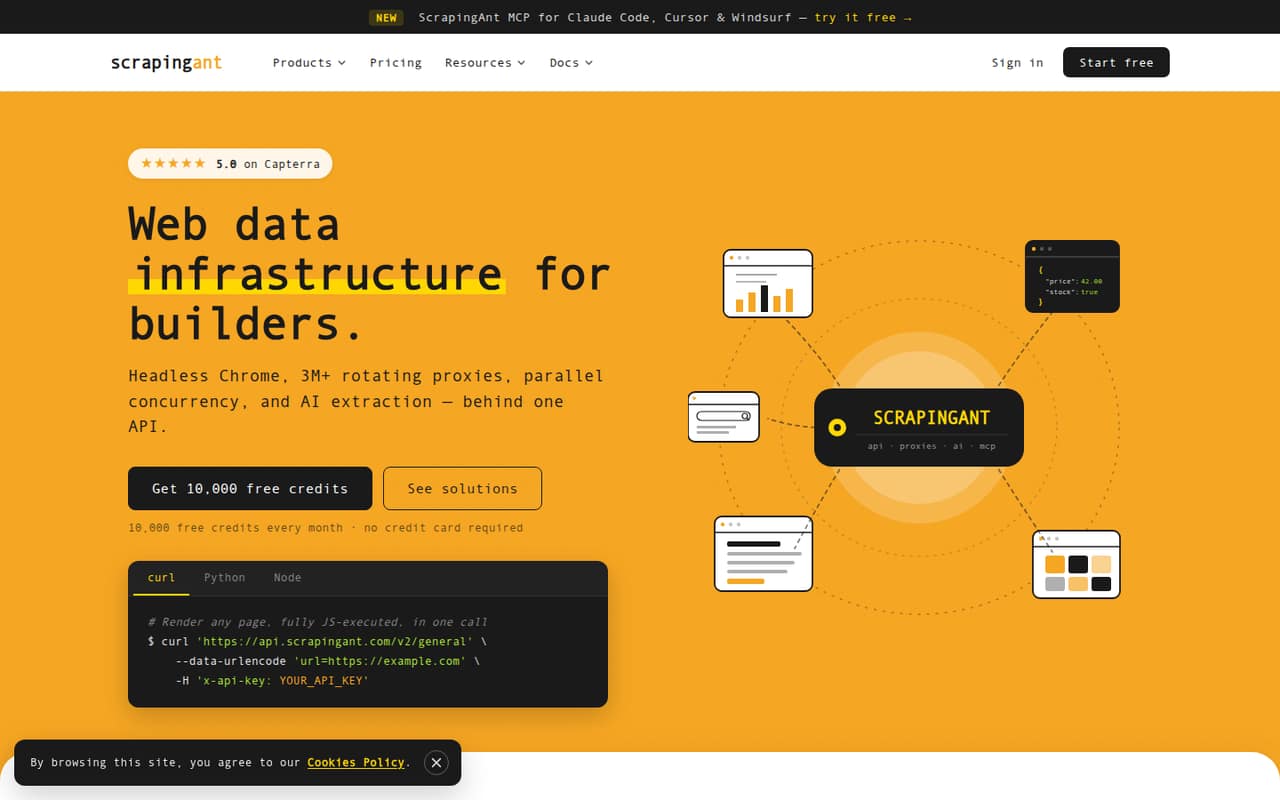
ScrapingAnt fits a small team that needs to collect web data regularly and has a developer who can work with an API. It handles browser rendering, proxy rotation, and parallel requests, so the team does not have to build each part of that scraping setup itself. The homepage also lists AI extraction, Markdown output, and an MCP server for using scraping tools with Claude Code, Cursor, or Windsurf.
For a one-to-ten-person business, the main question is whether scraping supports a real workflow: research, data collection, or feeding content into an application. If the need is occasional and someone expects a visual point-and-click interface, this API may be more tool than the team needs. Reddit discussion includes a commenter hoping for point-and-click help, which is a useful signal that not every buyer wants a developer-oriented setup. The free plan makes it possible to start without a subscription; paid plans begin at $19 monthly.
02ScrapingAnt free plan and trial
The pricing page lists a Free plan at $0 per month with 10,000 API credits monthly, one concurrent request, and no credit card required. That is enough to explore a small scraping workflow, but the one-request concurrency limit is the first clear ceiling for work that needs multiple requests at once. The page does not publish how many credits a particular page or extraction consumes, so estimate your actual monthly capacity with the vendor before relying on the allowance.
A free trial is not listed; the free plan is the way in. Credits do not roll over, according to the pricing details, and overage costs are not published. If one concurrent request is too restrictive, the cheapest paid option is Enthusiast at $19 per month, which lists 100,000 monthly credits and unlimited concurrency.
03What a small team pays for ScrapingAnt
The pricing page lists Enthusiast at $19 per month for 100,000 credits and unlimited concurrency. Startup is $49 for 500,000 credits, and Business is $249 for 3 million. These are monthly plan prices, not published per-seat rates. Seat limits and seat costs are not published, so ScrapingAnt does not provide enough information to confirm what three or five named users would pay.
For a rough budget split only, one person on Enthusiast costs $19 monthly; divide that same plan price by three and it is $6.33 per person, or by five and it is $3.80. Those figures assume sharing one plan and do not confirm that the plan permits those seats. Annual-billing prices are not published, so there is no verified annual comparison. Residential proxies are optional add-ons: 5 GB costs $30 monthly, 10 GB $55, 25 GB $130, and 50 GB $245. Datacenter proxy and custom scraper prices, plus overage costs, are not published. Ask the vendor about seats, credit use, and overages before choosing a tier.
04Getting started with ScrapingAnt
ScrapingAnt is an API, so expect to connect it to a script or application rather than set up a point-and-click workflow. The homepage lists Chrome rendering, proxy rotation, parallel requests, and AI extraction; which pieces you need depends on the pages and output your project requires. The product also offers Markdown or JSON output and an MCP server with HTML, Markdown, and text tools for Claude Code, Cursor, and Windsurf.
For a small team, a sensible first step is to try one target site on the free plan, then check the resulting credit use and whether JavaScript rendering or proxy targeting is needed. The available information does not specify a setup time or list particular programming-language integrations, so confirm those details in the docs before assigning the work. One Reddit commenter said they were hoping for a point-and-click option, a reminder that less technical teammates may need developer help.
05When small teams outgrow ScrapingAnt
The first reason to upgrade is workload: Free lists 10,000 monthly credits and one concurrent request, while Enthusiast starts at 100,000 credits with unlimited concurrency for $19 monthly. Larger listed tiers go from Startup at $49 for 500,000 credits to Business at $249 for 3 million. Plans can be restarted mid-month, but unused credits do not roll over, per the pricing details.
A growing team may also need clearer seat permissions, predictable overage charges, or a published annual rate. ScrapingAnt does not publish seat costs, overage costs, or annual prices, so ask the vendor whether your intended team access fits the plan before you scale. Reddit users in a scraping discussion describe how parallelizing browser work can reduce the time needed for large jobs, but those comments do not establish ScrapingAnt performance. The homepage says paid plans have no concurrency cap; still, check whether credits, proxy needs, or your own workflow become the practical constraint.
From the threadsWhat users say
The Reddit discussion is too limited to establish broad sentiment about ScrapingAnt itself. Comments show interest in scraping and parallelization, alongside uncertainty about the tool and a desire for point-and-click help.
Basically it will help you to save time while scraping some site
New to Webscraping, can you EiLI5 why this is useful/different?
Was hoping for a point and click
Thank you that’s awesome
Questions people ask
Does ScrapingAnt have a free plan?
Yes. The pricing page lists a Free plan at $0 per month with 10,000 API credits monthly, one concurrent request, and no credit card required. Credits do not roll over. ScrapingAnt does not publish how many credits a typical page or extraction uses, so check your expected usage before depending on the monthly allowance.
What is the cheapest paid ScrapingAnt plan?
The cheapest paid option listed is Enthusiast at $19 per month. It includes 100,000 API credits monthly, unlimited concurrency, email support, and docs-only integration help. The pricing page lists monthly prices; annual billing prices are not published.
Does ScrapingAnt charge per user?
ScrapingAnt's listed plans are described by monthly credit allowances, not per-seat prices. Seat limits and seat costs are not published, so a team should ask the vendor how multiple users can access one plan and whether any additional user fees apply.
Can ScrapingAnt scrape JavaScript-heavy websites?
Yes. ScrapingAnt lists Chrome rendering for JavaScript-heavy pages, with isolated Chrome instances. It also lists rotating residential and datacenter proxies, geographic targeting, and parallel requests. Confirm the proxy options and likely credit use for your target sites before selecting a plan.
Does ScrapingAnt work with AI coding tools?
ScrapingAnt lists an MCP server with HTML, Markdown, and text tools for Claude Code, Cursor, and Windsurf. It also offers AI extraction that turns plain-language requests into structured JSON, plus Markdown output. Check the docs for setup details and the integration steps that match your team's tools.