
We may earn a commission if you buy through links on this page. It never changes a score or a ranking. How we make money
The bottom line
Good query coverage and a free allowance; paid use means tracking prepaid credits, not seats.
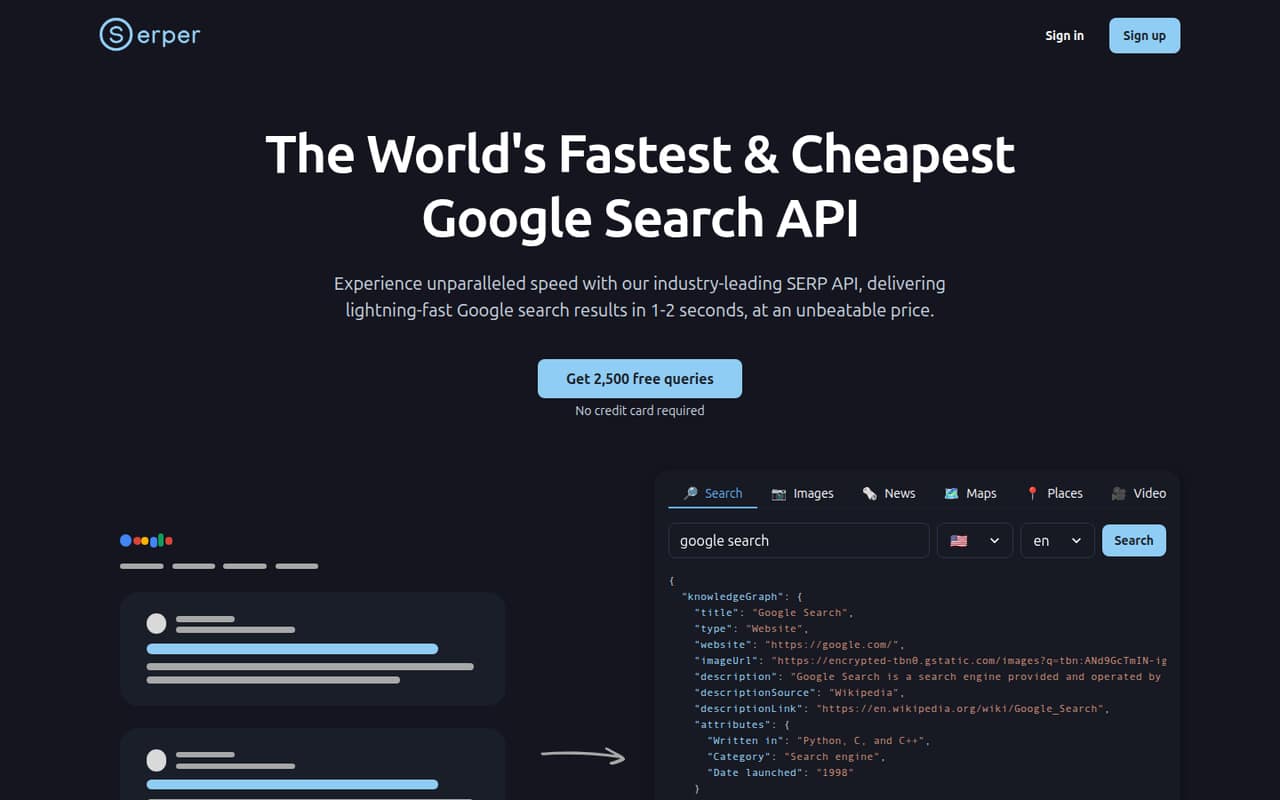
Serper gives developers an API for Google search results and SERP data, with query types including images, news, maps, shopping, Scholar, and autocomplete. The homepage says results arrive in 1–2 seconds, and the free plan includes 2,500 queries without a credit card.
For a small team, the main catch is budgeting: paid plans are prepaid credit packages, not monthly per-seat subscriptions, and credits are valid for six months. Reddit comments show interest in Serper’s affordability, but at least one user preferred another provider for their needs.
Good fit if
- Developer-led teams needing Google results
- Small API experiments before paying
- Automated search and research workflows
Skip it if
- Teams wanting a ready-made search dashboard
- Workloads needing monthly billing
- Teams needing published overage rates
ScoresHow it rates
What works
- Free plan includes 2,500 queries
- No credit card required for free access
- Covers search, images, news, maps, and more
- Paid packages list per-credit rates
- Package options include up to 300 QPS
What doesn't
- Free queries stop when the balance reaches zero
- Paid packages are prepaid, not monthly
- Credits expire after six months
- Overage costs are not published
- API setup requires a developer or technical workflow
01Who Serper is for
Serper is for small, developer-led teams that need Google search results inside an app, script, or automated workflow. It is an API, not a seat-based workspace, so the useful question is how many queries your team needs—not how many people need logins. A founder and a few teammates could share the same integration, while a team of 5–10 might use it to feed research, monitoring, or lead-enrichment workflows.
The API covers Google search results and SERP data, with query types for images, news, maps, places, videos, shopping, Scholar, patents, and autocomplete. Serper’s homepage says results arrive in 1–2 seconds. That breadth makes it worth considering when Google data needs to flow into another tool. It is less suitable if your team wants a finished research interface or needs to scrape and extract full website content; a Reddit commenter distinguishes those jobs from getting Google search data through an API.
02Serper free plan and trial
Serper’s Free plan includes a one-time allowance of 2,500 queries, and no credit card is required. It is a useful starting point for a small team to connect an API workflow and check whether the available search data fits the job. This is an allowance, not an ongoing monthly quota. Queries stop when the balance reaches zero.
The vendor lists no separate free trial. Once the free balance is gone, you need a prepaid package to continue: Starter costs $50 for 50,000 credits and is valid for six months. The pricing information does not state how many credits each query type consumes, so estimate your expected usage and confirm the credit rules before buying. If you only need to explore the API or run a small proof of concept, the free plan may be enough; it won’t cover continued use after those 2,500 queries.
03What a small team pays for Serper
Serper does not price by seat. The Free plan gives one team 2,500 queries; the cheapest paid option is Starter at $50 for 50,000 credits, or $1 per 1,000 credits. That is $50 for one person, a team of three, or a team of five if they share the same package. There is no monthly or annual per-seat total to calculate: paid packages are prepaid and valid for six months.
For a larger allowance, Standard is $375 for 500,000 credits ($0.75 per 1,000), Scale is $1,250 for 2,500,000 credits ($0.50 per 1,000), and Ultimate is $3,750 for 12,500,000 credits ($0.30 per 1,000). Listed limits are 50 QPS for Starter, 100 for Standard, 200 for Scale, and 300 for Ultimate. These packages make sense only if your workload can use the credits before they expire. Serper says additional prepaid credits are required when the balance runs out; overage rates are not published.
04Getting started with Serper
Because Serper is an API, setup means connecting it to a tool or workflow that can send requests and use the returned search data. A small team should plan for a developer to handle that connection and decide how queries, results, and remaining credits will be managed. That is more involved than opening a shared dashboard, but it can suit a team that already builds or maintains API-based workflows.
Serper’s product description lists the query types, and its homepage says results arrive in 1–2 seconds. The available pricing details do not specify setup steps, SDKs, or ready-made integrations, so check the current docs for your preferred language and workflow before committing. Start with the free allowance to confirm the data fits your use case. If you are connecting a third-party automation tool, verify how it handles API credentials and failed requests; don’t assume an integration or support feature that the vendor has not confirmed.
05When small teams outgrow Serper
The first sign you are outgrowing the Free plan is simply reaching its 2,500-query balance. Starter adds 50,000 credits, but it is a $50 prepaid purchase with a six-month validity period. Teams with bigger workloads can move to Standard, Scale, or Ultimate for more credits and higher listed QPS limits. Since the vendor does not publish overage costs, budget around buying another package when the balance runs out.
The bigger issue may be fit rather than team size. Serper does not charge per seat, so adding teammates does not automatically raise the package price; higher query volume does. A Reddit commenter says Serper and another provider would work for enriching outreach emails, while a separate user said DataForSEO was working better for their needs. Another Reddit thread describes a search-monitoring workflow and asks about more affordable alternatives. If you need richer data, broader source coverage, or website extraction, compare providers against those requirements before scaling spend.
From the threadsWhat users say
Reddit discussion is mixed: users consider Serper for affordable Google search data and free API access, but at least one commenter preferred another provider. The comments are use-case-specific rather than a broad verdict on reliability or support.
I'm thinking of creating free plans on serper.dev, or serpapi, tavily, etc
both would work for enriching your emails with web data
DataForSeo seems to be working best for me
after using serper.dev for a while, I'd like to figure out if there are good (and more affordable) alternatives
Questions people ask
What is Serper used for?
Serper is an API for retrieving Google search results and SERP data. It offers query types for regular search, images, news, maps, places, videos, shopping, Scholar, patents, and autocomplete. Teams can use it to bring search data into their own apps or workflows rather than relying on a standalone research interface.
Does Serper have a free plan?
Yes. The Free plan includes a one-time allowance of 2,500 queries, with no credit card required. Queries stop when the balance reaches zero. The allowance is not listed as a recurring monthly quota, so continued use requires a prepaid package.
How much does Serper cost?
The cheapest paid package is Starter at $50 for 50,000 credits, or $1 per 1,000 credits. Standard, Scale, and Ultimate offer larger prepaid credit balances at lower listed rates per 1,000 credits. Packages are valid for six months; Serper does not publish monthly or annual billing prices.
Do Serper credits expire?
Yes. The listed paid packages are valid for six months. Plan your expected query volume before buying so you can use the balance within that period. Serper’s pricing information does not state whether unused credits can be extended, so ask the vendor if that matters to your budget.
Is Serper a good fit for a small team?
It can fit a small team that has a developer or API-capable workflow and needs Google search data in another tool. The Free plan offers 2,500 queries to start, and paid packages are not priced per seat. It is less suited to teams that need a ready-made research workspace or predictable monthly billing.
Sources
- Serper homepage
- Serper pricing, compiled via web search from serpbase.dev, cloro.dev, serphouse.com
- Reddit: What is your favorite tool for SERP scraping and why?
- Reddit: What are some free servcies (or harness?) that I could use to help run a deep research session?
- Reddit: Is anyone using the Serper API ?
- Reddit: Alternatives for Serper.dev and Exa.ai for news monitoring