
We may earn a commission if you buy through links on this page. It never changes a score or a ranking. How we make money
The bottom line
Strong APIs for custom communications, but no free plan or simple per-seat budget.
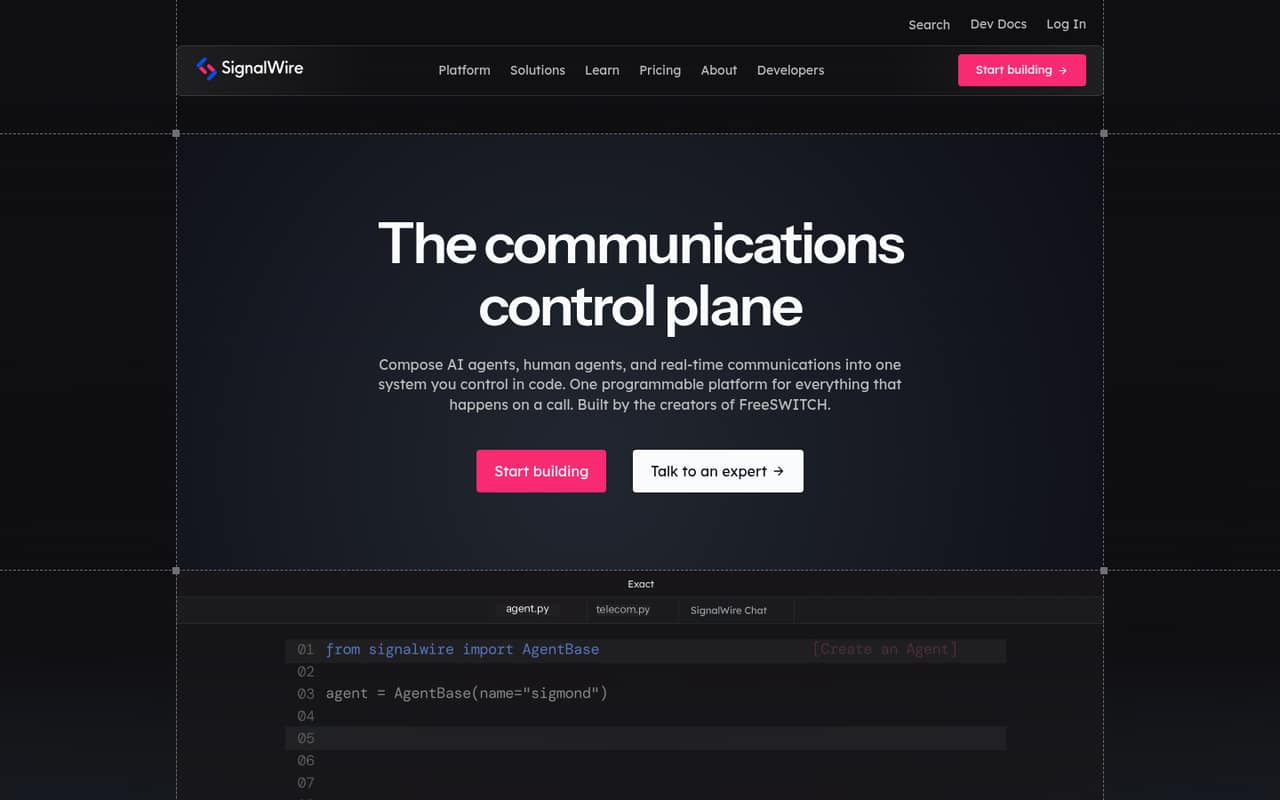
SignalWire is a programmable platform for voice, video, messaging, and AI agents. Small teams can use its APIs, SDKs, and SWML to build communications into their own products and workflows.
There’s no free plan or published seat-based package. Voice, messaging, and AI runtime have separate usage charges, so SignalWire makes the most sense when a developer can estimate and control consumption.
Good fit if
- Developer-led product teams
- Custom voice and messaging workflows
- Teams building AI voice agents
Skip it if
- Teams seeking a free tier
- Nontechnical teams wanting a turnkey app
- Buyers needing predictable seat pricing
ScoresHow it rates
What works
- APIs cover voice, video, messaging, and AI
- SWML flows can be defined in JSON or YAML
- AI runtime includes standard TTS and orchestration
- Voice and messaging use usage-based rates
- Local numbers start at $0.50 monthly
What doesn't
- No free plan is listed
- No free trial is listed
- AI voice transport is billed separately
- Premium TTS costs extra
- No per-seat monthly plan is listed
01Who SignalWire is for
SignalWire is for small, developer-led teams that need to put communications inside a product or automate calls and messages. It provides programmable voice, video, messaging, and AI, with APIs, SDKs, and SWML for defining communications flows. The company says it was built by the creators of FreeSWITCH.
A team of one to ten can use it, but the right budget depends on call minutes, messages, AI runtime, and any add-ons—not the number of seats. For a team building an AI voice agent, the AI Agent Runtime lists $0.16 per minute before voice transport. A team adding calls or texts to an existing app can instead look at the usage-based Voice API or Messaging API. We’d shortlist SignalWire when the work calls for custom call flows, routing, or API-driven communications. If the team just needs a ready-made business phone or messaging app, this programmable approach may be more than the job requires.
02SignalWire free plan and trial
SignalWire lists no free plan and no free trial. That means a small team should not expect a no-cost tier for testing ongoing use; ask the vendor about evaluation options before committing if you need a trial period.
The cheapest way in is a usage-based API, not a seat-based subscription. The Voice API lists US local calls at $0.00660 per inbound minute and $0.00800 per outbound minute; local numbers are $0.50 per month. The Messaging API lists local SMS at $0.00415 per segment. Those rates are before any applicable extras. For AI voice agents, the AI Agent Runtime starts at $0.16 per minute, and voice transport is billed separately. There’s no published fixed monthly starting price, so the first bill depends on what your team builds and how much it uses.
03What a small team pays for SignalWire
SignalWire doesn’t list per-seat pricing, so one person and a team of three or five don’t have separate seat totals. The pricing page lists usage rates and some recurring number fees, but no monthly-versus-annual plan billing. For an AI agent, 100 minutes of runtime works out to $16, plus voice transport. For voice, 100 US local inbound minutes cost $0.66; 100 outbound minutes cost $0.80. A local number adds $0.50 per month whether one person or five use the service.
Messaging charges are also usage-based: local SMS is $0.00415 per segment, and WhatsApp Business Messaging is $0.005 per message plus Meta fees. A five-person team sending the same volume pays the same listed usage charges; its actual total depends on volume and configuration. Budget separately for transport on AI calls, premium TTS if needed, and add-ons such as recording at $0.002 per minute. There’s no published flat plan price to use as a reliable monthly ceiling.
04Getting started with SignalWire
SignalWire is a developer tool, so a small team should plan for engineering time rather than a quick, no-code setup. Its stated building blocks include REST APIs, realtime SDKs, programmable call flows, and SWML, which defines communications flows in JSON or YAML. AI voice agents can be configured as a state machine with steps, tools, and logic.
Before choosing a plan, decide whether you need voice, messaging, AI runtime, or a mix. Then estimate minutes, message segments, phone numbers, and any add-ons; these determine the bill. Your day-one work will also depend on the app or service you want to connect. SignalWire describes APIs and SDKs, but setup requirements for specific integrations and the amount of implementation work are not published in the pricing details. Teams without a developer should ask the vendor what assistance or implementation options are available.
05When small teams outgrow SignalWire
SignalWire’s pricing is usage-based rather than seat-based, so adding teammates alone doesn’t trigger a listed per-seat jump. Growth can still make costs harder to manage: AI runtime, voice transport, phone numbers, messaging, and optional services are charged separately. Teams with larger call volumes should account for the listed high-throughput calling fees, which require a three-month commitment; PSTN and SIP are billed independently.
A team may also outgrow the product if it needs a ready-to-use communications app instead of APIs and programmable flows. The platform’s stated approach relies on code, SDKs, and flow definitions, which calls for development resources. There’s no published free tier to carry a project through early growth, and no flat monthly plan listed to cap routine usage. Before scaling, model expected minutes and messages against the relevant rates, and ask SignalWire about any volume terms or implementation needs that aren’t listed.
Questions people ask
What does SignalWire do?
SignalWire is a programmable platform for voice, video, messaging, and AI agents. Teams can use its APIs, SDKs, and SWML to build call flows, route calls, send messages, and create AI voice experiences.
What is SignalWire FreeSWITCH?
SignalWire says it was built by the creators of FreeSWITCH. The product described here is SignalWire’s programmable communications platform; the pricing information lists separate usage-based APIs and AI runtime rather than a FreeSWITCH plan.
Is SignalWire free to use?
The pricing page lists no free plan and no free trial. Its Voice API and Messaging API charge by usage, while AI Agent Runtime costs $0.16 per minute. Ask SignalWire about evaluation options if you need to test before paying.
Is SignalWire a phone app?
SignalWire is described as a programmable communications platform, not as a consumer phone app. It offers APIs, SDKs, and tools for building voice, video, messaging, and AI flows. Ask the vendor about any specific app you have in mind.
How much does SignalWire cost for a small team?
There’s no listed per-seat price or fixed monthly starting price. Costs depend on usage: for example, US local calls are $0.00660 per inbound minute and $0.00800 per outbound minute, while AI Agent Runtime is $0.16 per minute plus voice transport.