
We may earn a commission if you buy through links on this page. It never changes a score or a ranking. How we make money
The bottom line
Good model choice and pay-per-use pricing; budget around usage, not seats.
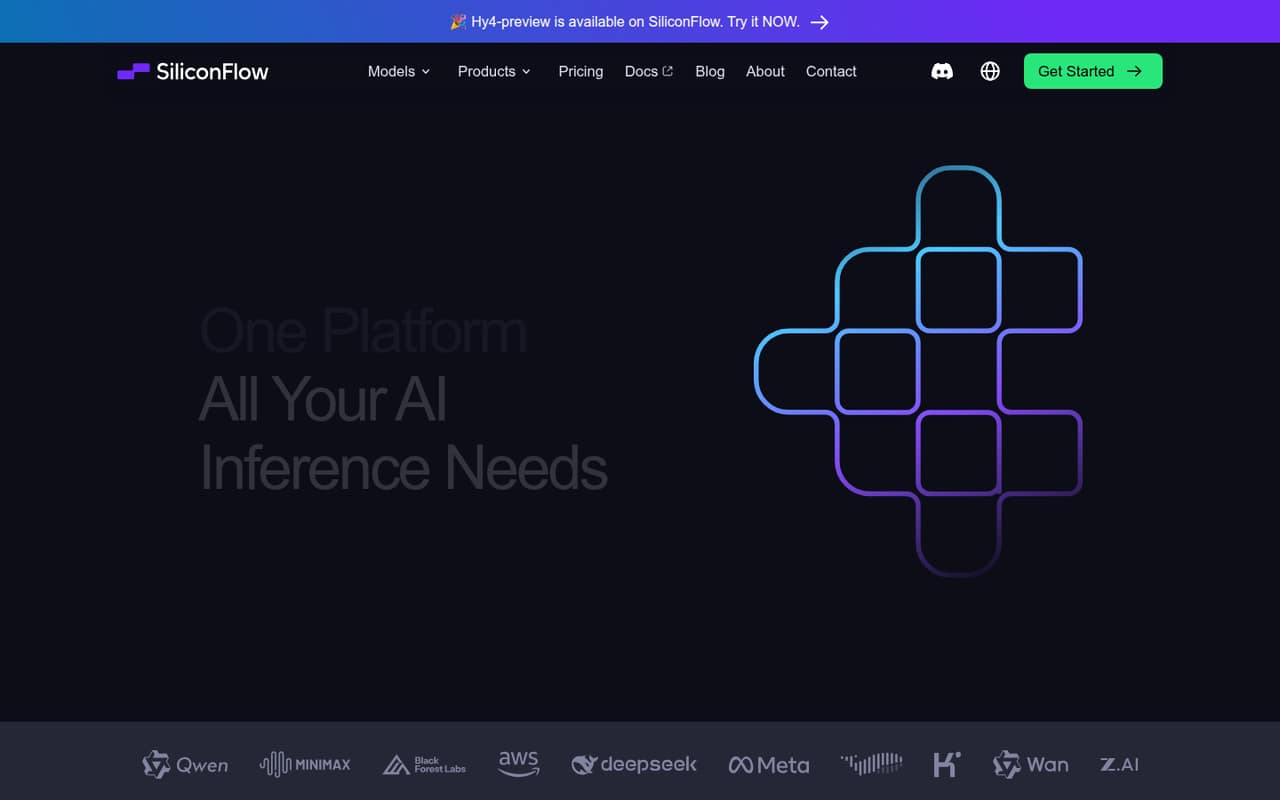
SiliconFlow is an AI inference cloud for teams that want to run open and commercial models through one OpenAI-compatible API. Its homepage lists serverless inference, fine-tuning, GPU options, an AI gateway, and text, image, video, and audio models.
There’s no free plan or fixed monthly subscription price listed. The serverless option bills by usage, so it can suit a small team with variable demand, but costs are harder to predict than a per-seat subscription. Reddit comments include praise for speed and provider satisfaction, alongside one report of trouble logging in with Google.
Good fit if
- Teams already building with model APIs
- Small teams with variable inference demand
- Developers wanting multiple model types
Skip it if
- Teams that require a free tier
- Buyers needing fixed monthly costs
- Nontechnical teams seeking guided setup
ScoresHow it rates
What works
- One OpenAI-compatible API for models
- Serverless inference billed by usage
- Fine-tuning and GPU options are listed
- Supports text, image, video, and audio
- Sample model prices are published
What doesn't
- No free plan is listed
- No fixed monthly subscription price is listed
- Costs vary with model and usage
- Team seat pricing is not listed
- One Reddit user reports Google login trouble
01Who SiliconFlow is for
SiliconFlow is aimed at developers and small teams that need to run AI models in an app or service, rather than people looking for a general-purpose chat subscription. A team of one to ten can use its unified API to access open and commercial language and multimodal models. The homepage also lists serverless inference, fine-tuning, GPU options, and an AI gateway with routing and cost controls.
The budget fit depends on demand. There is no listed seat fee or fixed monthly subscription, so a small team with light or uneven model use may prefer paying for actual inference. A team running steady, high-volume workloads should estimate usage carefully before committing. SiliconFlow publishes sample rates for some models, but your bill depends on which models you call and how much input and output you generate. It fits best when someone on the team can work with an API.
02SiliconFlow free plan and trial
SiliconFlow does not list a free plan or a free trial. The cheapest listed way in is Serverless usage-based pricing: the pricing page describes postpaid, pay-as-you-go billing, with no fixed monthly subscription price shown.
For a concrete reference, the listed rate for Qwen3.5-9B is $0.10 per 1 million input tokens and $0.15 per 1 million output tokens. DeepSeek-V4.1-Flash is listed at $0.15 per 1 million input tokens and $0.60 per 1 million output tokens. These are usage charges, not a free allowance, and the vendor does not publish a free monthly token quota here. Before moving a workload over, estimate expected input and output separately and check the live pricing page for the model you plan to use.
03What a small team pays for SiliconFlow
The listed plan is Serverless usage-based, with postpaid pay-as-you-go billing. SiliconFlow does not list a monthly or annual subscription price, per-seat fee, or minimum number of seats. One, three, or five people therefore do not have a set seat-price total; the bill follows their combined model usage.
For a simple illustration, suppose each person generates 1 million input tokens and 1 million output tokens in a month using DeepSeek-V4.1-Flash. At the listed rates, that is $0.75 per person: $0.75 for one person, $2.25 for three, and $3.75 for five. With Qwen3.5-9B, the same assumption comes to $0.25 per person: $0.25, $0.75, and $1.25. These are examples, not monthly plan prices.
The pricing page also lists FLUX.1-dev at $0.014 per image and Wan2.2-T2V-A14B at $0.29 per video. No add-on prices or annual billing rates are listed. GPU options are available, but their prices are not published on the vendor's site.
04Getting started with SiliconFlow
SiliconFlow’s homepage says its API is OpenAI-compatible, which may make it a familiar fit for developers whose applications already use an OpenAI-style API. The vendor also lists serverless inference, so teams can run models without setting up GPU capacity themselves. Fine-tuning, reserved GPU capacity, and elastic GPU deployment are other listed options, but they are not necessary to start with serverless inference.
A developer will still need to connect an application to the API and choose models; the vendor does not publish setup time or a step-by-step setup estimate in the available details. The homepage lists routing, rate limits, and cost controls in its AI gateway. Reddit feedback is mixed on access: one commenter said, “It's fast,” while another said they could not log in with a Google account. One Reddit report is not enough to predict everyone’s login experience, so check available sign-in methods before onboarding a team.
05When small teams outgrow SiliconFlow
A growing team may need to reconsider SiliconFlow when usage becomes large or steady enough that variable bills are harder to manage than a fixed commitment. The pricing page lists per-use rates, but no fixed subscription, seat-based tiers, or annual discount. It also does not publish a minimum spend or a price for the listed GPU options in the published pricing details. Ask the vendor about expected GPU costs, team administration, and support terms before depending on the service at scale.
Teams that need a free allowance may also need another starting point: SiliconFlow does not list a free plan. Public Reddit comments offer a few signals, not a full reliability picture. One commenter praised its speed, and another listed it among their satisfactory DeepSeek providers. A separate user reported they could not log in with a Google account. If predictable spend, sign-in options, or support commitments are essential, confirm those details with SiliconFlow before expanding usage.
From the threadsWhat users say
The small amount of Reddit feedback leans positive about provider satisfaction and speed, but it is not a broad review base. One commenter reported a Google login problem, so access feedback is mixed.
I think the most satisfactory providers I've used for Deepseek areDeepInfra, SiliconFlow, Novita, Parasail
It's fast
Wouldn't allow me to login with a Google account
Best pricing after DeepSeek. Anyone tested the performance ?
Questions people ask
Does SiliconFlow have a free plan?
SiliconFlow does not list a free plan or a free trial. Its listed entry point is Serverless usage-based pricing, billed postpaid according to use. The pricing page does not show a free token allowance, so teams should budget for usage from the start.
How does SiliconFlow charge for inference?
The listed serverless option uses postpaid, pay-as-you-go pricing. Rates depend on the model and whether tokens are input or output. The pricing page also lists per-image and per-video rates for selected models. It does not show a fixed monthly subscription or per-seat charge.
Is SiliconFlow compatible with the OpenAI API?
SiliconFlow’s homepage describes its unified model API as OpenAI-compatible. That may help teams connect applications built around an OpenAI-style API, but check the vendor’s current documentation for implementation details and compatibility requirements.
What kinds of models can I run on SiliconFlow?
SiliconFlow lists open and commercial language models as well as multimodal models for text, image, video, and audio. The pricing details include examples such as DeepSeek-V4.1-Flash, Qwen3.5-9B, FLUX.1-dev, and Wan2.2-T2V-A14B.
Does SiliconFlow include GPU hosting and fine-tuning?
The homepage lists fine-tuning and GPU options, including reserved capacity and flexible elastic deployment. The available pricing details do not publish prices for those GPU options, so ask SiliconFlow for a quote or current rates if you need them.