
We may earn a commission if you buy through links on this page. It never changes a score or a ranking. How we make money
The bottom line
Worth evaluating for mixed live workloads; a traditional app database may be simpler and cheaper.
SingleStore combines transactions, analytics, and AI context in one database, with data queryable as it is written. Its free Shared workspace gives a small team a way to evaluate SQL and programmability features before committing to hourly production pricing.
The trade-off is fit: teams with straightforward application workloads may not need a hybrid database, and production costs depend on usage. Reddit users report mixed results, so we’d test a representative workload before moving core systems.
Good fit if
- Teams combining transactions and analytics
- AI apps needing fresh business data
- Technical teams evaluating hybrid databases
Skip it if
- Small apps needing basic SQL
- Teams avoiding usage-based bills
- Workloads needing open storage formats
ScoresHow it rates
What works
- Combines transactions and analytics in one engine
- Includes one free Shared workspace
- Supports SQL, JSON, vector, and geospatial data
- Provides natural-language queries against live data
- Connects operational data to Apache Iceberg
What doesn't
- Production pricing is hourly and usage-dependent
- The vendor does not publish a monthly production total
- Storage format is not open, per an employee commenter
- Reddit users report workload-dependent performance
- Setup time and integration requirements are not published
01Who SingleStore is for
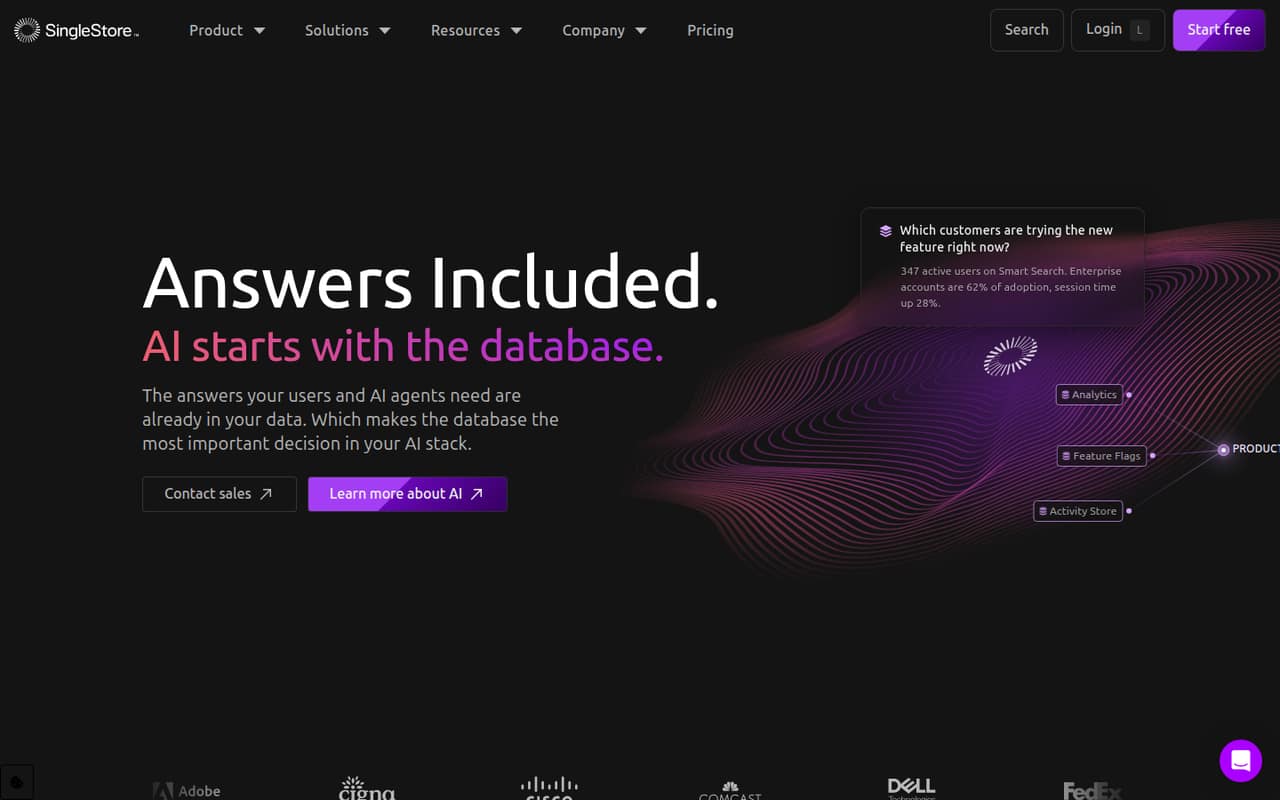
SingleStore is for technical teams that need transactions and analytics on the same current data, or are building AI features that need up-to-date business context. It combines those workloads in one database engine, with data queryable as it is written. The homepage also positions it for real-time applications and AI agents.
For a team of 1–10, the appeal is reducing the number of systems involved in a mixed workload, not replacing every database by default. SingleStore supports relational SQL, JSON, time-series, full-text, vector, and geospatial data, plus connectivity to Apache Iceberg. That breadth can be useful when the workload genuinely needs it. If your team mainly needs a conventional database for a basic app, this may be more system than you need. Reddit users describe results that vary by workload, so budget for a focused evaluation before migrating production data.
02SingleStore free plan and trial
The free Shared plan includes one free workspace, a shared workspace, SQL and programmability features, monitoring, and self-support, per the pricing page. It is listed for evaluation, development, and testing. The vendor does not publish a separate free-trial period or a detailed capacity limit on the published pricing information, so ask what workspace limits apply before relying on it for a live workload.
For a small team, this is a useful starting point for checking whether your schemas and queries fit. It is not the listed plan for general-purpose production workloads. The next plan, Standard, is usage-priced and starts at $0.99 per hour. We’d keep the free workspace for a contained proof of concept, then confirm production capacity and expected spend with SingleStore before switching.
03What a small team pays for SingleStore
SingleStore does not list production prices per seat. The pricing page lists Standard at $0.99 per hour and Enterprise at $1.49 per hour; these usage-priced plans cost the same listed hourly starting rate whether one person or a team of three or five uses the workspace. Actual monthly spend depends on usage, and the vendor lists no monthly or annual total. Shared is free for one workspace and is aimed at evaluation, development, and testing.
Standard is the entry point for general-purpose production workloads. It lists read replicas, database branching, 30-day monitoring, and a 99.9% or 99.99% SLA. Enterprise is positioned for customer-facing workloads needing disaster recovery and security; its listed features include online PITR, Smart DR, audit logging, and CMEK.
Budget for add-ons as well: the pricing page gives a SingleStore Flow example of $3.96 per credit plus $0.02 per GB processed. Storage examples list $0.023 or $0.025 per GB, with rates varying by example and region. SingleStore says it does not charge for data ingress, though cloud-provider charges may apply.
04Getting started with SingleStore
Expect a technical evaluation rather than a plug-and-play setup. SingleStore is a SQL database with programmability features, so your team will need to understand its schemas, queries, and workload before deciding how much to move. The product also includes a Context Engine that maps data schemas, relationships, and definitions for agents, and a natural-language Analyst for questions against the live database.
The vendor does not publish a setup-time estimate or a day-one integration checklist in the pricing information. It lists connectivity to Apache Iceberg, but the details of other integrations and migration steps should be confirmed with the vendor. One Reddit commenter recommends a small proof of concept to check performance and complexity trade-offs rather than attempting a 1:1 migration. For a small team, start with one representative analytics or AI use case, then verify operational requirements and expected hourly usage before expanding.
05When small teams outgrow SingleStore
A growing team may outgrow the free Shared workspace when it needs production workloads: the pricing page points general-purpose production users to Standard, starting at $0.99 per hour. Customer-facing workloads needing disaster recovery and security may need Enterprise, which starts at $1.49 per hour. Both are hourly, so rising usage—not headcount alone—is the cost question to watch.
There are also workload and compatibility questions. In one Reddit thread, a user reported performance comparable to PostgreSQL on their use case but a “vast reduction in features and compatibility.” An employee commenter said SingleStore’s storage format is not open and described READ COMMITTED for regular transactions and SNAPSHOT for backup. Those comments are not a substitute for checking current product documentation, but they flag real evaluation points. Teams that need open formats, specialized database features, or a simpler single-machine app database may prefer another design.
From the threadsWhat users say
Reddit sentiment is mixed: some commenters question product fit, compatibility, and bold performance claims, while an employee commenter describes a sweet spot in blended transaction and analytics workloads. The discussions support evaluating the specific workload rather than assuming one database suits every team.
Our sweet spot is a blend between OLTP (transactions) and OLAP (analytics)
with our real use case, SingleStore had comparable performance to PostgreSQL, with a vast reduction in features and compatibility
some other database engines like MS SQL also support this, it's not novel or unique to SingleStore
Our storage format is not open
Questions people ask
What is SingleStore?
SingleStore is a database for transactions, analytics, and AI context. It combines those workloads in one engine and makes data queryable as it is written. It supports relational SQL, JSON, time-series, full-text, vector, and geospatial data, and connects operational data to Apache Iceberg.
Does SingleStore have a free plan?
Yes. The Shared plan includes one free workspace, SQL and programmability features, monitoring, and self-support. It is listed for evaluation, development, and testing. The vendor does not publish a separate trial period or a detailed capacity limit in the pricing information, so confirm workspace limits before planning a production use.
How much does SingleStore cost?
Shared is free for one workspace. Managed production plans are priced by the hour: Standard starts at $0.99 per hour and Enterprise at $1.49 per hour. The vendor does not list a fixed monthly or annual total; actual cost depends on usage. Flow and storage may add charges.
Is SingleStore a good fit for a small team?
It can fit a small technical team that needs transactions, analytics, and AI features on current data in one system. The free Shared workspace supports evaluation. For a straightforward app workload, a conventional database may be simpler; check your own workload before choosing a production plan.
Does SingleStore support AI applications?
SingleStore positions its product for AI applications and agents that need current business data. Its Context Engine maps schemas, relationships, and definitions, and its natural-language Analyst lets users ask questions against a live database. The product also supports vector data.