
We may earn a commission if you buy through links on this page. It never changes a score or a ranking. How we make money
The bottom line
Sirion covers the contract lifecycle, but custom pricing puts it out of reach for many small teams.
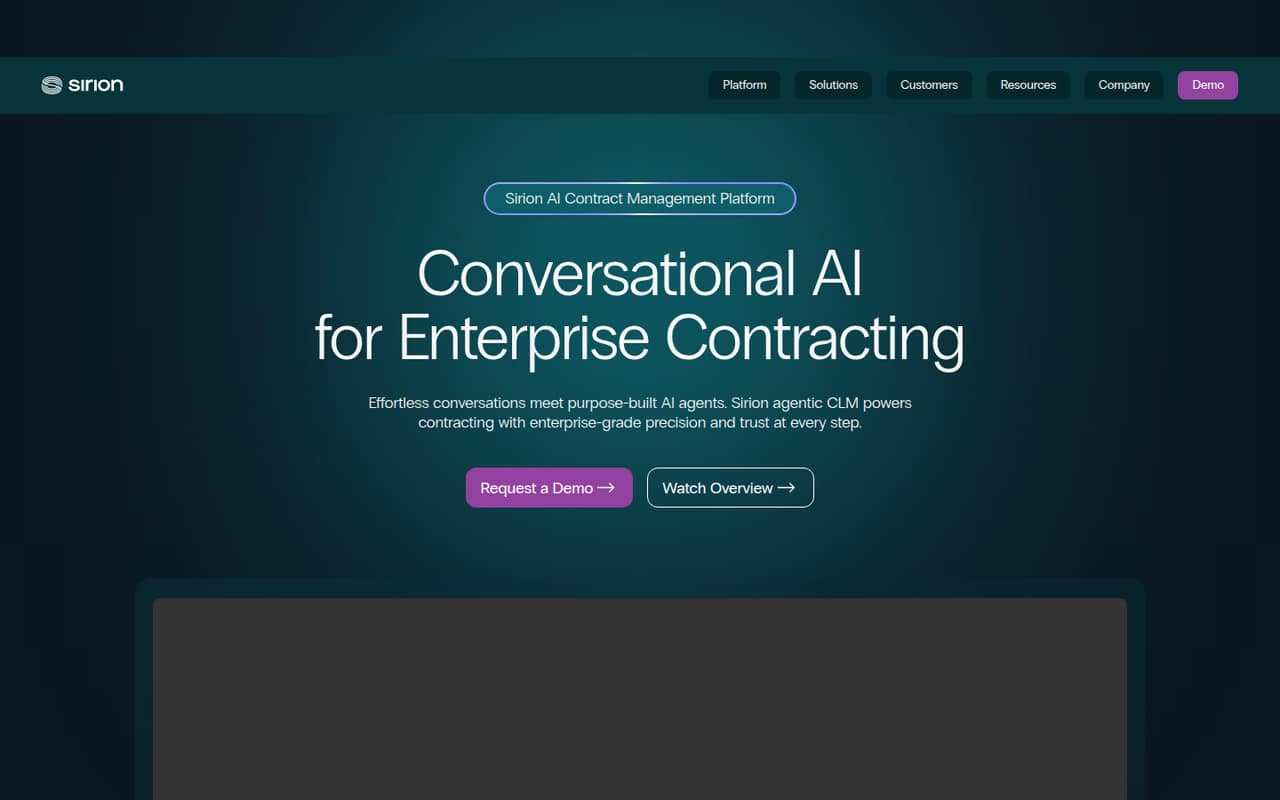
Sirion is an enterprise contract lifecycle management platform for centralizing agreements and using AI agents to search, draft, review, and track contracts. Its feature set is broad, but the pricing page lists custom quotes rather than rates a small team can compare.
There’s no listed free plan, and the vendor doesn’t publish seat or usage limits. A team of one to ten should ask for a quote and implementation details before investing time in evaluation.
Good fit if
- Enterprise contract operations
- Teams automating contract review
- Companies with complex workflows
Skip it if
- Teams needing a free CLM
- Buyers requiring published seat prices
- Small teams with simple contracts
ScoresHow it rates
What works
- Centralizes contracts in an access-controlled repository
- Search agents answer with citations
- Agents can draft and propose redlines
- Risk review covers third-party contract paper
- Monitors obligations and notifies owners
What doesn't
- No free plan is listed
- Pricing requires a custom quote
- Seat limits are not published
- Usage limits are not published
- Specific integrations and setup effort are unclear
01Who Sirion is for
Sirion is aimed at enterprise contract teams, not clearly at a one-to-ten-person business watching every subscription. It brings contract storage, search, drafting, negotiation, risk review, and obligation monitoring into one contract lifecycle management platform. Its agents can also be built to connect with other agents and enterprise data sources.
That breadth may suit a team handling agreements across departments, especially when contracts need structured access, review steps, and ongoing obligation tracking. For a small team, the key question is whether those workflows solve a costly problem or add more platform than the team needs. The pricing page lists a custom quote, with no published starting rate or seat limits, so a tight-budget buyer cannot confirm affordability from the page alone. Ask Sirion for a quote covering your expected users, contract volume, and required workflows before treating it as a practical fit.
02Sirion free plan and trial
The pricing information lists no free plan, and no free trial is listed. That means a small team should not expect to use Sirion at no cost before committing. The listed Enterprise plan is custom-quote based, so the cheapest way in is to request pricing from Sirion; there is no published lower-cost tier to compare.
The vendor does not publish what a quote includes, such as seat allowances, usage limits, implementation services, or a trial period. Ask whether a team can evaluate the repository, conversational search, drafting, and risk-review agents before signing, and whether the quote changes with contract volume or the number of users. Get those terms in writing so a low initial quote does not hide limits your team will hit.
03What a small team pays for Sirion
The pricing page lists one plan, Enterprise, with custom pricing. It does not publish a monthly or annual rate, and it does not publish seat or usage limits. So we can’t calculate what one person, three people, or five people would pay per month, or compare monthly billing with an annual commitment. Ask Sirion for both billing options and a quote for your exact seat count.
The pricing information lists no add-ons, but that does not establish whether optional modules or services affect a quote. Ask whether repository setup, agent configuration, integrations, support, and additional contract volume are included or priced separately. For a small team, the practical buying test is a written total for the users and workflows you need, plus the cost of adding seats later. Until Sirion provides that, there is no published starting price a budget-conscious buyer can use to screen the product.
04Getting started with Sirion
Sirion’s described capabilities suggest a team would need to organize contracts in a structured repository, set access controls, and decide how its agents should support search, drafting, risk review, and obligation monitoring. But Sirion does not publish setup time or a learning-curve estimate in the pricing information. Ask the vendor what configuration and training your team would handle, and what help is included in its quote.
The platform can connect custom agents to other agents and enterprise data sources, but no specific integrations are named here. One r/legaltech buyer considering Sirion lists Salesforce integration as a requirement; that discussion does not confirm that Sirion offers a particular Salesforce connection. Before choosing it, confirm the connectors your team needs, how contract data moves between systems, and whether setup requires technical help.
05When small teams outgrow Sirion
For a small team, the first concern may be fit rather than outgrowing the product: Sirion is positioned for enterprise contract work, and its pricing is custom. If the team grows, the absence of published seat and usage limits makes it hard to forecast when costs change or whether current capacity will cover more contracts and users. Ask for limits and expansion pricing before signing.
One r/legaltech thread describes a mid-sized company evaluating Sirion alongside other CLM vendors, with AI, Salesforce integration, and multi-department workflows as buying criteria. It is a request for advice, not a report from a Sirion customer, so it offers no evidence about actual scaling costs or product limits. A growing team should compare Sirion’s written quote and connector coverage with alternatives before standardizing on it. If your workflows remain simple, a more plainly priced tool may be easier to budget for.
From the threadsWhat users say
The Reddit discussion is a buyer’s evaluation question, not a first-hand account of using Sirion. It identifies enterprise AI, integration, and workflow needs but gives no clear verdict on the product.
strong AI capabilities
Salesforce integration
multi-department workflows
Any experiences or insights on these vendors?
Questions people ask
What does Sirion do?
Sirion is a contract lifecycle management platform for enterprise teams. It centralizes contracts, provides conversational search, supports agreement drafting and risk review, and monitors obligations. Its agents can connect to other agents and enterprise data sources, according to the product description.
Does Sirion have a free plan or trial?
The pricing information lists no free plan, and no free trial is listed. Ask Sirion whether it offers a guided evaluation or trial for prospective customers, and whether that access is included in a quote. Don’t assume there is a self-serve way to test the platform.
How much does Sirion cost?
Sirion’s pricing page lists a custom quote for its Enterprise plan, not a monthly or annual rate. It also does not publish seat or usage limits, so the cost for one, three, or five users cannot be calculated from listed prices. Request a written quote for your team size.
Does Sirion integrate with Salesforce?
A Reddit buyer mentions Salesforce integration as a requirement while considering Sirion, but that discussion does not confirm Sirion has a Salesforce connector. Sirion describes custom agents that connect to enterprise data sources. Ask the vendor whether your Salesforce setup is supported and what configuration it requires.
What can Sirion’s AI agents do?
Sirion’s described agents can answer questions about contract terms with citations, assemble draft agreements from a playbook, propose redlines, and identify risks in third-party contracts. Other agents monitor obligations and SLAs, surface gaps, and notify owners. The platform also supports building and deploying custom agents.