
We may earn a commission if you buy through links on this page. It never changes a score or a ranking. How we make money
The bottom line
Free, reliable SQL for embedded data; plan for a different tool if many clients need shared access.
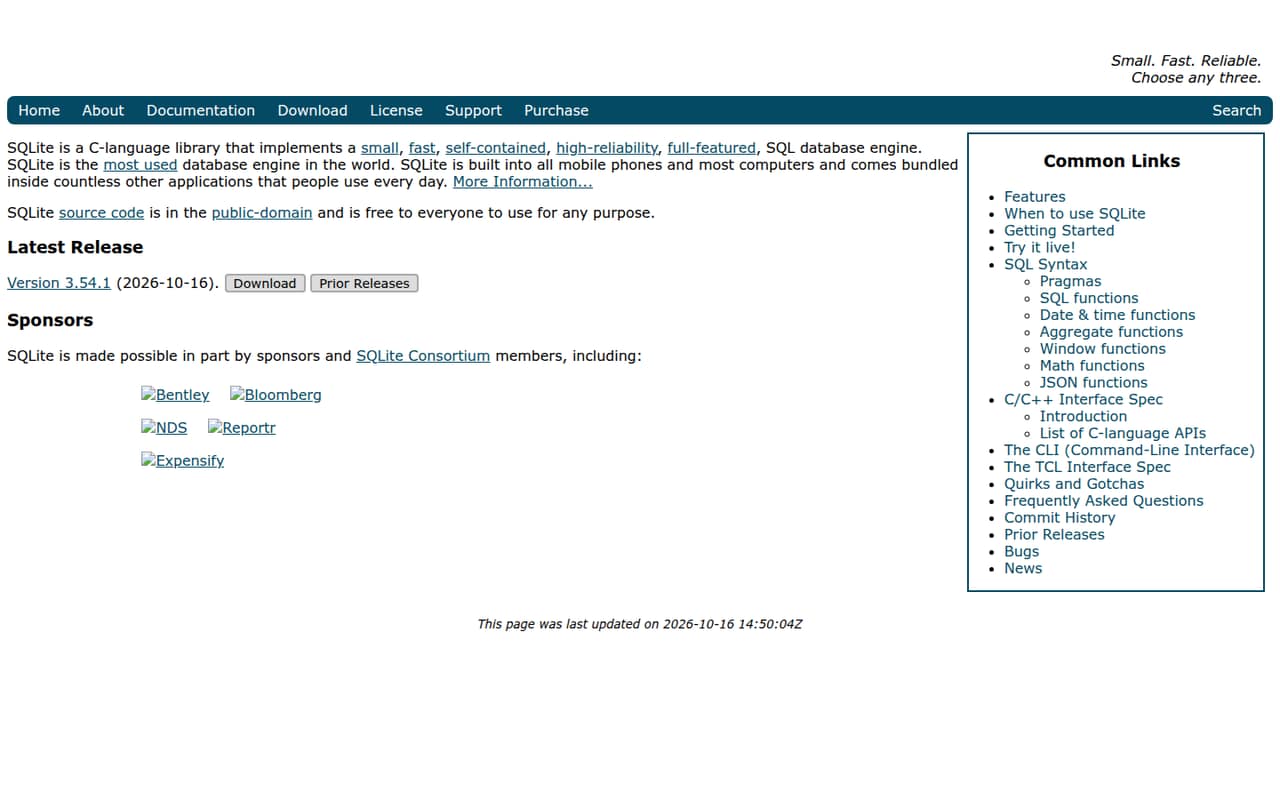
SQLite is a small, self-contained SQL database engine delivered as a C library. Its core code is public domain and free to use, making it a good fit for small teams building apps or handling local data without a separate database service.
The trade-off is support and workload fit: public forum help is free, while annual maintenance starts at $1,500 for one development team. Reddit users praise its simplicity and reliability, but caution that networked, multi-client workloads may call for a different database.
Good fit if
- Apps storing data on devices
- Small teams with tight budgets
- Local databases and read-mostly data
Skip it if
- Many clients sharing a network database
- Teams needing included direct support
- Projects planning for constant scaling
ScoresHow it rates
What works
- Core engine is public domain and free
- Implements a full-featured SQL database
- Small and self-contained by design
- No per-seat license price for core use
- Users praise its simplicity and reliability
What doesn't
- Paid annual maintenance starts at $1,500
- Free support is through a public forum
- Not a fit for every networked workload
- Teams must integrate the library into an application
- Future scaling needs deserve early planning
01Who SQLite is for
SQLite suits a small team—whether one developer or a group of up to ten—building an application that needs a database close to the app or its users. The homepage describes it as a small, fast, self-contained C-language library that implements a full-featured SQL database engine. In plain terms, it lets an application use SQL with a database engine embedded as a library, rather than requiring a separate database service.
That makes the free core attractive when every subscription matters and the job is local data, an app’s stored state, or a relatively contained workload. Reddit users describe choosing it for read-mostly datasets and embedded applications. It is less compelling when your main need is a shared backend for many networked clients, or when you want a vendor-managed service and direct support included. The deciding question is less “How many seats?” and more “Where does the data live, and who needs to access it?”
02SQLite free plan and trial
SQLite is not presented as a seat-based SaaS plan with a trial. The core source code is in the public domain and free for anyone to use for any purpose, so there is no core license fee for one person or a team of five. The pricing listing also includes a free Public Forum for community support; seat and usage limits are not published.
The free code does not mean dedicated vendor help is included. For one development team needing maintenance, the listed Annual Maintenance Subscription costs $1,500 per year and covers one contact person and up to 20 contact hours annually. Organizations seeking direct technical support have a standard agreement listed at $8,000 for one year. So a small team can start with no license spend, but should budget separately if it needs paid support.
03What a small team pays for SQLite
For the core engine, one person, three people, or five people all pay $0 in license fees: SQLite’s source code is public domain and free to use. There is no published per-seat price, and monthly subscription prices are not published. Paid support is quoted annually.
The Annual Maintenance Subscription is listed at $1,500 per year for one development team, one contact person, and up to 20 contact hours. That is $1,500 annually for one person; if a team of three or five shares the same team subscription, the illustrative cost is $500 or $300 per person per year. Those are simple cost splits, not per-seat rates or additional contact entitlements. The standard Technical Support agreement is $8,000 for one year; custom packages are generally listed at $8,000–$35,000 annually. The SQLite Encryption Extension is a $2,000 one-time fee for one team. Other paid options include compression extensions, while guaranteed response time and SEE support prices are not published.
04Getting started with SQLite
The homepage describes SQLite as a C-language library, so getting started means using the database engine from an application rather than setting up a seat-based hosted workspace. A team needs an application that can work with the library and a database design suited to its data. The product description identifies SQL as the database interface; it does not identify a required third-party integration for day one.
The learning curve depends on what your team already knows: SQL skills help with querying and structuring data, while integrating a C library may require application-development work. Reddit users describe SQLite as simple and low-overhead, including for embedded data stores, but that is not the same as having no setup work. One commenter also cautions against treating an open database file like an ordinary file copy while it is open. Check the project’s backup guidance before choosing a backup routine.
05When small teams outgrow SQLite
Outgrowing SQLite is usually about the shape of the workload, not the number of seats. Reddit users point to networked applications with many access points and concurrent users as cases where a database designed for multiple clients may be a better fit. One commenter says SQLite works well for its intended job but is a poor fit when that job is misunderstood; another recommends PostgreSQL or another database designed for many clients in a networked architecture.
Plan a move sooner if your roadmap calls for constant growth, shared backend access, or scaling beyond a contained workload. A Reddit commenter who used SQLite for years advises considering long-term plans before adopting it when scaling needs are expected. The pricing does not impose a per-seat upgrade as the team grows, but paid help can become material: maintenance is $1,500 per year, standard technical support is $8,000 for one year, and custom support packages are generally listed at $8,000–$35,000 annually. Those costs buy support, not a different workload model.
From the threadsWhat users say
Reddit sentiment is mostly positive about SQLite’s simplicity, reliability, and usefulness for embedded or local data. The main reservations are workload fit—especially networked, concurrent access—and the need to think ahead about scaling.
Once that clicks it becomes obvious that SQLite would be good solution
SQLite and LMDB are two of the easiest alternatives to working through that process yourself
Because most applications in production are accessed from multiple points
developers should carefully consider what their long-term plans are
Questions people ask
Is SQLite free for a small team?
Yes. SQLite’s core source code is in the public domain and free for anyone to use for any purpose, so there is no per-seat core license fee. The listed Public Forum is also free. Paid maintenance and direct technical support are separate options, with annual prices listed for those services.
Is SQLite suitable for production?
It can be, when the application’s workload fits. Reddit users report using SQLite in shipped applications and embedded systems, while others caution that shared, networked workloads with many clients may need a different database. Decide based on access patterns and growth plans rather than the word “production” alone.
What are SQLite’s main downsides?
The main concern raised by Reddit users is fit for networked, multi-client workloads. SQLite is a library, not a seat-based hosted database service, so a team also needs to integrate it into its application. Direct support costs extra, and annual support prices can be significant for a small team.
Does SQLite include free technical support?
The pricing listing includes a free public forum, but it does not list dedicated technical support as free. Annual Maintenance Subscription is $1,500 per year for one development team, one contact person, and up to 20 contact hours. Standard Technical Support is listed at $8,000 for one year.
Can a growing team keep using SQLite?
Yes, if its workload continues to fit SQLite’s role. Team size alone does not create a published per-seat charge for the core engine. Reddit users advise planning a change when growth brings many networked clients or scaling needs that call for a database designed for that architecture.
Sources
- SQLite homepage
- SQLite pricing, compiled via web search from sqlite.org
- Reddit: Why isn't SQLite more commonly used for save files or for other user-facing application file formats?
- Reddit: Why does SQLite (in production) have such a bad rep?
- Reddit: SQLite is not a toy database
- Reddit: Why you should probably be using SQLite