
We may earn a commission if you buy through links on this page. It never changes a score or a ranking. How we make money
The bottom line
Free to self-host, but best for small teams with the skills to run a data warehouse.
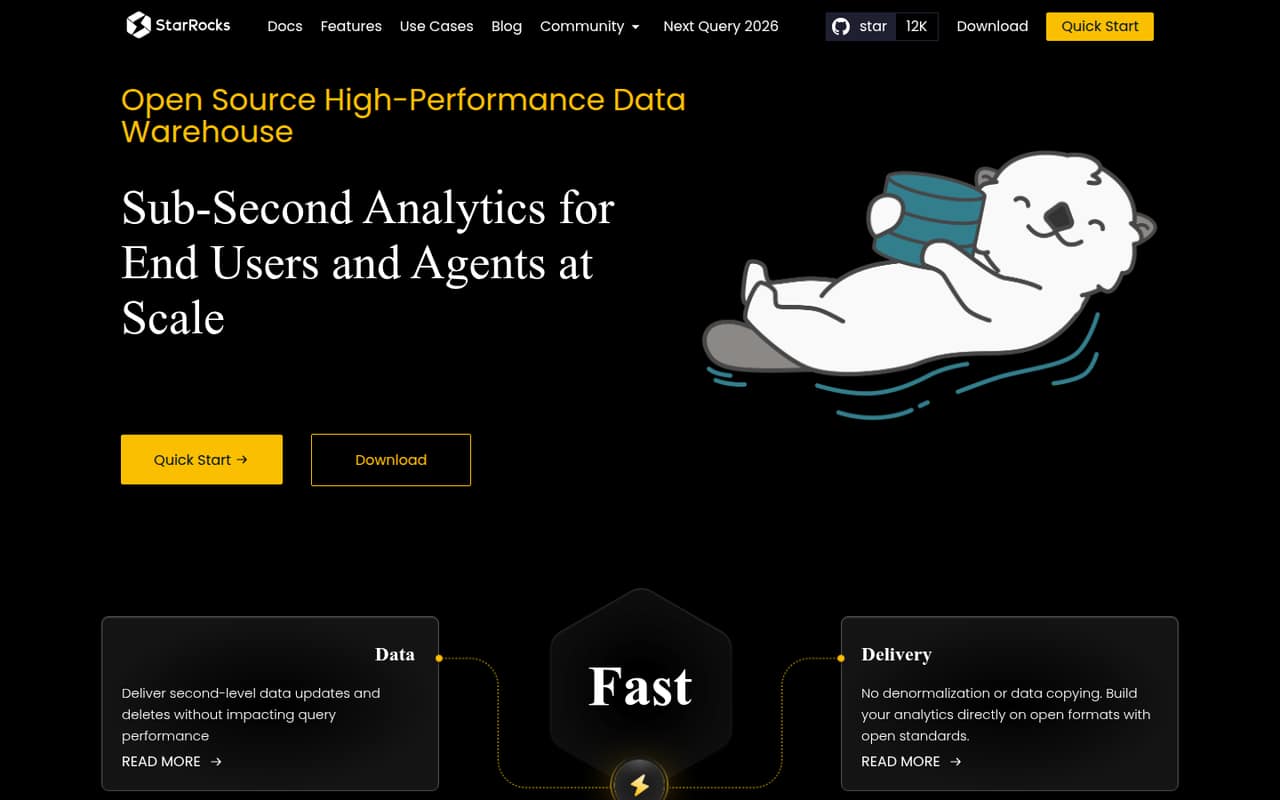
StarRocks is an open-source warehouse for real-time analytics, lakehouse queries, and AI workloads. Its homepage highlights sub-second complex queries, quick updates and deletes, and analytics on open formats without copying data or denormalizing it.
The Open Source plan is free to download and self-host under Apache License 2.0. That keeps the software cost at zero for a small team, but the pricing page lists no hosting or support rates. Reddit users praise its performance for some workloads, while also flagging self-deployment effort and bugs.
Good fit if
- Data-savvy teams of 1–10
- Real-time analytics on fresh data
- Teams querying open data formats
Skip it if
- Teams wanting managed pricing clarity
- Small teams without deployment skills
- Workloads needing published support terms
ScoresHow it rates
What works
- Free to download under Apache License 2.0
- Supports second-level data updates and deletes
- Designed for sub-second complex queries
- Queries open formats without copying data
- Reddit users report strong results for some workloads
What doesn't
- The pricing page lists no hosting rates
- Self-hosting means taking on deployment
- The vendor does not publish trial terms
- Support pricing and terms are not published
- Reddit users mention bugs and a need for help
01Who StarRocks is for
StarRocks makes sense for a small data or engineering team that needs fast analytics on fresh data and has someone comfortable owning a database deployment. For a 1–10-person company, the price of the software can fit a tight budget: the Open Source plan is free to download and self-host under Apache License 2.0. You still need to account for the people and infrastructure required to run it; the pricing page does not list those costs.
In plain terms, StarRocks stores and queries data for analytics. Its homepage pitches sub-second complex, multi-table queries, quick updates and deletes, and direct analytics on open formats without copying or reshaping data first. That can suit teams building real-time dashboards, lakehouse queries, or low-latency AI agent serving. It is a less natural fit if your team wants a managed, hands-off warehouse with a clearly published bill.
02StarRocks free plan and trial
The pricing page lists an Open Source plan that is free to download, self-hosted, and licensed under Apache License 2.0. That makes it the cheapest way in: there is no listed software charge for one person or a small team. The plan is not described as a hosted service, so a team choosing it takes on running the deployment.
The vendor does not publish a free-trial offer or trial terms on the pricing page. It also does not list limits for the free plan, such as storage, capacity, or support. Before adopting it, ask the vendor what support is available, and estimate your own infrastructure and maintenance costs. Reddit users discussing self-deployment say teams may need help; one commenter also describes both projects in a comparison as buggy.
03What a small team pays for StarRocks
For a one-person team, the listed Open Source software price is $0 to download and self-host. For three or five people, the published software-price math is still $0: the plan is not priced per seat. Those figures cover the listed software plan, not the cost of running it. The pricing page publishes no monthly or annual rate, billing terms, or infrastructure costs, so we cannot give a complete monthly bill for one, three, or five users.
The pricing page also lists no add-ons. That does not establish whether managed hosting or paid support is available or what either costs; ask the vendor for current options and terms before budgeting. For a small team watching subscriptions, the free license is attractive, but self-hosting shifts the cost question to infrastructure and staff time. Those costs depend on your setup and are not published in the pricing information.
04Getting started with StarRocks
The entry point is a self-hosted download, not a listed hosted trial. That means your team should plan to handle deployment and ongoing operation; the pricing page does not provide a setup estimate or list installation steps. We would budget for someone on the team to evaluate those requirements before using StarRocks for important reporting.
The homepage describes querying open formats and standards directly, without denormalization or data copying, and highlights real-time analytics and lakehouse queries. One Reddit commenter says StarRocks can connect to data lake storage, while another mentions querying external catalogs. Those are user reports, not a complete integration list, so confirm that your specific formats and catalog work before committing. In a Reddit discussion, a commenter says self-deploying teams may need help and calls both projects buggy. The vendor does not publish a setup-effort estimate in the pricing details.
05When small teams outgrow StarRocks
The first reason to move on may be operational, not a seat limit. The pricing page lists a self-hosted open-source plan but publishes no capacity limits, paid tiers, or upgrade thresholds. As workloads grow, ask the vendor how to plan capacity and what managed hosting or support would cost; those rates are not listed.
A team may also outgrow the skills it can spare for deployment and maintenance. In a Reddit comparison, one commenter says self-deploying teams may need help and describes both projects as buggy. Another commenter reports that resource isolation was a weak point in their experience, while saying related work was underway at the time; treat that as one user's dated report, not a current product guarantee. If your team wants less operational work, request current hosting and support details before deciding whether to stay or move.
From the threadsWhat users say
The Reddit discussion includes enthusiastic reports from users who chose StarRocks for particular workloads, especially data updates and lakehouse queries. Sentiment is not uniformly positive: commenters also raise self-hosting effort, bugs, community considerations, and the limits of comparisons based on old or scarce benchmarks.
StarRocks handles things differently. It replaces duplicate rows in real-time
For my environment, StarRocks was able to outpace Druid and Pinot by a significant measure
Unfortunately, there are very few publicly available benchmark results about the two
Questions people ask
Is StarRocks free for a small team?
The pricing page lists an Open Source plan that is free to download and self-host under Apache License 2.0. It does not publish infrastructure costs, support pricing, or hosting rates, so free software does not mean a fully cost-free deployment. Ask the vendor about any paid options you may need.
Does StarRocks charge per user?
The listed Open Source plan is not shown with a per-seat price. Its published software cost is free to download, whether one person or a small team uses it. The pricing page does not list infrastructure or support costs, so ask the vendor how those would affect your total bill.
Is StarRocks managed or self-hosted?
The Open Source plan listed on the pricing page is self-hosted. The pricing page does not publish rates or terms for a hosted option. If your team does not want to operate a deployment, ask the vendor whether a managed service is available and request current pricing and support terms.
What can StarRocks query?
StarRocks' homepage describes analytics on open formats and standards without denormalization or data copying, along with real-time and lakehouse queries. A Reddit commenter also mentions external catalogs. Check with the vendor that your specific formats and catalog are supported before planning a deployment.
Does StarRocks offer a free trial?
The pricing page does not publish a free-trial offer or trial terms. It does list a free-to-download, self-hosted Open Source plan under Apache License 2.0. Ask the vendor whether it offers a trial of any hosted or support options, and what conditions apply.