
We may earn a commission if you buy through links on this page. It never changes a score or a ranking. How we make money
The bottom line
Status.io covers incidents and notifications well, but costs at least $79 monthly with no free plan.
Small teams need Status.io if customers rely on their service and need a clear place to check outages, maintenance, and service health. It combines a hosted public status page with incident updates, subscriber notifications, metrics, and page customization.
The Basic plan costs $79 monthly or $75.05 per month with annual billing. It includes one public page, five team members, 500 subscribers, and five metrics. There is no free plan or trial listed, so teams with only occasional updates may find the entry price steep.
Good fit if
- Small teams managing customer-facing services
- Teams needing incident and maintenance notices
- Companies that want subscriber notifications
Skip it if
- Teams that need a free status page
- Organizations needing multiple public pages
- Teams wanting more than five Basic metrics
ScoresHow it rates
What works
- Basic includes five team members
- Email, SMS, and other notification options
- Scheduled maintenance and subscriber reminders
- Custom charts through the Custom Metric API
- 24/7 human support on Basic
What doesn't
- No free plan or trial listed
- Basic starts at $79 per month
- Basic limits teams to 500 subscribers
- Each listed plan includes one public page
- Basic includes only five metrics
01Who Status.io is for
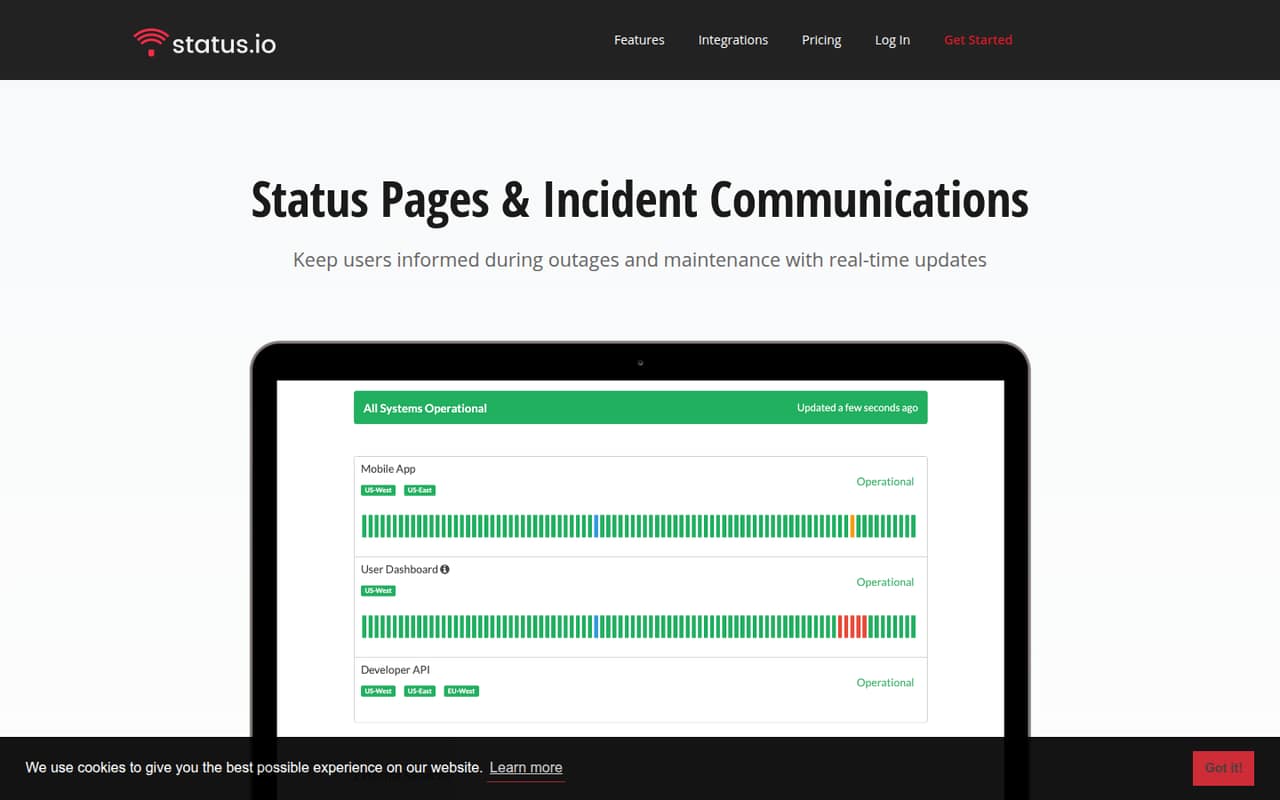
Status.io is for small teams that run a service customers depend on and need a central place to report outages, maintenance, and service health. The hosted page can show component statuses and incident history, while notifications keep subscribers informed through channels such as email, SMS, webhooks, RSS, and Slack.
The Basic plan is sized for up to five team members, 500 subscribers, and five metrics, with one public status page. That makes it a plausible fit for a founder-led support or engineering team that needs a formal customer update channel but does not need several separate pages. The starting cost is $79 per month, or $75.05 per month with annual billing, so this is not a casual free add-on. Teams that only need to post the occasional service note may be better off with a simpler option; Status.io makes more sense when incident communication is part of the service customers expect.
02Status.io free plan and trial
The pricing page lists no free plan, and no free trial is listed. That means a small team cannot test Status.io on a lasting free tier before committing, based on the published pricing. The cheapest way in is Basic, which costs $79 per month or $75.05 per month with annual billing.
Basic includes one public status page, five team members, 500 subscribers, five metrics, and 24/7 human support. It is enough for a small team to publish service updates and communicate with a modest subscriber list, but the plan has firm limits. If you need more than five teammates, subscribers, or metrics, the next listed tier is Standard. Ask the vendor about trial access if you need to evaluate the setup before paying.
03What a small team pays for Status.io
The pricing page lists Basic at $79 per month, or $75.05 per month with annual billing. That works out to $79 or $75.05 per person for one person; for three people, the plan cost divided across seats is about $26.33 monthly or $25.02 annually; for five, it is $15.80 monthly or $15.01 annually. These are plan-cost averages, not per-seat prices. Annual billing is listed at a 5% discount, and purchase-order invoicing is available only on annual plans.
Basic includes five members, 500 subscribers, five metrics, one public page, and 24/7 human support. Standard costs $149 monthly or $141.55 with annual billing and raises the limits to 20 members, 2,000 subscribers, and 20 metrics. Plus is $349 monthly or $331.55 annually, with 50 members, 5,000 subscribers, and 50 metrics. The pricing lists no add-ons. Enterprise starts at $999 per month.
04Getting started with Status.io
The vendor does not publish a setup-time estimate, so we would not count on a specific number of minutes or hours. At a minimum, a team needs to configure its status page and components, decide how it will report incidents and maintenance, and choose which notification channels to use. The feature list includes custom page sections, graphics, colors, and options to add HTML, JavaScript, or CSS.
For day one, a small team can start with the public page and the notification channels its customers already use. Status.io lists email, SMS, webhooks, RSS, iCalendar, IRC, Microsoft Teams, Slack, and Twitter/X. Metrics can use the Custom Metric API or external data sources. The vendor does not publish a learning-curve estimate here, so teams with custom design or metric needs should ask about the setup work before choosing a plan.
05When small teams outgrow Status.io
The first upgrade trigger is Basic's cap of five team members, 500 subscribers, or five metrics. Standard raises those limits to 20 members, 2,000 subscribers, and 20 metrics, but costs $149 per month or $141.55 with annual billing. A team that crosses those Basic limits needs to decide whether the Standard increase fits its budget and audience.
Page count is another consideration: each listed plan includes one public status page. The published tiers do not show a higher page allowance, so teams that need separate pages should ask the vendor what options are available. Plus raises the listed limits to 50 members, 5,000 subscribers, and 50 metrics at $349 monthly or $331.55 annually. Enterprise starts at $999 per month. A team may outgrow the product when its required page count or budget no longer matches those published tiers.
Questions people ask
Does Status.io have a free plan?
The pricing information lists no free plan and no free trial. The cheapest listed option is Basic at $79 per month, or $75.05 per month with annual billing. Basic includes one public status page, five team members, 500 subscribers, five metrics, and 24/7 human support.
How much does Status.io cost for a small team?
Basic costs $79 per month or $75.05 per month with annual billing. It includes up to five team members, so the plan-cost average for five people is $15.80 monthly or about $15.01 with annual billing. Those are averages across the plan, not individual seat prices.
What does Status.io Basic include?
Basic includes one public status page, five team members, 500 subscribers, five metrics, and 24/7 human support. It supports incident and maintenance updates, subscriber notifications, and status metrics. The published starting price is $79 per month, with a 5% discount for annual billing.
Can Status.io send maintenance and incident notifications?
Yes. Status.io supports incident updates and scheduled maintenance with subscriber reminders. Its listed notification channels include email, SMS, webhooks, RSS, iCalendar, IRC, Microsoft Teams, Slack, and Twitter/X. The Basic plan includes 500 subscribers.
How many status pages does a Status.io plan include?
Each listed plan includes one public status page. The published plan details do not give a higher page allowance for Standard, Plus, or Enterprise. If your team needs separate pages for different services or audiences, ask the vendor which options are available before purchasing.