
We may earn a commission if you buy through links on this page. It never changes a score or a ranking. How we make money
The bottom line
Good incident communication for small teams, though subscriber and seat limits can make costs climb.
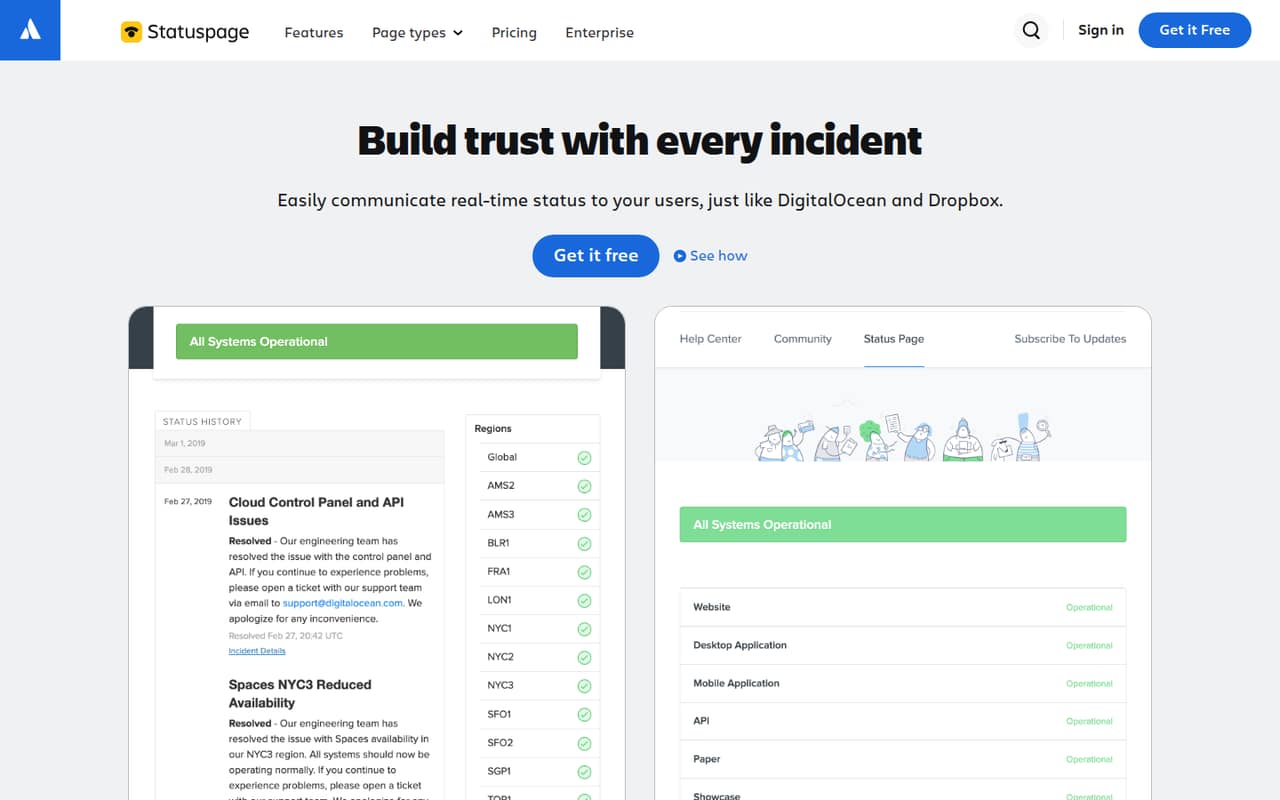
Statuspage gives teams a dedicated place to share service status and incident updates with customers or employees. Its free public plan is a sensible start for a small team that can work within two team members and 100 subscribers.
For a public page with three to five team members, Hobby costs $29 per month. Private pages start at $79 per month, so teams should pick based on who needs updates—not just the lowest listed price.
Good fit if
- Small teams posting public incidents
- Companies sending customer status updates
- Teams needing public and private page options
Skip it if
- Teams needing free access for over two members
- Organizations seeking built-in monitoring
- Teams with tight budgets and many subscribers
ScoresHow it rates
What works
- Free public page includes two team members
- Hobby supports five team members for $29 monthly
- Public, private, and audience-specific page options
- Supports email, SMS, and webhook notifications on higher plans
- Incident templates help structure status updates
What doesn't
- Free plan is limited to 100 subscribers
- Free plan allows only two team members
- Hobby has a 250-subscriber limit
- Public Startup jumps to $99 per month
- Annual discounts and setup time aren't published
01Who Statuspage is for
Statuspage is for small organizations that need a reliable place to explain service incidents to customers or employees. It puts status updates, incident progress, service components, and historical uptime on a page people can check. Teams can also send updates to subscribers by email, SMS, or in-app messages, depending on the plan and setup.
A one- or two-person team can start on the free public plan. A team of three to five people should budget $29 per month for Hobby if it needs a public page, while internal updates start at $79 per month for Starter. Those prices make sense when incident communication is part of customer support or service operations. Statuspage is not a replacement for monitoring: it connects with monitoring and alerting tools, while the page communicates what is happening. Teams looking for monitoring itself should check that their existing tools cover it.
02Statuspage free plan and trial
Statuspage has a free plan for public status pages. Free (Public Page) includes 100 subscribers, 25 components, two team members, two metrics, and email, Slack, and Microsoft Teams notifications. That is enough for a very small team sharing a basic public service status.
The limits are the catch: a third teammate means moving to a paid public plan, and more than 100 subscribers also exceeds the free allowance. The cheapest paid public option is Hobby at $29 per month, with five team members and 250 subscribers. The pricing lists no free trial. For internal-only updates, Free is not the entry plan; Starter (Private Page) costs $79 per month and includes five team members and 50 employees.
03What a small team pays for Statuspage
For a public page, Free (Public Page) costs $0 and covers up to two team members. Hobby (Public Page) costs $29 per month for up to five members. That is $29 per month for one paid seat, or about $9.67 per seat for three and $5.80 for five, assuming the full plan is used. The monthly price works out to $348 over 12 months; the pricing page lists no annual discount.
A team of three or five that needs a public page can fit Hobby, provided it stays within 250 subscribers. The next public tier, Startup, is $99 per month for up to 10 team members and 1,000 subscribers. For internal pages, Starter starts at $79 per month for five team members and 50 employees. No add-ons are listed. Before choosing, check which page type you need and whether your subscriber, employee, and team-member counts fit; going over them can mean a plan jump.
04Getting started with Statuspage
The basic job is straightforward: create a status page, choose the service components to show, and publish updates when an incident changes state. Statuspage also offers incident templates, which can give a team a prepared starting point for updates. The vendor does not publish a setup-time estimate, so allow time to decide which services and audiences belong on the page and who will post updates.
For day-one notifications, Free and Hobby list email, Slack, and Microsoft Teams. Startup adds email, SMS, and webhook notifications. Statuspage supports integrations with monitoring, alerting, chat, and help desk tools, but the specific tools and setup steps depend on the integration. Teams should check the integration they rely on before committing. Small teams can begin with a public page; teams sharing internal incidents need a private-page plan instead.
05When small teams outgrow Statuspage
The first ceiling for a small public team is often the two-member limit on Free. Hobby raises that to five members and 250 subscribers, but a growing audience or a sixth teammate means looking at Startup, listed at $99 per month. Business is $399 per month for up to 25 team members and 5,000 subscribers. Internal teams face their own limits: Starter covers five team members and 50 employees, while Growth costs $249 per month and raises those limits to 15 members and 300 employees.
Some Reddit discussions about status-page tools describe Statuspage pricing as too high and consider alternatives. Others raise a practical concern about self-hosting a page on infrastructure that could fail at the same time as the service. That trade-off matters: a hosted tool has a recurring fee, while a self-hosted option needs to remain available during an outage. Move on when plan limits or price no longer fit, or when you need monitoring capabilities Statuspage itself does not claim to provide.
From the threadsWhat users say
Reddit discussion around status-page tools is mixed: some commenters look for alternatives because of cost, while others point out the risk of self-hosting a page on infrastructure that may also go down. The comments offer limited direct feedback on Statuspage itself, so treat sentiment as a pricing and deployment signal rather than a broad verdict.
Very high pricing, is not what I'm looking for
Self hosting a status page is not a great idea
Yeah. You'd have to host your status page on a commercial vps to keep it separate
I like uptime.com. Their tools for building more sophisticated tests so you can test logins or deeper functions in your apps are better than most and their status page customizations are also quite good
Questions people ask
Is Statuspage free?
Yes. Free (Public Page) costs $0 and includes 100 subscribers, 25 components, two team members, two metrics, and email, Slack, and Microsoft Teams notifications. It is for public pages. Internal updates start with Starter (Private Page) at $79 per month.
How does Atlassian Statuspage work?
Statuspage gives an organization a page for sharing service status and incident updates with customers or employees. Teams can show selected service components, post updates as an incident progresses, and message subscribers. It also connects with monitoring, alerting, chat, and help desk tools.
Does Statuspage monitor uptime?
Statuspage is described as an incident communication tool, with integrations for monitoring and alerting tools. The product can show service components and historical uptime through Uptime Showcase, but its plans are not presented as a substitute for a monitoring service.
Can a small team use Statuspage for internal updates?
Yes. Starter (Private Page) is the entry plan for internal updates at $79 per month. It includes five team members, 50 employees, five metrics, email notifications, incident templates, and email support.
What happens when we exceed our Statuspage plan limits?
The listed plans set caps for team members, subscribers or employees, and metrics. For a public page, Free allows two team members and 100 subscribers; Hobby allows five members and 250 subscribers. Check the next tier's limits and price before you outgrow your current plan.