
We may earn a commission if you buy through links on this page. It never changes a score or a ranking. How we make money
The bottom line
Good coverage and a useful free tier, but the first paid private-repo plan costs $499/month.
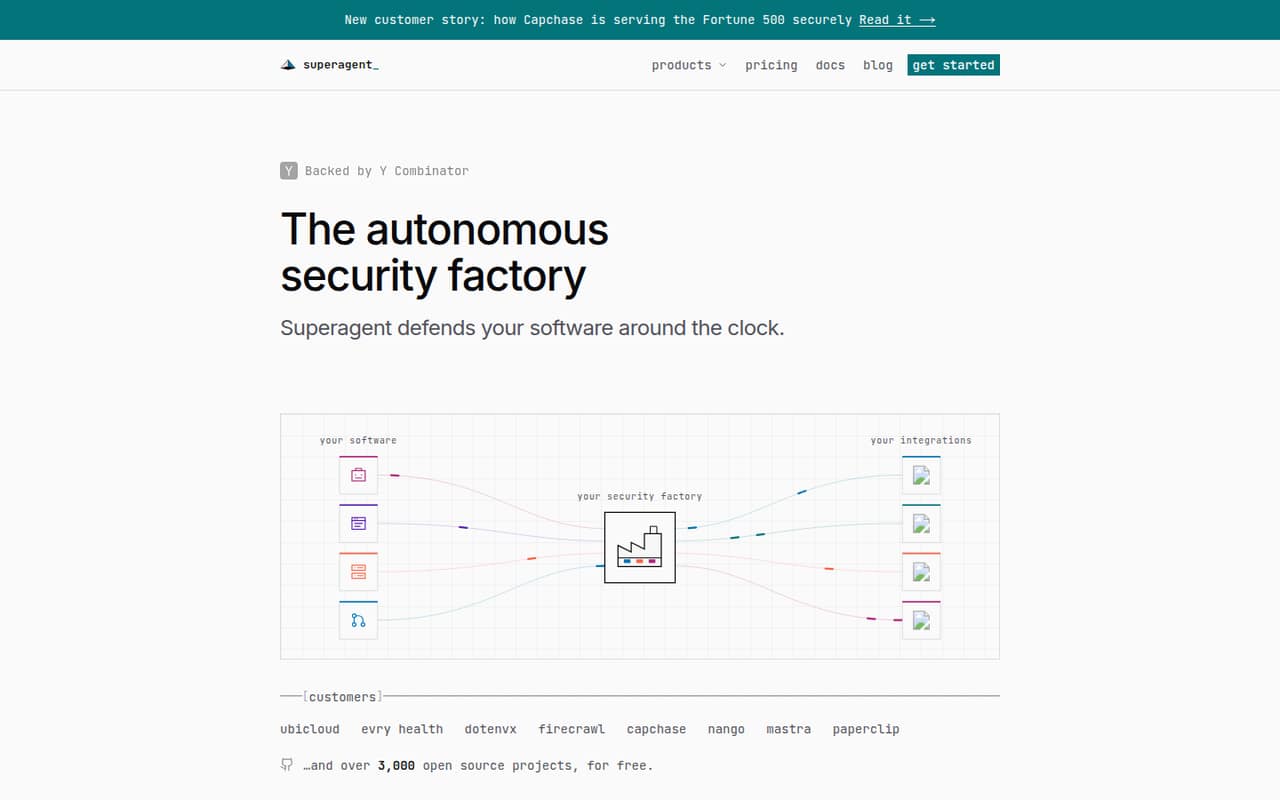
Superagent runs security checks across code, dependencies, applications, agents, and infrastructure, then sends findings into existing workflows. Its free plan includes 100 credits a month for private repositories, and public-repository use is unlimited on the separate Open source plan.
The catch for a small team: Starter costs $499/month for 500 credits. Seats are unlimited, so adding teammates does not raise the listed plan price, but credit-heavy checks can use the allowance quickly.
Good fit if
- Teams securing public repositories
- Small teams assessing agent security
- Teams that need several security checks
Skip it if
- Teams needing low-cost private-repo security
- Teams with predictable per-seat pricing
- Teams needing published setup instructions
ScoresHow it rates
What works
- Unlimited public-repository usage on the Open source plan
- Free plan includes 100 private credits monthly
- All listed plans include every Superagent product
- Unlimited seats across the listed plans
- One platform covers code, dependencies, agents, and infrastructure
What doesn't
- Starter costs $499/month for 500 credits
- Red teaming uses 500 credits per report
- Annual plan prices are not published
- Credit needs may be hard to predict
- The vendor doesn't publish named integrations in its pricing details
01Who Superagent is for
Superagent is for teams that want security checks across more than their source code. It covers code changes, dependencies, applications, agents, and infrastructure, with findings sent into existing workflows. A small engineering or security team can use it to scan pull requests, investigate dependencies, screen content for agents, and monitor supported risky actions.
For a team of one to ten, the free private plan is the practical place to start: it includes 100 credits a month and unlimited seats. Public-repository teams can use the Open source plan for unlimited usage at no charge. The budget question comes when private-repository use exceeds the free allowance. Starter is $499/month for 500 credits, so it suits a team that can justify a broader security program, not one looking for a low-cost per-seat add-on. The plans include every product, but the credit allowance sets the real boundary.
02Superagent free plan and trial
There are two free options. The Open source plan is free forever and includes unlimited usage on public repositories, every Superagent product, API and MCP access, and unlimited seats. For private repositories, the Free plan provides 100 credits per month, also with every product, API and MCP access, and unlimited seats.
The private plan is a useful way to check whether Superagent’s range of security tools fits your workflow. It is not an unlimited private-repository plan: checks draw on credits, and the vendor lists 100 per month. For example, PR scanning costs one credit per scan, context screening costs one per item, and red teaming costs 500 per report. The next listed plan is Starter at $499/month for 500 credits. The pricing page lists no separate trial terms.
03What a small team pays for Superagent
Starter is the cheapest paid plan listed for private repositories: $499/month for 500 credits. Since the plan includes unlimited seats, one person pays $499/month in total; a team of three pays the same $499, or about $166.33 per person; five people also pay $499, or $99.80 per person. Those per-person figures are simple divisions, not per-seat prices.
Growth costs $1,499/month for 2,000 credits. Scale starts at $3,999/month for 6,000 credits. The pricing page lists monthly prices; annual billing is upfront and includes 20% more credits, but annual prices are not published.
Watch credit use, not seat count. PR scanning costs one credit per scan, dependency validation costs five per private investigation, context guardrails cost one per item, and red teaming costs 500 per report. Public dependency investigations are free. Security-One-27B is priced separately at $0.05 per million input tokens.
04Getting started with Superagent
The product covers several different jobs, from pull-request scanning to agent runtime controls, so a small team should decide which checks it wants to run first and how many credits those checks may use. The pricing page lists API and MCP access on every plan, and the product description says findings go into existing workflows. It does not name specific repository hosts, CI systems, or other integrations there.
That leaves some practical setup questions to settle before committing: which code hosts and workflows are supported, what permissions are required, and how teams configure runtime rules. The vendor doesn't publish those details in the pricing information, so ask for them before planning a rollout. Setup effort and learning curve aren't published either. Starting with a limited set of checks on the free private plan can help a team assess its credit needs before moving to paid usage.
05When small teams outgrow Superagent
The clearest reason to upgrade is exhausting the monthly credit allowance. The Free plan has 100 private credits; Starter raises that to 500 for $499/month, and Growth provides 2,000 for $1,499/month. Red teaming alone costs 500 credits per report, so a team that relies on frequent reports may need a larger plan even before adding routine scans.
Seat count is less likely to force an upgrade: every listed plan has unlimited seats. Instead, track how often the team scans pull requests, investigates private dependencies, screens agent content, and runs red-team reports. Public dependency investigations are free, but private investigations cost five credits each. If usage grows beyond Starter, Scale starts at $3,999/month and includes 6,000 credits. That is a substantial monthly commitment for a small team. Annual plans include 20% more credits, but their prices aren't published, so ask the vendor for a quote before comparing annual costs.
Questions people ask
Does Superagent have a free plan for private repositories?
Yes. The Free plan includes 100 credits per month for private repositories, every Superagent product, API and MCP access, and unlimited seats. Public repositories have a separate Open source plan with unlimited usage. Private checks use credits, so review the credit costs for the checks your team expects to run.
How much does Superagent cost for a small team?
Starter is the cheapest paid plan listed for private repositories at $499 per month for 500 credits. It includes unlimited seats, so the listed plan total stays $499 for one, three, or five teammates. The equivalent per-person amounts are $499, about $166.33, and $99.80, respectively.
How do Superagent credits work?
The plans include monthly credit allowances, and different checks use different amounts. PR scanning costs one credit per scan, private dependency validation costs five credits per investigation, context guardrails cost one per item, and red teaming costs 500 credits per report. Public dependency investigations are free.
Does Superagent charge per seat?
No per-seat charge is listed. The Open source, Free, Starter, Growth, and Scale plans all include unlimited seats. The listed plan price and monthly credit allowance—not the number of teammates—set the main subscription cost. Starter, for example, is $499 per month for 500 credits.
Does Superagent offer annual billing?
The pricing page says annual plans are billed upfront and include 20% more credits. It does not publish annual prices, so you cannot calculate the annual subscription total from the listed figures alone. Ask the vendor for the annual price and confirm how the extra credits apply to your plan.