
We may earn a commission if you buy through links on this page. It never changes a score or a ranking. How we make money
The bottom line
A strong runtime-security fit if you can get a clear quote before committing.
Sysdig combines cloud security, threat detection and response with kernel-level runtime insights. That focus can help teams see what workloads are doing, rather than relying only on static findings.
For a small team watching every subscription, the sticking point is price: Sysdig doesn't publish a starting rate, and its Secure products are licensed by host rather than seat. There is no free plan listed, so ask sales for a quote and licensing details before budgeting.
Good fit if
- Cloud-native security teams
- Kubernetes-heavy environments
- Teams needing runtime context
Skip it if
- Teams needing a free security tool
- Buyers requiring upfront prices
- Small general-purpose monitoring teams
ScoresHow it rates
What works
- Kernel-level system-call runtime insights
- Combines cloud prevention, detection and response
- Supports container and Kubernetes security
- AI agent actions can be monitored and blocked
- Users praise its container monitoring integration
What doesn't
- Starting prices aren't published
- No free plan is listed
- Secure licensing is host-based, not per seat
- Exact usage limits aren't published
- A Reddit user says the UI needs work
01Who Sysdig is for
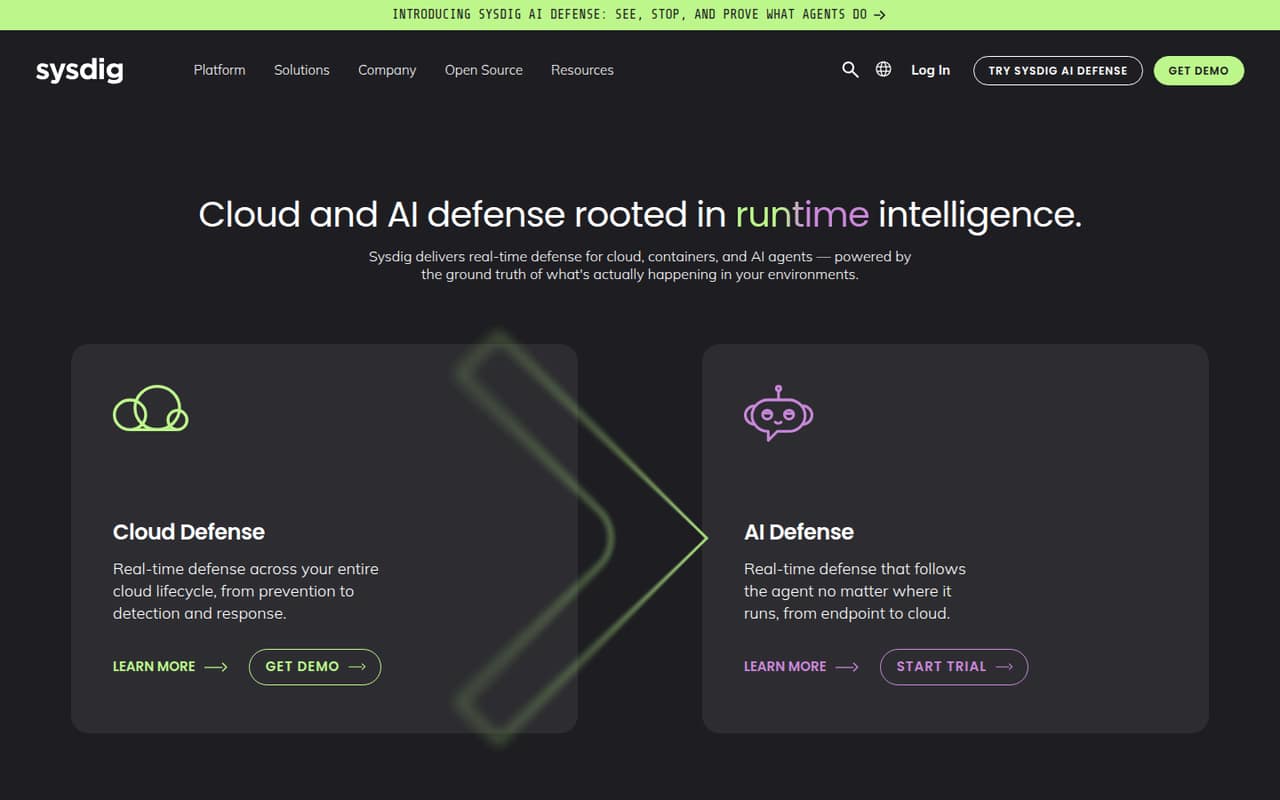
Sysdig is aimed at teams securing cloud environments, containers and workloads, especially teams running Kubernetes. It combines prevention, detection and response with runtime information from kernel-level system calls. In plain terms, it can show what is actually running and help security teams investigate cloud threats. Its platform also includes AI agent security, including visibility into agent actions and the ability to block actions that go too far.
That makes it a better fit for a security or platform team with cloud-native workloads than for a small business looking for basic server monitoring. A team of one to ten could consider it if runtime security is a real requirement and the team can manage host-based licensing. But with no published starting price or exact usage limits, a small team on a tight budget should get a quote before spending time on evaluation. One Reddit commenter praised Sysdig's container and orchestration monitoring, while another noted the product could be costly.
02Sysdig free plan and trial
Sysdig's pricing information lists no free plan. Trial availability and terms aren't published, so ask the vendor whether a trial is available and what it covers before planning an evaluation. That leaves no confirmed free way for a small team to use the product or validate whether its runtime data is useful for its environment.
The cheapest way in isn't clear from the published pricing details. Sysdig Secure is licensed per host, but prices and usage limits aren't published; Sysdig Monitor's price and limits aren't published either. Ask sales for a quote based on the hosts, cloud logs and features you need, plus any minimum commitment. If a trial is offered, ask whether it includes the Secure features you plan to buy and whether it can run during a real deployment cycle.
03What a small team pays for Sysdig
Sysdig doesn't publish monthly or annual prices, so we can't calculate a reliable bill for one person or a team of three or five. The key detail is that Sysdig Secure is licensed per host, not per seat. A team of five does not necessarily pay five times a per-person rate; the quote depends on the hosts covered. The company doesn't publish exact usage limits, either.
The pricing information lists Secure CNAPP with host-based licensing and Secure Detection and Response with host licensing plus cloud-log billing by events processed. Sysdig Monitor's pricing and usage limits aren't published. No add-ons are listed, but that doesn't confirm that every feature is included in a quote. Ask for separate monthly and annual totals, host definitions, event-processing charges and any minimums. Also ask how the quote changes as you add hosts or cloud logs. Until Sysdig provides those figures, the cost for a small team is unknown, not a predictable per-seat subscription.
04Getting started with Sysdig
Setup effort and onboarding time aren't published, so a small team should ask Sysdig what deployment involves for its specific cloud and Kubernetes setup. Sysdig's stated runtime approach captures live system calls at the kernel level, and the platform covers cloud environments, containers and Kubernetes workloads. That means buyers should clarify which agents or other components are needed, what permissions are required, and who will maintain them.
The available documentation details for setup and integrations aren't published in the pricing information, so don't assume a particular connection is ready on day one. A Reddit user who monitored OpenShift clusters praised Sysdig's agent and orchestration integration, while another said the UI needed work. For an evaluation, ask for a clear setup checklist, supported environments, required integrations and help for a small team. If you test the product, a Reddit commenter recommends doing so during a real deployment cycle so you can see how runtime monitoring handles new workloads.
05When small teams outgrow Sysdig
Sysdig may become harder to budget as the number of hosts and processed cloud-log events grows. Secure uses host-based licensing, and its Detection and Response offering also bills cloud logs by events processed. Because Sysdig doesn't publish prices, usage limits or a per-host rate, a growing team will need updated quotes to understand the cost of adding coverage. Ask for expansion pricing before a renewal, not after workloads have spread.
A team can also outgrow the product if it needs a monitoring tool with clear public rates, a confirmed free tier or a simpler buying process. Reddit feedback is mixed: one Sysdig Cloud user called it costly, while another praised its container and orchestration monitoring and said the UI needed attention. Those comments are about particular users' experiences, not a guarantee of what your team will see. If the platform no longer fits the budget or workflow, compare the full cost of coverage and the effort of moving the data and monitoring process before switching.
From the threadsWhat users say
Reddit feedback is positive about Sysdig's container and orchestration monitoring, with one user praising its agent. Cost and the UI are concerns; the comments offer limited evidence about security use cases or vendor support.
I haven't found anything else on the market that actually has as sane an approach to container and PaaS / orchestration monitoring as Sysdig
it is somewhat costly which we kind of expected and can appreciate but its going to be a hard sell to the accounts team etc
Their UI needs some love, which they're definitely working toward,
Their agent is also quite hard to beat,
Questions people ask
What does Sysdig do?
Sysdig provides cloud security and monitoring products. Its security platform combines prevention, detection and response with runtime insights from kernel-level system calls. It also covers containers and Kubernetes workloads, detects cloud threats, and offers security features for AI agents. Sysdig Monitor is its monitoring product.
Does Sysdig have a free plan or trial?
Sysdig's pricing information lists no free plan. Trial availability and terms aren't published, so ask Sysdig whether a trial is available and what features, limits and duration it includes. Don't assume a trial covers every product or the same usage your team would have on a paid plan.
How much does Sysdig cost?
Sysdig doesn't publish monthly or annual prices. Secure is licensed per host, and Detection and Response also bills cloud logs by events processed. Sysdig Monitor's price isn't published. Ask for a quote that spells out host coverage, event charges, usage limits and any minimum commitment.
Is Sysdig priced per user or per host?
The pricing information lists host-based licensing for Sysdig Secure, rather than a per-seat rate. Its Detection and Response offering also bills cloud logs by events processed. Sysdig doesn't publish exact usage limits or prices, so ask how your hosts and event volume affect the quote.
Does Sysdig support Kubernetes security?
Yes. Sysdig describes security for containers and Kubernetes workloads, along with runtime insights that capture live system calls at the kernel level. A Reddit user also reported using Sysdig Cloud to monitor OpenShift clusters. Ask Sysdig which Kubernetes and cloud environments are supported for your specific setup.