
We may earn a commission if you buy through links on this page. It never changes a score or a ranking. How we make money
The bottom line
Broad payment options, but custom pricing makes the real cost hard to judge before a sales conversation.
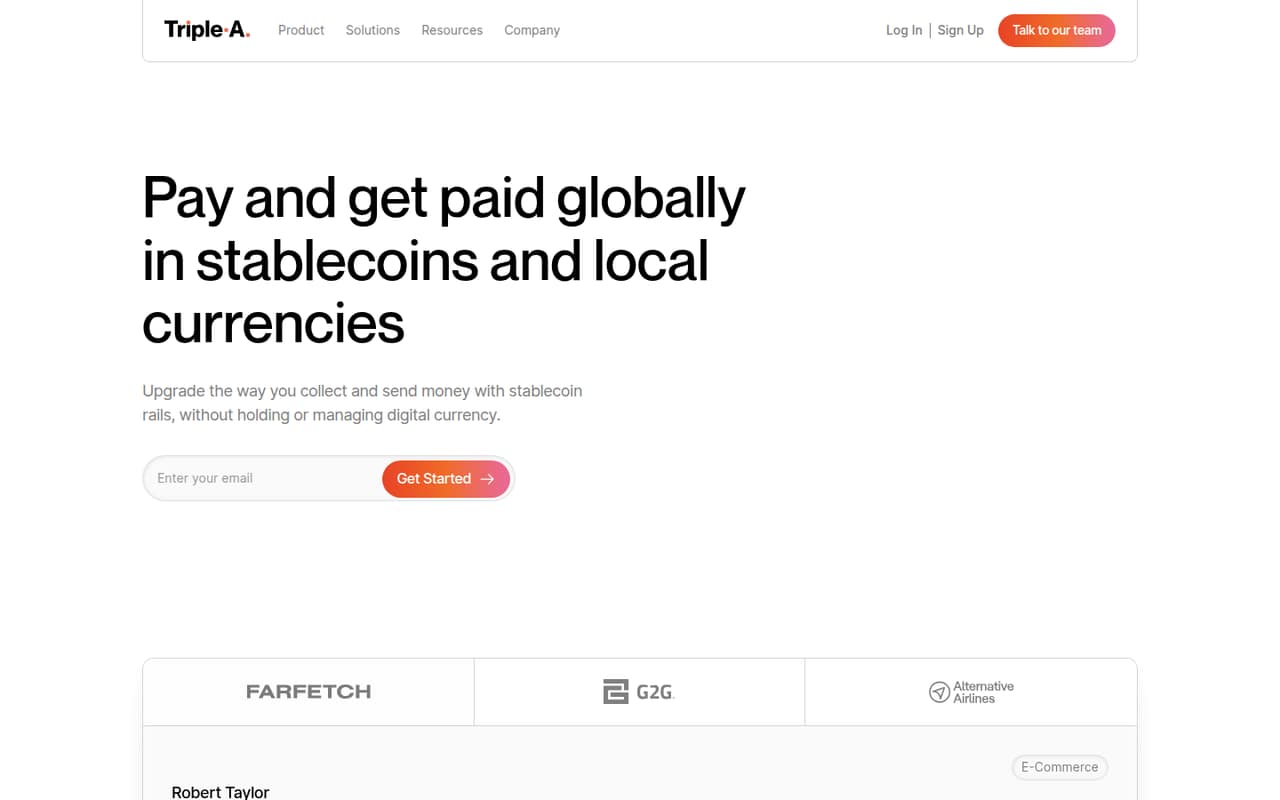
Triple-A helps businesses collect and send stablecoins and local currencies, with checkout, payment links, named-IBAN accounts, and international payouts. Its homepage says businesses can use stablecoin payment rails without holding or managing digital currency.
The trade-off for small teams is price uncertainty: Triple-A has no listed free plan, and its pricing is custom and volume-based. Get a quote before deciding whether its global payment options fit your budget.
Good fit if
- Businesses accepting stablecoin payments
- Teams paying suppliers internationally
- Companies needing branded remittance
Skip it if
- Teams needing a free payment gateway
- Buyers who need prices upfront
- Businesses with simple local payments
ScoresHow it rates
What works
- Accept stablecoins through checkout
- Collect with payment links and invoices
- Named IBAN account option
- Payouts cover 70+ countries
- Stablecoin payouts available 24/7
What doesn't
- No free plan is listed
- Pricing is custom and volume-based
- No starting price is published
- Seat-based prices are not published
- Setup details and integrations need confirmation
01Who Triple-A is for
Triple-A is aimed at businesses that need to collect or send money across borders, especially if stablecoins are part of the payment flow. A small team of one to ten people could use it to accept stablecoins at checkout, send payment links or invoices, receive payments to a named IBAN, or pay suppliers and service providers. The homepage says businesses can use stablecoin payment rails without holding or managing digital currency.
This is a business payment gateway, not a general-purpose tool for managing a team’s subscriptions or expenses. Its local payout offering covers 30+ currencies across 70+ countries, while stablecoin payouts are described as available 24/7. Triple-A also offers white-label remittance for businesses launching a branded money transfer service. The homepage describes the company as licensed in the US, EU, and Singapore. For a tight budget, the key question is whether those payment options justify a custom quote.
02Triple-A free plan and trial
Triple-A does not list a free plan. Its pricing material does not publish a free-trial offer, so a team should ask the vendor whether it can evaluate the service before committing. That makes it harder to compare Triple-A with payment tools that let a small business start at no charge.
The pricing page lists custom, volume-based pricing rather than a self-serve starter tier. In practical terms, the cheapest way in is to request a quote for your expected payment volume and use case. Ask whether any minimum fees, transaction charges, setup costs, or contract terms apply; those details are not published in the pricing material. A one-person business and a five-person team should both get the same basics in writing before budgeting, since a public per-seat price is not available.
03What a small team pays for Triple-A
The pricing page lists custom, volume-based pricing, but no monthly or annual schedule and no starting price. So we can’t give a reliable bill for one person, three people, or five people: Triple-A does not publish per-seat prices, and the cost is not presented as a seat-based plan. Ask for a quote using your expected transaction volume and payment routes, and request the total for each billing period.
The pricing material also does not list add-on prices. Before signing, ask whether checkout, payment links, named-IBAN accounts, stablecoin payouts, local payouts, or white-label remittance carry separate charges. Confirm any minimums, transaction fees, currency conversion costs, and setup fees as well; those amounts are not published. This is the main budgeting hurdle for a small team: even if you only need one feature, the public pricing information does not show what that simplest setup costs. Compare the written quote with your current payment costs before moving funds through the service.
04Getting started with Triple-A
Triple-A describes several ways to use its payment service: checkout, payment links and invoices, named-IBAN accounts, and payouts. A small team should first decide which of these it needs, then ask the vendor what onboarding and technical work each option requires. The public product description does not publish a setup timeline, a step-by-step process, or a list of supported integrations.
That leaves the learning curve hard to rate in advance. A team using payment links may have different implementation needs from one adding checkout to an existing flow or launching branded remittance. Before signing, ask whether your current payment stack is supported, what information or development work is required, and who handles configuration. The public description does not specify those details. Also confirm which currencies and payout destinations apply to your business, rather than assuming every advertised option is available for your use case.
05When small teams outgrow Triple-A
Triple-A’s published description does not give seat limits, transaction limits, or plan tiers, so there is no stated threshold at which a team must upgrade. Its pricing is custom and volume-based; as payment volume grows, ask how that changes your quote and whether rates, minimums, or terms change with it.
A team may decide Triple-A is no longer a fit if it needs prices it can forecast without a sales quote, a free entry plan, or payment features beyond the ones the vendor describes. That is a buying-fit issue, not a published product limit. Growing teams should also check that their needed currencies, countries, integrations, and operational requirements are supported before expanding their use. Triple-A advertises local payouts in 30+ currencies across 70+ countries, but the public description does not spell out every eligibility condition. Get those details and any revised fees in writing before relying on the service for a larger payment operation.
Questions people ask
Does Triple-A have a free plan?
Triple-A does not list a free plan. Its pricing is custom and volume-based, so the cheapest way to get started is to ask the vendor for a quote based on your expected payment volume and the features you need.
How much does Triple-A cost?
Triple-A does not publish a starting price or monthly and annual prices. The pricing page describes pricing as custom and volume-based. Ask for a quote and confirm any transaction charges, minimums, setup fees, and currency conversion costs.
Can my business accept stablecoins without holding them?
Triple-A’s homepage says businesses can use stablecoin payment rails without holding or managing digital currency. It also describes stablecoin checkout, payment links, and invoices. Ask the vendor how settlement works for your specific payment flow.
Where can Triple-A send local payouts?
Triple-A describes local payouts in 30+ currencies across 70+ countries. The public description does not specify every eligibility condition, so confirm that your destination countries and currencies are supported for your business before signing.
Does Triple-A offer a free trial?
The pricing material does not publish a free-trial offer. Ask Triple-A whether it offers a trial or another way to evaluate the service, and confirm whether any onboarding or transaction costs apply during evaluation.