
We may earn a commission if you buy through links on this page. It never changes a score or a ranking. How we make money
The bottom line
A useful AI control layer with a strong free plan, but expect some setup and learning effort.
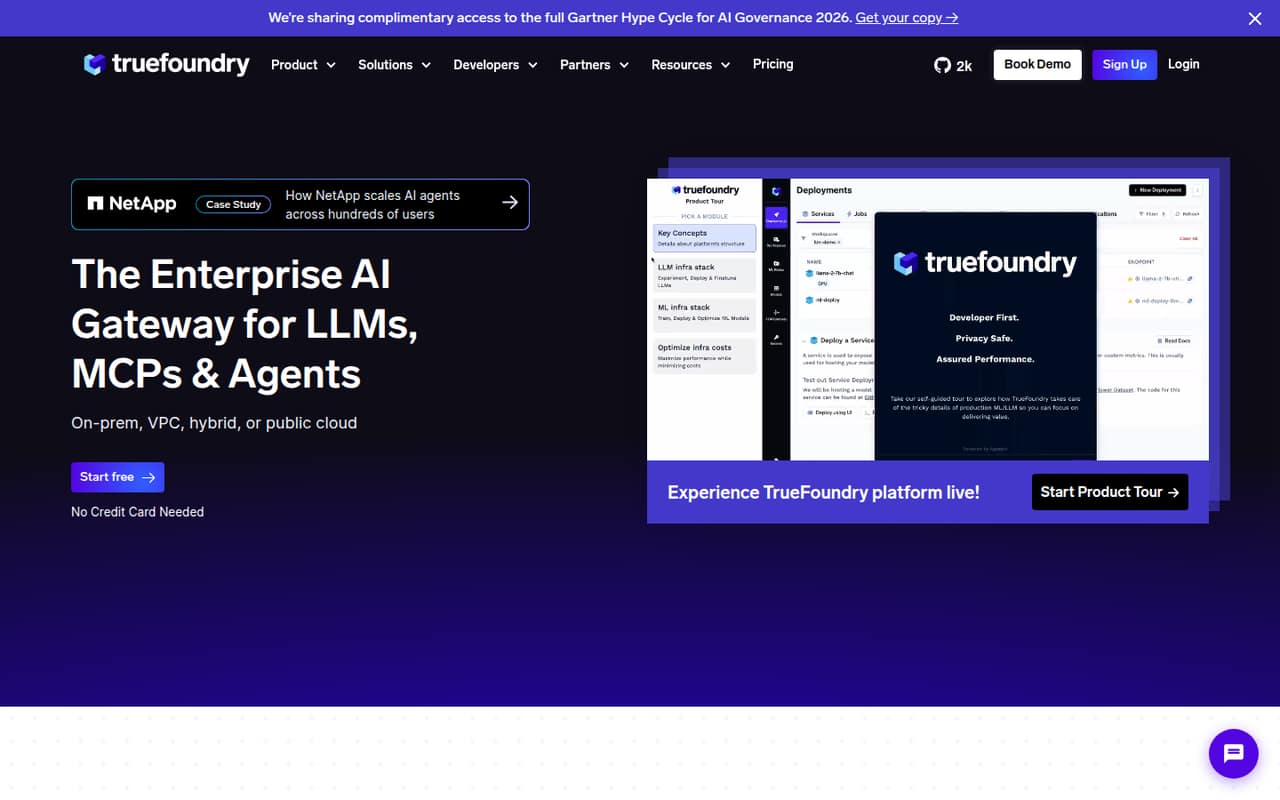
TrueFoundry gives teams one place to manage model routing, MCP servers, and agent access. Its free Developer plan covers up to three users, and Pro starts at $25 per user per month.
That’s a practical entry price for a small team that needs governance and usage controls. But setup details aren’t spelled out in the available plan information, and Reddit feedback on the developer experience is mixed.
Good fit if
- Small teams prototyping AI workflows
- Teams governing MCP and agent access
- Organizations needing private deployment
Skip it if
- Teams wanting a simple model proxy
- Teams needing published setup instructions
- Teams without AI governance needs
ScoresHow it rates
What works
- Free plan includes up to three users
- Free tier includes five model accounts and five MCP servers
- Pro pricing is published per user
- Supports VPC, on-premises, and air-gapped deployment
- Combines routing, access controls, and observability
What doesn't
- A commenter described the developer experience as clunky
- No annual Pro rate is published
- Provider charges are billed separately
- Free logs are retained for only seven days
- Enterprise pricing requires a custom annual commitment
01Who TrueFoundry is for
TrueFoundry makes the most sense for a small engineering or ML team building AI features and needing more than a model API connection. It puts model routing, MCP servers, agent access, and execution traces behind one gateway. In plain terms, it helps a team manage which models and tools its AI workflows can reach, and keep a record of that activity.
For one to three people still prototyping, the free Developer plan covers the basics without a subscription. A team of four or more can start on Pro at $25 per user per month. That can be worthwhile if routing controls, audit logs, or private deployment matter to your work. If your team only needs to send requests to a model, the governance features may be more tool than you need. Reddit discussions show interest from ML teams, but one thread says it was hard to find much production experience beyond the first few months.
02TrueFoundry free plan and trial
The Developer plan costs $0 per month and includes up to three users, two teams, five model accounts, and five MCP servers. Each user gets up to 10,000 requests and tool calls per month, with seven-day log retention. That’s enough room for a small team to prototype workflows and try the gateway’s basic governance features.
The free plan is limited on seats, teams, usage, and log history. A fourth user means moving to Pro, which the pricing page lists at $25 per user per month. The listed plan details don’t specify a separate free trial, so the free Developer tier is the no-cost way in. Model-provider charges are passed through and billed separately, even when using the free plan.
03What a small team pays for TrueFoundry
The pricing page lists Pro at $25 per user per month. That works out to $25 monthly for one person, $75 for three, or $125 for five. The page doesn’t publish an annual Pro rate, so we can’t compare monthly billing with an annual discount. Developer remains free for up to three users, but it has lower usage limits and seven-day log retention.
Pro includes unlimited users, 20,000 requests and tool calls per user per month, up to 10 teams, 30-day log retention, SSO, and custom roles. For a five-person team, the listed subscription is $125 per month before usage-related costs. Pro overage is $20 per additional 100,000 requests and tool calls. Model-provider charges are pass-through and billed separately. Third-party guardrails are Enterprise-only and billed on provider usage. Enterprise has a custom annual commitment; ask the vendor for a quote if you need its deployment, retention, or support terms.
04Getting started with TrueFoundry
TrueFoundry’s feature set spans models, MCP servers, agents, access rules, routing, and tracing, so teams should plan time to decide what they want to govern first. The available plan details don’t specify installation steps, supported integrations, or a setup timeline. Ask the vendor what configuration is needed for your model providers, MCP servers, and deployment environment before you commit.
For a first pass, the free tier allows five model accounts and five MCP servers, giving a small team room to connect a limited set of tools. TrueFoundry says it can run in a VPC, on-premises, air-gapped, or across multiple clouds. That flexibility is useful, but deployment requirements will depend on the environment. One commenter on r/Python said the product felt clunky and its developer experience was not great; treat that as an individual report, not a guarantee of your team’s experience.
05When small teams outgrow TrueFoundry
The first upgrade point is the free plan’s three-user cap. It also limits teams to two, requests and tool calls to 10,000 per user each month, and log retention to seven days. Pro removes the seat limit and raises those limits to 10 teams, 20,000 requests and tool calls per user, and 30-day retention. It also adds SSO and custom roles.
A growing team may still need to watch usage: Pro overage costs $20 per additional 100,000 requests and tool calls, while provider charges are separate. Teams needing custom usage commitments, longer or custom retention, VPC or on-premises deployment, or priority support and an SLA will need an Enterprise quote. Reddit feedback is mixed: one commenter reports clunky developer experience, and a thread says it found little production experience beyond the first few months. Those reports suggest asking for references and clarifying support and upgrade terms before relying on it for critical workflows.
From the threadsWhat users say
Reddit sentiment is mixed and thin on long-term production reports. Some comments raise concerns about developer experience and credential handling, so teams should validate their own security and support requirements.
can't find much real production experience past the first few months though
we tried truefoundry but it felt clunky, devX was not great
they have been emailing us all day about how customers provider credentials are being leaked
TrueFoundry — keeps coming up in conversations with other ML teams for the governance and cost-tracking layer
Questions people ask
Is TrueFoundry free?
Yes. The Developer plan costs $0 per month for up to three users and two teams. It includes up to 10,000 requests and tool calls per user per month, five model accounts, five MCP servers, and seven-day log retention. Model-provider charges are billed separately.
How much does TrueFoundry Pro cost for a small team?
The pricing page lists Pro at $25 per user per month. That is $75 per month for three users or $125 for five. No annual Pro rate is published. Provider charges are separate, and Pro overage is $20 per additional 100,000 requests and tool calls.
What is included in TrueFoundry Pro?
Pro includes unlimited users, up to 20,000 requests and tool calls per user each month, up to 10 teams, and 30-day log retention. The plan also lists SSO and custom roles. It costs $25 per user per month, before provider charges and any overage.
Can TrueFoundry run in a private environment?
TrueFoundry lists deployment options for a VPC, on-premises, air-gapped environments, and multiple clouds. The Enterprise plan specifically includes VPC, on-premises, and data residency. Ask the vendor which plan and deployment requirements apply to your intended setup.
Does TrueFoundry charge for model usage?
Model-provider charges are pass-through and billed separately from the TrueFoundry subscription. Pro overage is also billed at $20 per additional 100,000 requests and tool calls. Third-party guardrails are Enterprise-only and billed based on provider usage.