
We may earn a commission if you buy through links on this page. It never changes a score or a ranking. How we make money
The bottom line
Unit21 combines fraud and AML workflows, but small teams need a custom quote before they can judge the cost.
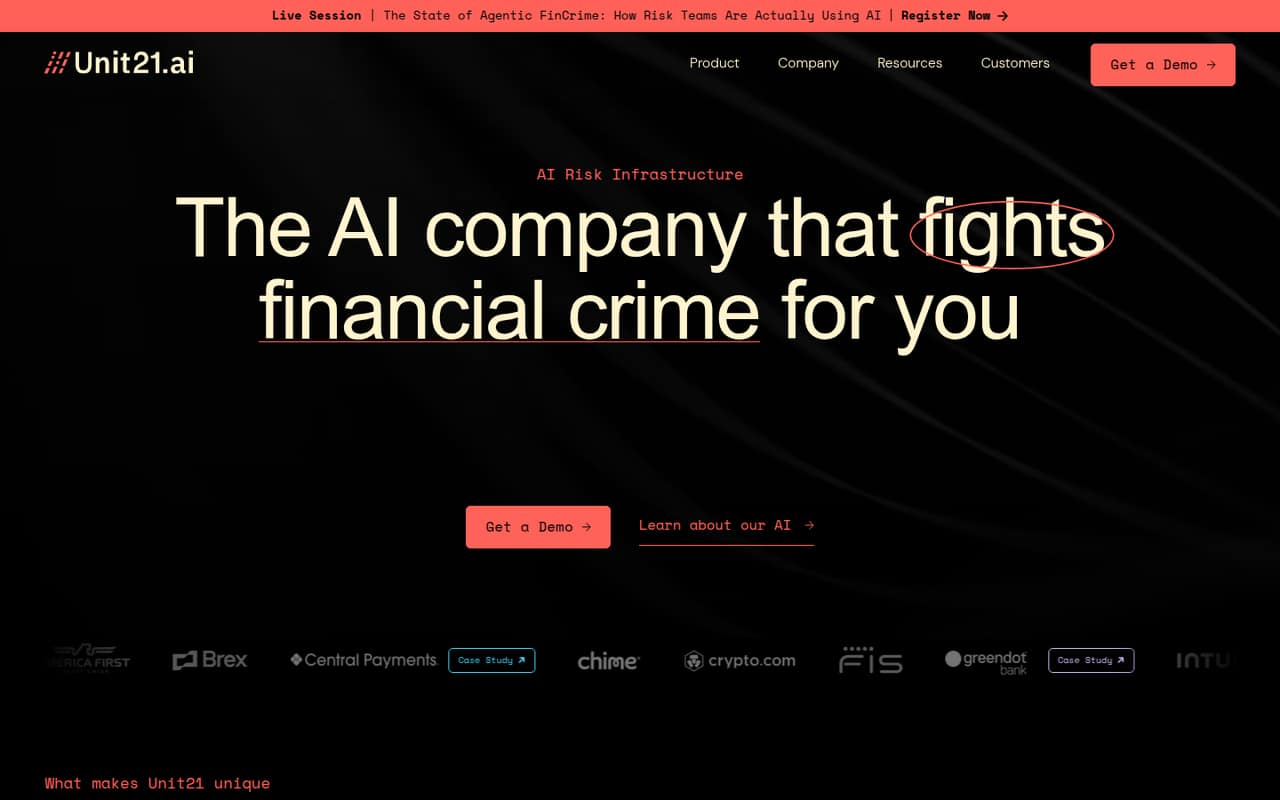
Unit21 is for financial institutions and fintechs that need fraud detection, AML monitoring, investigations, case management, and regulatory filings in one system. Its feature set is broad, but the vendor lists no public price or free entry plan.
For a team of one to ten, that makes the buying decision hard to budget. Ask sales for seat and usage limits, implementation details, and a quote based on your team’s workload before committing.
Good fit if
- Fintech fraud and AML teams
- Financial crime investigation workflows
- Teams consolidating risk operations
Skip it if
- Teams needing a free starting plan
- Buyers requiring public seat pricing
- Small businesses without compliance work
ScoresHow it rates
What works
- Combines fraud and AML workflows
- AI tools support investigations and case narratives
- Fraud monitoring covers multiple payment rails
- Device Risk Score uses behavioral signals
- Regulatory filings include evidence and timelines
What doesn't
- No free plan is listed
- Monthly and annual prices are not published
- Seat and usage limits are not published
- Plan inclusions require confirmation with sales
- Setup effort and integrations need clarification
01Who Unit21 is for
Unit21 is aimed at financial institutions and fintechs with fraud prevention or AML compliance work—not a general-purpose tool for a small business. It brings detection, investigations, case management, and regulatory filings into one platform, with audit trails for decisions. The pricing page lists a custom enterprise plan for financial crime risk teams.
A small team could consider it if one to ten people handle meaningful fraud or compliance workloads and need connected tools for alerts, investigations, and filings. But team size alone does not establish fit: Unit21 does not publish a starting price, seat limits, or usage limits. A lean team should ask sales for a quote tied to its actual number of users and workload, then compare that total with its budget. If you only need basic monitoring or have little compliance work, this enterprise buying process may be more than you need.
02Unit21 free plan and trial
Unit21 does not list a free plan, and a free trial is not published. The pricing page lists a custom enterprise plan, with contracts arranged through sales demos. Its plan inclusions, seat limits, and usage limits are not published, so a small team cannot confirm a self-serve way to try the platform or start with a limited set of features.
The cheapest listed way in is to contact sales for a demo and custom quote. Before scheduling one, ask whether the demo can use your workflows or data, whether a trial is available under a custom agreement, and what the minimum contract covers. Those details—and any minimum commitment—are not published. Treat the demo as a sales conversation, not as a confirmed free trial.
03What a small team pays for Unit21
The pricing page lists one option: Custom enterprise, with contracts arranged through sales demos. The starting price, monthly rate, and annual rate are not published. That means we cannot calculate a reliable cost for one person or compare three- and five-seat totals, whether billed monthly or annually. Per-seat pricing is not published either, so do not assume the quote scales linearly with headcount.
Seat and usage limits are also unpublished, as are the plan inclusions. The pricing material lists no add-ons, but that is not confirmation that every feature or service is included in a quote. Ask sales for the full price for your expected number of users, any usage-based charges, contract length, and whether fraud monitoring, device intelligence, investigations, and filings are included. For a budget-conscious team, the quote—not a public rate card—is the only dependable way to assess the cost.
04Getting started with Unit21
The available product details describe what Unit21 does, but do not publish a setup timeline, implementation steps, learning curve, or integration list. We can’t responsibly estimate how much work a one-to-ten-person team would need to get it running. The product combines detection, investigations, case management, and filings, so a buyer should map which workflows it wants to move into the platform before signing.
Ask sales which transaction and behavioral data sources are needed, which payment rails are supported for your use case, and how the system connects to your existing case tools. Also confirm who configures rules and risk scoring, what audit trails cover, and what training or implementation help is included in the quote. These answers will tell you whether a small team can manage setup itself or needs to budget for vendor support.
05When small teams outgrow Unit21
Unit21 is already positioned as a custom enterprise platform, so the usual growth path from a free tier to paid seats is not published. The vendor also does not publish seat or usage caps, making it impossible to name a specific team size or alert volume at which you would need an upgrade. Ask sales to put those thresholds and any overage costs in writing before you buy.
A team may outgrow the fit in either direction. If its fraud and AML work becomes more complex, it should confirm that its quote covers the needed users, workflows, and usage. If the team’s needs stay simple, a custom contract may be hard to justify compared with a tool that publishes small-team pricing. Revisit the decision when headcount, transaction volume, or compliance needs change, and compare the updated quote with the cost and scope of other options.
Questions people ask
How much does Unit21 cost?
Unit21 lists custom enterprise pricing arranged through sales demos. Its starting price and monthly and annual rates are not published, so there is no reliable public cost for one user or a small team. Ask sales for a written quote based on your user count, expected usage, contract length, and required features.
Does Unit21 have a free plan or trial?
Unit21 does not list a free plan, and a free trial is not published. The listed route to access is a sales demo and custom contract. Ask the vendor whether a trial is available for your organization and what the demo includes; neither is specified in the published pricing details.
What does Unit21 do?
Unit21 is an AI-powered fraud and AML platform for financial institutions and fintechs. It brings real-time detection, investigations, case management, and regulatory filings into one system. Its listed capabilities include device risk scoring, configurable AML rules, and audit trails for decisions.
Does Unit21 support both fraud and AML monitoring?
Yes. Unit21 lists fraud monitoring that detects and blocks fraud across payment rails, along with AML monitoring that combines configurable rules, behavioral models, and adaptive risk scoring. Confirm with sales which capabilities are included in your quote and whether they cover your specific workflows.
What should I ask before buying Unit21?
Ask for the full cost for your user count and expected usage, plus seat limits, contract terms, and any extra charges. Confirm which data sources and payment rails connect, what setup and training involve, and which detection, investigation, case management, and filing features are included in the quoted plan.