
We may earn a commission if you buy through links on this page. It never changes a score or a ranking. How we make money
The bottom line
Apono’s free tier is generous for a small team, but broader controls cost $49 per user monthly.
Apono manages privileged access by granting scoped, just-in-time permissions and revoking them when work ends. Its free Starter plan includes up to five users, which makes it worth considering for a small cloud team with modest integration needs.
The catch is the boundary between Starter and Standard: Standard is $49 per user monthly, and annual rates are not published. A team should map its resource and integration needs before treating the free plan as a long-term fit.
Good fit if
- Small cloud infrastructure teams
- Teams limiting standing privileges
- Up to five users evaluating PAM
Skip it if
- Teams needing custom IdP integrations
- Teams wanting published annual pricing
- Teams with more than five Starter users
ScoresHow it rates
What works
- Starter is free for up to five users
- Starter includes up to 50 distinct resources
- Just-in-time access is automatically revoked
- Standard includes unlimited Access Flows
- Supports Slack, Teams, Jira and CLI workflows
What doesn't
- Starter is limited to five Access Flows
- Starter covers only one cloud service
- Standard costs $49 per user monthly
- Annual Standard pricing is not published
- Premium pricing is custom
01Who Apono is for
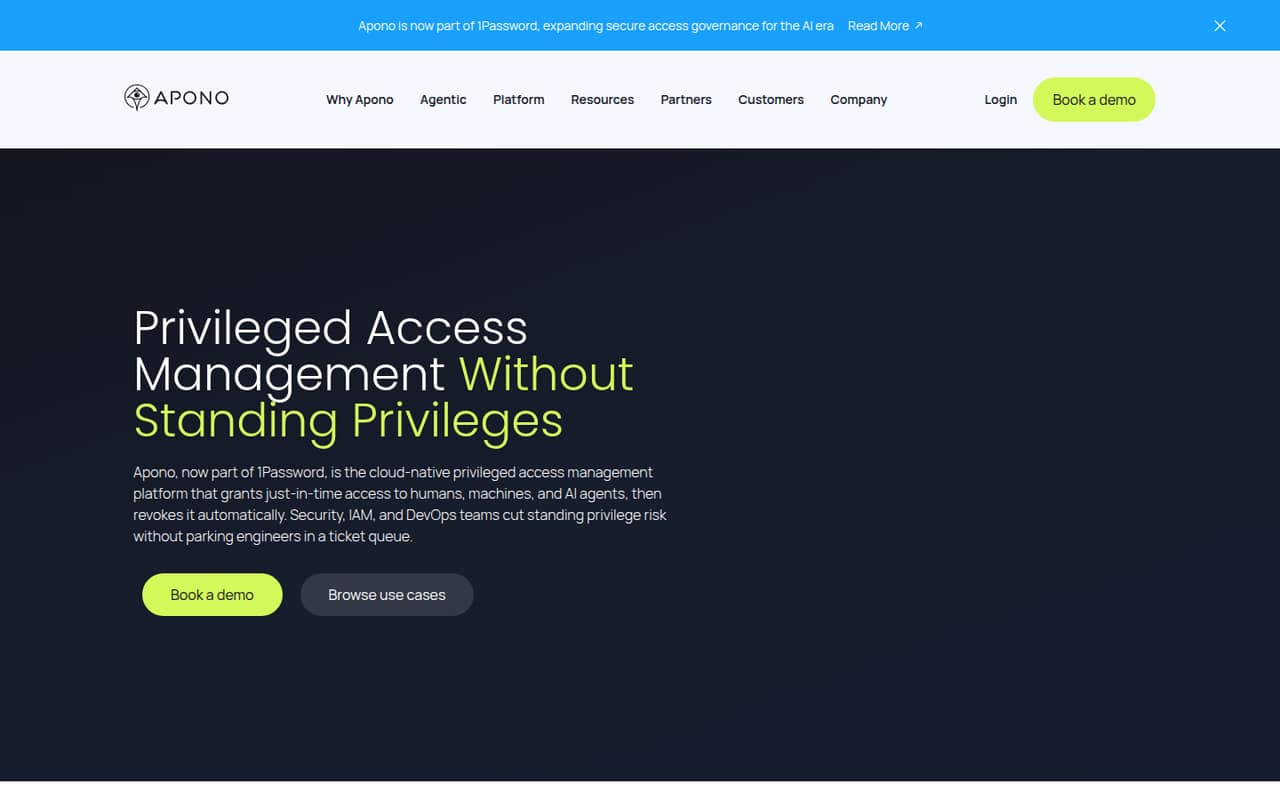
Apono is for small teams managing cloud infrastructure, databases or Kubernetes who need to control privileged access without leaving permissions standing indefinitely. It grants scoped access when a person, machine or AI agent needs it, then revokes that access and logs the request and action.
For a team of one to five, the free Starter plan offers a low-cost way to evaluate the approach, as long as its limits fit: up to 50 distinct resources, five Access Flows, one cloud service, one database integration and one Kubernetes cluster. That can suit a focused environment, but it may not cover a team spread across several clouds or services. Teams needing broader integrations or unlimited flows will be looking at Standard, listed at $49 per user monthly. Apono is now part of 1Password, and its feature set is aimed at access governance rather than basic password sharing.
02Apono free plan and trial
Apono’s free Starter plan includes up to five users and 50 distinct resources. It also allows up to five Access Flows and includes one cloud service, one database integration and one Kubernetes cluster. That is a meaningful starting point for a small team with a contained environment.
The limits matter if you need more than one cloud service, more than five flows or broader integrations: Standard is the next listed plan, at $49 per user per month. Standard includes unlimited Access Flows, a single IdP and unlimited integrations, including multi-cloud, database and Kubernetes integrations. Apono also offers a free trial on paid plans, but the trial duration is not published. Ask the vendor about the trial length and what happens to configured policies when it ends.
03What a small team pays for Apono
Starter costs $0 for up to five users, subject to its resource and integration limits. If you need Standard, the pricing page lists $49 per user per month: one person costs $49 monthly, three cost $147, and five cost $245. These are monthly-rate calculations; annual billing is available on select contracts, but its rate is not published, so we can’t give a reliable annual total.
Standard adds unlimited Access Flows, a single IdP and unlimited integrations, including multi-cloud, database and Kubernetes integrations. Premium is custom-priced and adds features such as multiple IdPs, custom integrations and internal SIEM, ITSM and DevX integrations.
The AWS Marketplace option lists a $4,900 monthly base commitment for 100 users, with additional Standard users at $49 per month each beyond the commitment limit. That is not the natural entry point for a small team, but confirm the commitment before purchasing through that route. Ask Apono about any contract-specific terms before budgeting.
04Getting started with Apono
Apono’s listed workflows can connect access requests to Slack, Teams, Jira, the CLI and Apono Assist. It also supports cloud, database and Kubernetes integrations, with Starter limited to one of each relevant service or cluster and Standard offering broader integrations. A small team should start by listing its cloud accounts, infrastructure, request channels and the people or agents that need access.
The product relies on scoped permissions and dynamic guardrails, so teams will need to decide which access is allowed, who can approve requests and what conditions should apply. That configuration is likely to take more planning than simply inviting users to a basic SaaS app. Apono does not provide a setup-time estimate in the pricing details, so ask for one based on your environment. Before rollout, confirm how your specific cloud and infrastructure policies map to Apono’s runtime permissions.
05When small teams outgrow Apono
The first clear ceiling is Starter’s five-user limit. A team adding a sixth user will need to consider Standard, listed at $49 per user monthly; six seats calculate to $294 per month. Even at five people, a team may need to move up if it exceeds 50 distinct resources, needs more than five Access Flows or requires more than one cloud service, database integration or Kubernetes cluster.
Standard removes several of those constraints with unlimited Access Flows and integrations, but it still lists a single IdP. Teams that need multiple IdPs, custom integrations or internal SIEM, ITSM and DevX integrations will need to ask about Premium, whose price is custom. A growing team may also need to check whether its cloud setup and approval processes fit Apono before committing to a paid contract. Compare those needs with the per-seat bill and ask for annual terms in writing.
Questions people ask
Does Apono have a free plan?
Yes. The free Starter plan includes up to five users, 50 distinct resources, five Access Flows, one cloud service, one database integration and one Kubernetes cluster. Teams that exceed those limits or need broader integrations should compare Standard, listed at $49 per user monthly.
How much does Apono cost for a small team?
Starter is free for up to five users within its plan limits. Standard is listed at $49 per user per month, so three seats calculate to $147 monthly and five to $245. Annual billing is available on select contracts, but its rate is not published.
How does Apono’s just-in-time access work?
Apono grants scoped privileges when access is needed and revokes them when the task ends. It evaluates the requester, requested action, environment and risk, and logs requests, approvals, grants and revocations for an audit trail.
Which request channels does Apono support?
Apono lists Slack, Teams, Jira, the CLI and Apono Assist as supported access-request workflows. Check with Apono about the setup and availability of the specific workflow you want to use.
Can Apono control access for AI agents?
Apono lists agent privilege control that checks an agent’s declared intent against its actions at runtime. It also describes access for people, machines and AI agents, with scoped permissions and automatic revocation.