
We may earn a commission if you buy through links on this page. It never changes a score or a ranking. How we make money
The bottom line
Worth considering if your team needs resource planning; budget for every scheduled person.
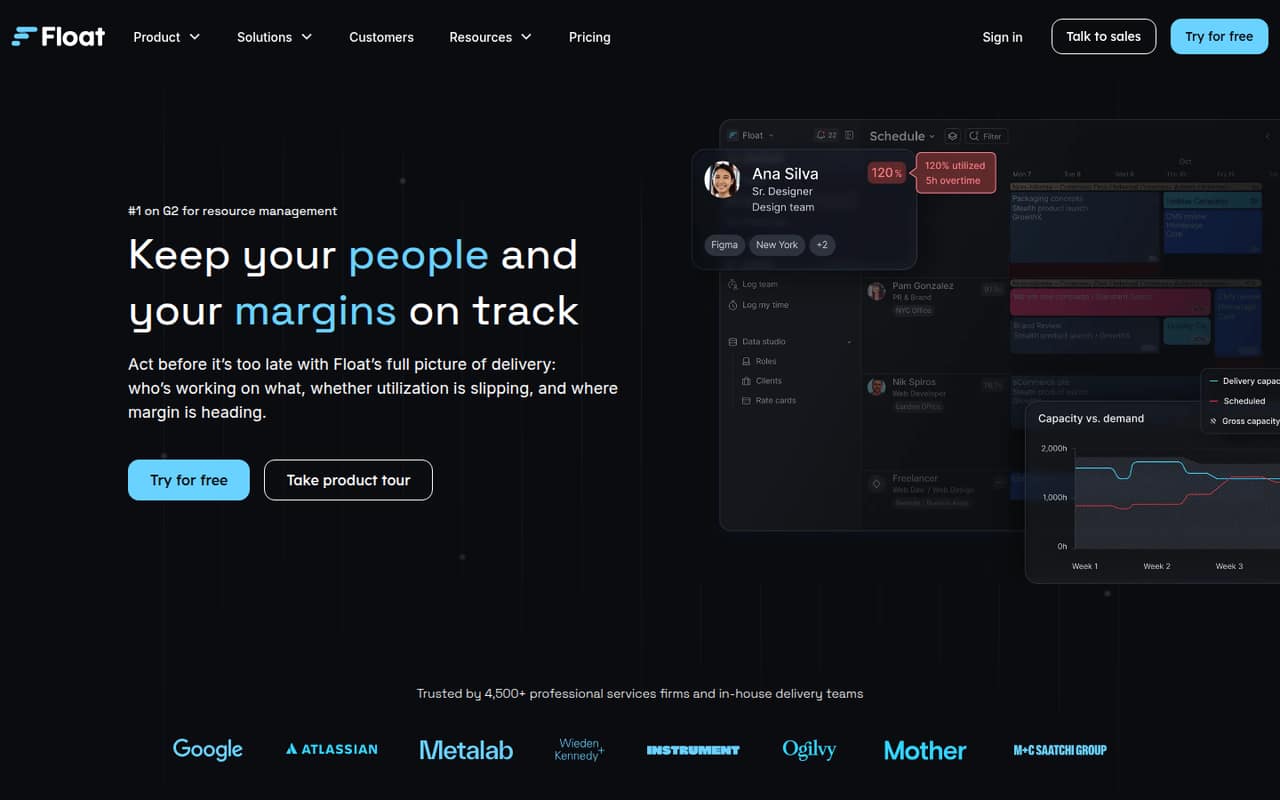
Float helps professional services and delivery teams schedule people, plan capacity, estimate projects and track delivery. It also offers time tracking, reporting and AI-assisted staffing.
There’s no free plan. Starter costs $7 per scheduled person per month with annual billing or $8.50 month to month, after a 30-day trial. That can work for a small team that needs dedicated resource planning, but it’s another recurring cost to weigh against simpler project tools.
Good fit if
- Services teams scheduling client work
- Teams tracking capacity and utilization
- Managers planning project staffing
Skip it if
- Teams that need a free plan
- Teams seeking a basic task tracker
- Teams unwilling to pay per person
ScoresHow it rates
What works
- Unlimited projects and clients on Starter
- Unlimited free guests who don’t need scheduling
- Capacity planning helps spot under-utilization
- Tracks actual time against project plans
- Pro adds more placeholders and activity history
What doesn't
- No free plan after the trial
- Every scheduled person adds to the bill
- Starter includes only one placeholder
- Add-on and overage costs aren’t published
- Integration names and setup steps aren’t published
01Who Float is for
Float is for professional services and delivery teams that need to coordinate people across client projects. Instead of only tracking tasks, it helps managers see who is scheduled, plan capacity and compare project estimates with delivery. It also includes time tracking and reporting for utilization, margin and budget burn.
For a team of one to ten, Float makes most sense when staffing is a regular management job: for example, when several projects compete for the same people. The smallest teams should check whether that planning need justifies paying for each scheduled person. Starter begins at $7 per scheduled person per month with annual billing, or $8.50 month to month. There’s no free plan, though a 30-day trial gives a team a limited-time way to assess the fit. Float is less compelling if you only need a basic task list or want to avoid another paid subscription.
02Float free plan and trial
Float doesn’t offer a free plan. The pricing page lists a 30-day free trial, but doesn’t publish trial limits or say whether all plan features are included. Ask Float to confirm what your team can use during the trial before relying on it for a live project.
After the trial, the cheapest listed option is Starter: $7 per scheduled person per month with annual billing, or $8.50 month to month. Starter includes unlimited projects and clients, unlimited free guests who don’t need scheduling, one placeholder and a seven-day activity feed. The free guests aren’t a substitute for free employee seats: people who need to be scheduled are billable. If you only need occasional planning, the trial may help you decide whether the recurring cost is justified, but there’s no permanent free tier to fall back on.
03What a small team pays for Float
Starter is $8.50 per scheduled person each month with monthly billing, or $7 per person per month with annual billing. That puts one scheduled person at $8.50 monthly or $7 per month on an annual plan. Three people cost $25.50 monthly or $21 per month with annual billing; five cost $42.50 monthly or $35 per month with annual billing. The annual figures are per-month rates, not the total annual bill: for five people, that rate works out to $420 for a year.
Pro costs $14 per scheduled person monthly or $12 per person per month with annual billing. That makes three people $42 monthly or $36 per month on annual billing, and five people $70 monthly or $60 per month on annual billing. Pro adds five placeholders and a 180-day activity feed; both plans include unlimited projects and clients. Enterprise pricing is available on request and requires an annual contract. Float says new seats are charged immediately and prorated for the remaining billing cycle. Add-on and overage costs aren’t published, so ask about them before signing up.
04Getting started with Float
Float’s core job is to organize schedules, capacity, project estimates and delivery actuals in one planning tool. The product description says it connects with CRM, project management and finance tools, but the specific integration names and setup steps aren’t published in the pricing material. Confirm that your current systems are supported before choosing Float, and ask what data needs to be imported or maintained.
Setup effort and learning curve aren’t published, so we can’t promise a particular onboarding time. A small team should plan to define who needs a scheduled seat, how it represents roles and experience, and which project budgets and timelines need baselines. It’s also worth deciding who will keep schedules and time actuals current. The 30-day trial offers a window to work through those questions, but Float doesn’t publish trial limits. Before adopting it, check whether your team can test the specific workflows and integrations it relies on.
05When small teams outgrow Float
Float’s listed plans don’t set a maximum seat count: Starter and Pro charge for active people on the Schedule. That means growth doesn’t trigger a published seat cap, but it does raise the bill with each additional scheduled person. New seats are charged immediately and prorated for the rest of the billing cycle, so teams should account for hires and added project staff as they join.
The more immediate reason to move up is needing Pro’s five placeholders or 180-day activity feed instead of Starter’s one placeholder and seven-day feed. If those differences matter, the Pro price is $14 per scheduled person monthly or $12 with annual billing. Enterprise is aimed at organizations needing custom terms, custom placeholders and an annual contract; its price is available on request. A team may outgrow Float if it needs a feature the vendor doesn’t publish or if its undisclosed add-on costs don’t fit the budget. Ask Float about those costs and any required integrations before committing.
Questions people ask
Does Float have a free plan?
No. Float lists a 30-day free trial, but no permanent free plan. After the trial, Starter is the cheapest listed plan at $7 per scheduled person per month with annual billing or $8.50 month to month.
How much does Float cost for a team of five?
Starter for five scheduled people is $42.50 per month with monthly billing, or $35 per month with annual billing. The annual rate totals $420 for a year. Pro for five costs $70 monthly or $60 per month with annual billing.
Who counts as a scheduled person?
Float says plans charge for active people on the Schedule. Guests who don’t need scheduling are free. If you’re unsure whether a particular role or collaborator needs a paid seat, confirm the billing treatment with Float.
What’s the difference between Starter and Pro?
Starter includes one placeholder and a seven-day activity feed. Pro includes five placeholders and a 180-day activity feed. Both plans list unlimited projects, clients and free guests who don’t need scheduling.
Does Float connect with other business tools?
Float describes connections with CRM, project management and finance tools. Specific integration names aren’t published in the pricing details, so check with Float that your team’s current systems are supported before subscribing.