
We may earn a commission if you buy through links on this page. It never changes a score or a ranking. How we make money
The bottom line
Heroku makes app hosting simpler, but even a small production app needs a paid plan.
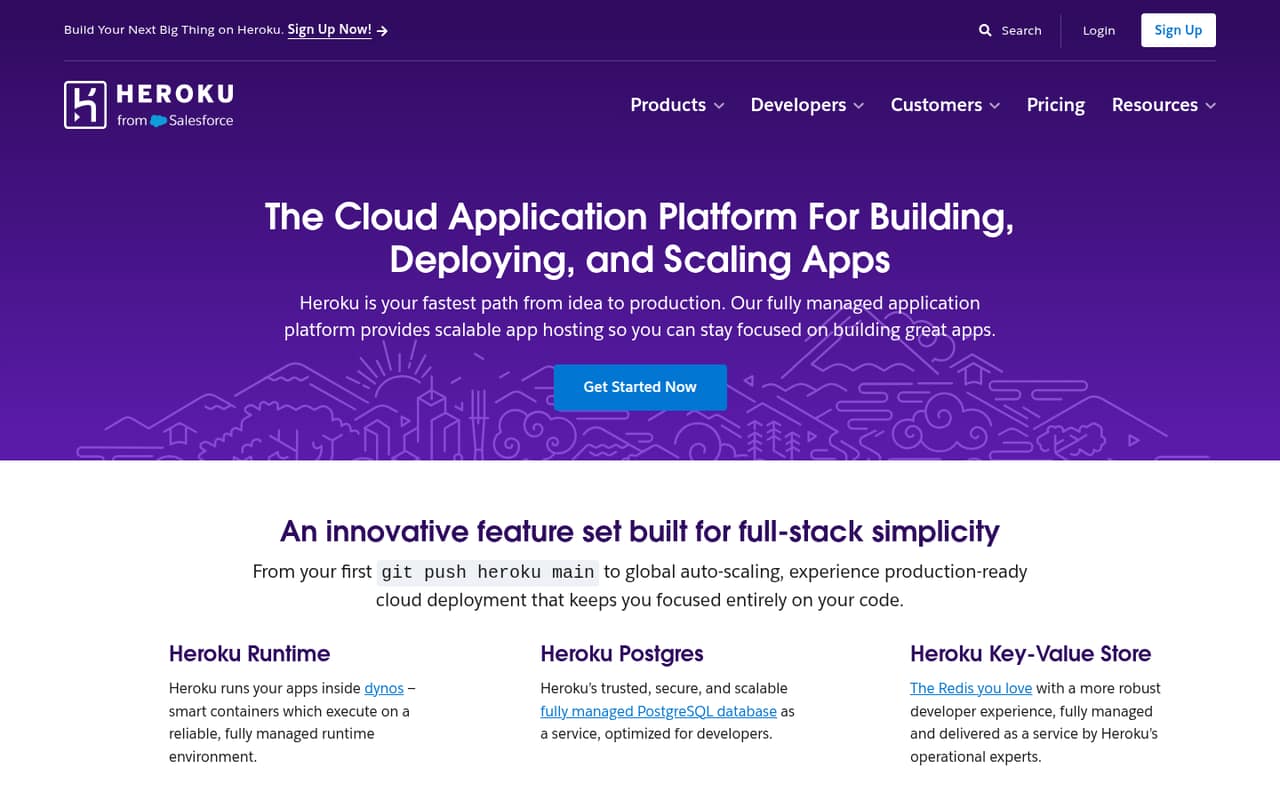
Heroku is a managed platform for building, deploying, and scaling apps, with managed runtimes, databases, deployment tools, and AI services. GitHub deployments, buildpacks, and managed data services make it a fit for small teams that want to spend less time maintaining infrastructure.
There’s no free plan or free trial listed. Eco costs $5 per month but sleeps after 30 minutes of inactivity; Basic costs $7 per month and stays on. Those prices are for app resources, not team seats, so your total depends on what the app needs.
Good fit if
- Small teams hosting a web app
- Developers who want managed infrastructure
- Apps using managed Postgres or Redis
Skip it if
- Teams that need free hosting
- Apps with the tightest hosting budgets
- Teams requiring guaranteed uptime details
ScoresHow it rates
What works
- Managed runtime reduces infrastructure work
- Managed Postgres and Redis-based storage
- GitHub deployments and disposable Review Apps
- Plans range from hobby projects to enterprise workloads
- Buildpacks support different language stacks
What doesn't
- No free plan or free trial listed
- Always-on Basic starts at $7 per month
- Eco sleeps after 30 minutes of inactivity
- Add-on prices are not listed with these plans
- Reddit users raise concerns about cost and outages
01Who Heroku is for
Heroku suits a solo developer or a small team of roughly 1–10 people that wants to ship and run an app without managing its runtime and data services itself. The platform runs apps in dynos, and includes managed Heroku Postgres and a Redis-based key-value store. It also supports GitHub deployments, disposable Review Apps, continuous delivery, add-ons, and buildpacks.
For a small team, the appeal is straightforward: spend less time assembling hosting infrastructure and more time building the product. That convenience comes at a cost. The cheapest listed option, Eco, is $5 per month and sleeps after 30 minutes of inactivity. Basic is $7 per month for an app that needs to stay on. Heroku’s listed prices are plan prices, not per-person charges, so a team of five doesn’t automatically pay five times as much as a solo developer.
02Heroku free plan and trial
Heroku has no free plan or free trial listed in its pricing information. The cheapest way in is Eco at $5 per month. It includes 0.5 GB RAM, 1x–4x compute, and two process types, but sleeps after 30 minutes of inactivity. That makes it a better fit for personal apps and low-traffic projects than for an app that needs to respond at all times.
If your app needs to stay on, the cheapest listed option is Basic at $7 per month. It also includes 0.5 GB RAM and 1x–4x compute, with 10 process types. The pricing page lists monthly prices and does not show annual billing or annual discounts. Database and add-on costs should be checked separately before you set a budget.
03What a small team pays for Heroku
Heroku’s listed prices are monthly plan prices, not seat prices. One Eco dyno costs $5 per month whether one person or five people work on the app. Split among one, three, or five teammates, that is $5, about $1.67, or $1 per person per month, respectively. Eco sleeps after 30 minutes of inactivity.
For an always-on app, one Basic dyno is $7 per month regardless of team size. That works out to $7 for one person, about $2.33 each for three people, or $1.40 each for five. These are just shared-cost calculations, not Heroku per-seat rates; adding app resources can change the bill. Standard-1X is $25 per month and includes unlimited process types, while Standard-2X is $50 per month with 1 GB RAM.
Heroku also offers managed Postgres, a Redis-based store, and third-party add-ons. Their prices are not included in the listed plan prices here, so check the relevant service before estimating your total. The pricing page lists monthly prices, with no annual billing or discount shown.
04Getting started with Heroku
Heroku is built to take on some of the hosting work a small team might otherwise manage itself. The platform provides a managed runtime, and supports GitHub deployments, buildpacks, and continuous delivery. Heroku Postgres and a managed Redis-based key-value store are options for app data. Those features suggest a more approachable starting point than assembling each hosting component separately, though your team will still need to configure its app and choose the services it needs.
The first decisions are practical ones: whether Eco’s sleep behavior is acceptable, whether the app needs an always-on Basic plan, and which data services it uses. Teams working on changes can also use disposable Review Apps. How much setup a particular app needs depends on its stack and configuration; a specific setup time is not published. Heroku supports buildpacks for language stacks, but teams should confirm that their chosen stack and any required add-ons fit their deployment plan.
05When small teams outgrow Heroku
The first reason to move up is usually an app requirement, not a team-seat threshold. Eco sleeps after 30 minutes of inactivity; Basic stays on but has 0.5 GB RAM and 10 process types. When those limits no longer suit the app, the listed Standard-1X plan costs $25 per month and includes unlimited process types. Standard-2X costs $50 and lists 1 GB RAM. Higher-traffic or private workloads have more expensive tiers.
The bill can also grow as an app needs additional resources or data services. The plan prices alone do not provide a complete estimate for an app using paid add-ons. Reddit discussions show a mixed picture: one r/rails post calls the dynos “ridiculously overpriced,” and another describes losing confidence after an outage. A separate r/node poster says they love Heroku’s simple Git-based workflow. Treat those comments as individual experiences, not a service guarantee; teams with strict availability or budget requirements should check current terms and workload costs.
From the threadsWhat users say
Reddit sentiment is mixed. Some users value the straightforward Git-based workflow, while r/rails discussions raise concerns about dyno prices and an outage.
I have been learning on Heroku for a long time and love git push heroku master and slamming enter
Aside of the ridiculously overpriced dynos, of course
This recent incident has made me lose all confidence in Heroku as a platform
I shared a post that Heroku looks like it's going to be sunsetted
Questions people ask
Does Heroku have a free plan?
Heroku’s listed pricing has no free plan or free trial. Eco is the cheapest listed option at $5 per month, but it sleeps after 30 minutes of inactivity. For an app that needs to stay on, Basic is the cheapest listed plan at $7 per month.
Is Heroku part of AWS?
Heroku describes itself as a managed cloud application platform. That description does not establish its ownership or underlying cloud infrastructure. If the corporate relationship or infrastructure provider matters to your decision, check Heroku’s current company and technical disclosures.
Is Heroku being discontinued?
Heroku’s pricing information lists plans including Eco, Basic, Standard, Performance, Private, and Shield options. A current list of plans does not establish a future product roadmap. Check Heroku’s own announcements for the latest status before making a long-term hosting decision.
Does Heroku’s Eco plan stay on?
No. The listed Eco plan sleeps after 30 minutes of inactivity. Heroku lists Eco for personal apps and low-traffic projects. If your app needs to stay on, Basic is the cheapest listed always-on option at $7 per month.
Can Heroku scale an app?
Heroku lists plans for scaling apps, from Eco and Basic to larger Performance, Private, and Shield tiers. The plans include different compute and memory amounts, and some higher tiers list autoscaling. Which plan fits depends on your app’s workload and requirements.