
We may earn a commission if you buy through links on this page. It never changes a score or a ranking. How we make money
The bottom line
Keycloak costs nothing to license, but a small team pays in setup and self-hosting work.
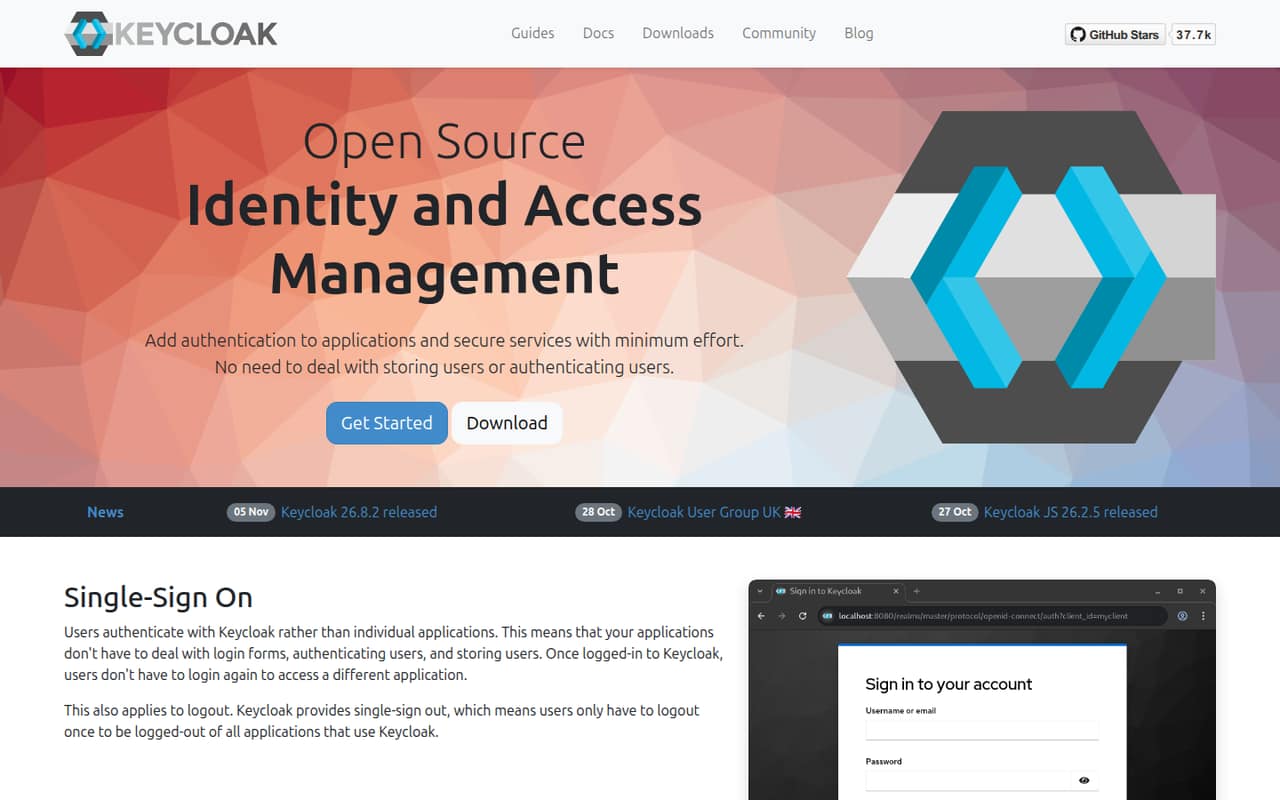
Keycloak is a free, open-source identity and access management tool for applications and services. It covers single sign-on, identity brokering, user federation, account management, and authorization from centralized consoles.
For a small team, the trade-off is clear: there’s no per-seat software bill, but you need to host and manage it. Reddit users describe both flexible, painless deployments and a learning curve that can be a big lift for newer teams.
Good fit if
- Teams able to self-host
- Apps needing centralized sign-in
- Teams avoiding per-user fees
Skip it if
- Teams wanting managed hosting
- Founders avoiding infrastructure work
- Teams needing published support terms
ScoresHow it rates
What works
- Free to download and use under Apache License 2.0
- No user or seat limits published
- Supports single sign-on across applications
- Connects to LDAP and Active Directory
- Includes account management and authorization tools
What doesn't
- Your team is responsible for self-hosting
- Hosting and infrastructure costs are separate
- No paid plans or support terms published
- Reddit users describe a meaningful learning curve
- No published user or seat limit to plan around
01Who Keycloak is for
Keycloak fits a small software team that needs one login system for several applications and has someone comfortable running infrastructure. The software is free to download and use under the Apache License 2.0, and the pricing page lists no user or seat limits. That makes it appealing for a budget-conscious team of one to ten people that would rather manage its own identity system than pay per user.
In plain terms, Keycloak handles sign-in centrally, so each application does not have to manage its own login forms and user store. It supports single sign-on, connects to OpenID Connect or SAML identity providers, and can federate users from LDAP or Active Directory. Admins can manage applications, users, and authorization policies in its consoles; users can manage profiles, passwords, two-factor authentication, and sessions. It’s a broad toolkit, not a hands-off service: your team takes on hosting and configuration.
02Keycloak free plan and trial
Keycloak’s open-source version is free to download and use under the Apache License 2.0. It is self-hosted software, and the pricing page lists no user or seat limits. There are no paid Keycloak plans listed, so there is no paid tier to unlock more seats or features, and a free trial is not listed as a separate offer.
The free license does not mean your whole setup has no cost. Your team supplies the hosting and handles deployment and upkeep; the vendor does not publish a hosting price because this plan is self-hosted. For a one-to-ten-person team, the cheapest way in is to use the software at no license charge and budget separately for the infrastructure and staff time. The vendor does not publish a paid support plan or add-on pricing, so ask about support arrangements if you need them.
03What a small team pays for Keycloak
The pricing page lists one option: open-source Keycloak, free to download and self-host. That makes the software-license cost $0 for one person, $0 for three people, or $0 for five people. Monthly and annual billing are not published because Keycloak sells no paid plans; there’s no per-seat multiplication to do.
Those figures cover the software license, not the total cost of running it. Your team needs to provide hosting, and infrastructure prices depend on what you run it on; Keycloak does not publish a hosting rate. The pricing page lists no paid add-ons, and it does not publish separate user caps or seat fees. So a small team can avoid a software subscription, but should still account for infrastructure and the time needed to set up and maintain its own deployment. If you need a hosted service or paid support, ask the vendor what’s available and what it would cost.
04Getting started with Keycloak
Setup means more than creating an account: Keycloak is self-hosted, so your team needs to deploy it and connect it to the applications that will use it. The product supports OpenID Connect and SAML identity providers, social login, and user federation through LDAP and Active Directory. Those options give teams room to fit it into existing systems, but the work depends on the applications and identity sources you need to connect.
Reddit comments show a range of experiences. One r/devops commenter says the initial setup is somewhat annoying but not overly complicated; another describes a Kubernetes setup managed with Terraform as painless. A different commenter says Keycloak can be a big lift for greener teams to maintain and troubleshoot. We’d treat it as a real implementation project, not a plug-and-play login switch. The vendor does not publish a setup-time estimate, so test your specific integrations before choosing it for a deadline-sensitive rollout.
05When small teams outgrow Keycloak
Keycloak does not publish a user or seat cap, so there is no listed threshold where a growing team must upgrade. Nor is there a paid Keycloak plan to move into. The pressure point is more likely to be operational: as your applications and identity requirements grow, your team still owns the deployment, configuration, and upkeep. If nobody on the team can take that on, a self-hosted tool can become a poor fit well before you hit a user limit.
Reddit reports are mixed rather than a clear warning against scaling. One r/devops commenter says their Kubernetes setup is painless and relies on Terraform; another mentions a slow restart and an annoying initial setup. A commenter also says teams with very large user counts should consider high availability. That is an individual opinion, not a published Keycloak limit or guarantee. As your service grows, plan how you will handle availability, backups, and maintenance, and ask the vendor about support if you need a formal commitment.
From the threadsWhat users say
Reddit sentiment is mixed: some users praise Keycloak’s flexibility and manageable deployments, while others flag the initial setup and learning curve. The overall trade-off is consistent: no software license bill in exchange for owning the deployment.
Incredibly flexible and extensible via plug-ins if you so choose
The initial setup is somewhat annoying, but not super complicated
keycloak works great but it’s a very big lift and learning curve, especially for greener teams to maintain and troubleshoot
The maintenance is more than made up for by not having to work around the limitations and pricing model of Auth0
Questions people ask
Is Keycloak free for a small team?
Yes. Keycloak is free to download and use under the Apache License 2.0, and the pricing page lists no user or seat limits. That covers the software license, not the infrastructure or staff time needed to self-host it. Keycloak lists no paid plans, so there is no paid tier price to compare.
Does Keycloak charge per user?
Keycloak’s pricing page lists no per-user price and no user or seat limits. The open-source software is free to use, whether one person or a small team uses it. Your deployment still needs hosting, which is a separate cost your team must arrange; Keycloak does not publish a hosting rate.
Can I use Keycloak without self-hosting?
The listed Keycloak option is self-hosted software. Keycloak does not list a managed hosting plan or hosted-service price, so a team seeking a hosted setup should ask the vendor what options are available. With the open-source version, your team is responsible for providing and managing the hosting.
What identity providers and user stores does Keycloak support?
Keycloak connects to OpenID Connect and SAML identity providers and supports social login. For user federation, it connects to LDAP and Active Directory, and custom providers can connect other user stores. Which setup fits depends on your existing identity systems and the applications you need to connect.
Does Keycloak support single sign-on and two-factor authentication?
Yes. Keycloak provides single sign-on so users can access multiple applications after logging in once, and they can sign out of them together. Its account management features let users set up two-factor authentication, update profiles, change passwords, and manage sessions.
Sources
- Keycloak homepage
- Keycloak pricing, compiled via web search from authgear.com, ycombinator.com, skycloak.io, fusionauth.io, keycloakpro.com
- Reddit: Keycloak vs. Authentik vs. Authelia, help choose SSO
- Reddit: Which Identity Provider are you using?
- Reddit: Is Keycloak worth the maintenance?
- Reddit: Anyone using Keycloak? How is it?