
We may earn a commission if you buy through links on this page. It never changes a score or a ranking. How we make money
The bottom line
Strong portfolio-planning scope, but custom pricing and reported usability issues make it a tough small-team fit.
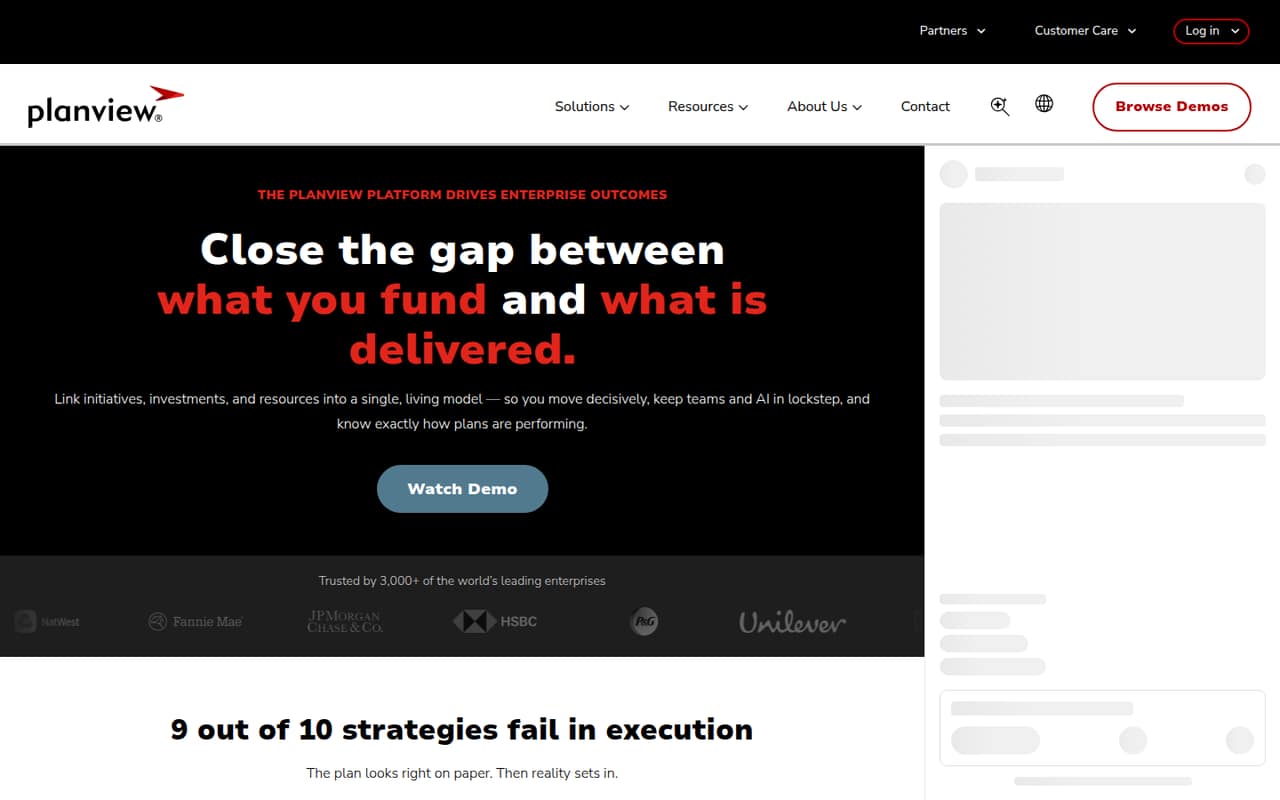
Planview connects strategy, investments, resources, and delivery, with scenario planning and portfolio visibility for organizations managing many priorities. That breadth may suit an enterprise PMO, but a team of 1–10 should weigh the setup and adoption effort carefully.
There’s no free plan, and the pricing page lists custom quotes rather than rates for one, three, or five seats. Reddit users report frustration with usability and support needs for AgilePlace, so ask for a product-specific demo and a clear quote before committing.
Good fit if
- Enterprise portfolio management
- Teams aligning work to strategy
- Organizations reallocating shared resources
Skip it if
- Teams needing a free plan
- Small teams with fixed budgets
- Teams wanting a lightweight work tracker
ScoresHow it rates
What works
- Connects initiatives, investments, resources, and delivery
- Scenario planning models capacity trade-offs
- Tracks investments against measurable outcomes
- Supports enterprise Agile planning
- Includes AI agent oversight with strategic context
What doesn't
- No free plan is listed
- Pricing is custom and quote-based
- Seat and usage limits are not published
- A Reddit commenter says AgilePlace needs a full support team
- Reddit users report usability and performance frustrations
01Who Planview is for
Planview is aimed at large organizations coordinating portfolios, rather than a small team looking for a simple task board. It connects initiatives, investments, resources, and delivery so decision-makers can see how work relates to strategic goals.
The feature set covers portfolio visibility, capacity scenario planning, investment tracking, resource reallocation, enterprise Agile planning, and oversight for AI agents. That scope may fit an enterprise PMO or a company coordinating work across business functions and methods. For a team of 1–10, the question is whether you need that organization-wide view badly enough to justify a custom quote and the effort of getting teams onto the platform. The vendor’s pricing page says user count and deployment model affect the quote, but doesn’t publish a minimum team size or seat price. Set requirements with the people who will use the tool, then ask Planview to quote your exact product mix and team size.
02Planview free plan and trial
Planview does not list a free plan, and a free trial is not published in the pricing information. That means there’s no no-cost tier for a small team to use while it decides whether portfolio planning is worth the change.
The cheapest listed route in is Custom / quote-based. The pricing page says the quote is tailored to product mix, deployment model, and user count. It does not publish seat or usage limits, so a team can’t tell from public rates what a basic rollout would include. Ask the vendor whether it can provide a product-specific demo or a time-limited evaluation, and confirm which products, users, and services the quote covers. For a team that only needs shared task tracking, the lack of a free entry point makes Planview hard to justify before that conversation.
03What a small team pays for Planview
The pricing page lists one option: Custom / quote-based. It publishes no monthly or annual rate, so we can’t calculate a cost for one person, a team of three, or a team of five—or compare monthly billing with annual billing. The price is tailored to product mix, and the page says deployment model and user count also factor into the quote.
For a small team, the practical answer is that the price for a few seats is not published. Ask Planview for separate quotes at your expected headcount, and request the total for the exact deployment and products you need. The page also says seat and usage limits are not published, so ask how the quote handles both as the team grows.
No add-ons are listed in the pricing information. That is not a public confirmation that every feature or service is included, so ask the vendor to identify any separately priced products or services. Without published rates, Planview is difficult to budget against other project tools on a small-team subscription.
04Getting started with Planview
Planview’s feature scope suggests teams need to agree on how portfolios, investments, resources, and delivery will be represented before rollout. The vendor does not publish a setup timeline or a list of integrations in the pricing information, so a small team should ask what implementation work and connections its chosen products require.
Reddit comments point to adoption risks worth checking in a demo. One commenter discussing AgilePlace, a Planview product, says it requires a full team of people to support and make useful. Another Planview user complains that the tool is slow and that seeing a project timeline is difficult. Those are individual accounts, not a measure of every Planview product, but they make it sensible to ask who will administer the system and how much training is expected.
Before signing, map one real workflow from planning through delivery and have the people doing that work assess it. Confirm integrations, implementation responsibilities, and support costs in writing.
05When small teams outgrow Planview
Planview is positioned for enterprise portfolio coordination, so the main small-team risk may be buying more scope and administration than the team needs. If priorities expand across business functions, teams, and work methods, its portfolio visibility, scenario planning, investment tracking, and resource reallocation may become more relevant. The vendor does not publish seat or usage limits, so ask how a growing team would affect its quote before committing.
A different kind of growing pain is adoption. One Reddit commenter says AgilePlace needs a full team of people to support and make useful; other Planview users describe a difficult interface and slow performance. These are anecdotes, but they suggest checking daily workflows with actual users rather than judging only on portfolio-level features.
If the team mainly needs task tracking or a clearer project timeline, reconsider whether an enterprise portfolio platform is the right fit. Ask for a revised quote as headcount grows and for the cost and effort of changing products if adoption falls short.
From the threadsWhat users say
The Reddit sentiment published is mostly negative, with complaints about usability, speed, and the effort needed to support AgilePlace. These are individual user accounts and do not establish that every Planview product or rollout has the same issues.
RUN from agile place. The system has 0 metrics and is terrible for agile tracking. It requires a full team of people to support and make useful
Why is it so hard to see the project's timeline?
Both Jira and especially Planview are quite legacy tools IMO
all heavy weight enterprise solutions which finally didn’t fly
Questions people ask
What is Planview used for?
Planview connects strategy, investments, resources, and delivery. Its features include portfolio visibility, scenario planning, investment tracking, resource reallocation, enterprise Agile planning, and oversight for AI agents. It is intended to help organizations coordinate work and track outcomes against strategic goals.
Is Planview the same as Jira?
No. Planview is described as an enterprise platform for connecting strategy, investments, resources, and delivery. Jira is a separate product mentioned by Reddit users discussing Agile software choices. If you are comparing them, match each product against your team’s workflows and the specific Planview product being quoted.
Does Planview have a free plan or trial?
The pricing information lists no free plan and does not publish a free trial. The listed route is Custom / quote-based. Ask Planview whether it can provide a demo or evaluation for the specific products you are considering, and confirm any conditions before planning around one.
How much does Planview cost for a small team?
Planview pricing is custom and quote-based. The pricing page does not publish monthly or annual rates, so the cost for one, three, or five users is not available to calculate. User count, deployment model, and product mix factor into the quote; request pricing for your exact setup.
What should we check before choosing Planview?
Confirm which Planview products are included, how the quote changes with user count and deployment model, and what seat or usage limits apply. Ask about setup, integrations, administration, and support needs. A demo using a real team workflow can help users assess whether the interface fits their day-to-day work.